

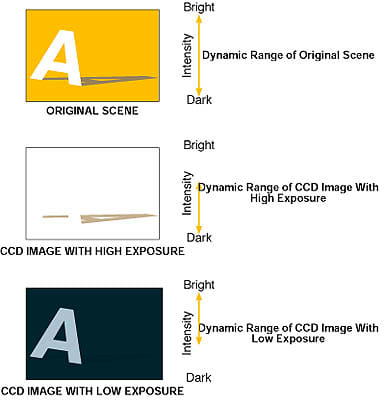
A simple technique for extending the dynamic range of a charge-coupled-device (CCD) video camera involves the use of photochromic material — the same material used in self-adjusting sunglasses. The dynamic range of an image is the ratio between the maximum and minimum brightness levels in the image. The dynamic range of a CCD is the ratio between an overexposure brightness level (above which the image becomes saturated or "washed out") and an underexposure level (below which details disappear into the darkness). The dynamic range of a CCD is less than that of the human eye; for example, a human observer can often see both shadowed and unshadowed features in a scene illuminated by sunlight, whereas a CCD cannot capture details simultaneously in both the brightest and darkest parts of the scene (see Figure 1).
The present technique provides for compression of the dynamic range of brightness of an image focused on a CCD so that all or most parts of the image lie within the dynamic range of the CCD. When such compression is effected, the CCD output can be expected to show details in both the brightest and darkest parts of the scene.
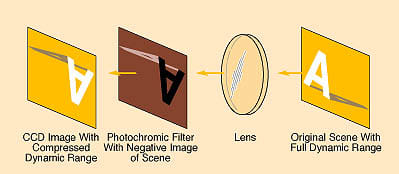
In practice, compression of the dynamic range of brightness in an image must be accomplished through local darkening of the image, with greater darkening in brighter locations. Photochromic material exhibits the required greater darkening with exposure to brighter light. In the present technique, a photochromic filter is placed at (or immediately in front of) the CCD image plane, so that it becomes darkened in the bright areas of the image (see Figure 2). As a result, the light that passes through the photochromic filter forms the desired reduced-dynamic-range version of the image.
This work was done by Richard A. Volpe of Caltech for NASA's Jet Propulsion Laboratory. NPO-20254
This Brief includes a Technical Support Package (TSP).
Photochromic image-plane filter extends dynamic range of CCD
(reference NPO-20254) is currently available for download from the TSP library.
Don't have an account?
Overview
The document discusses a novel technique developed by Richard A. Volpe at NASA's Jet Propulsion Laboratory to extend the dynamic range of charge-coupled devices (CCDs) used in electronic imaging systems. CCDs are widely employed in video cameras and photography but face limitations in capturing high-contrast scenes due to their restricted dynamic range. This range refers to the difference between the brightest and darkest parts of an image, which is significantly narrower in CCDs compared to the human eye. As a result, CCDs often struggle to simultaneously capture details in both bright and dark areas, leading to overexposure or underexposure.
To address this issue, the proposed solution involves the use of a photochromic filter placed at or near the CCD image plane. Photochromic materials, which darken in response to bright light (similar to self-adjusting sunglasses), can selectively reduce the intensity of bright regions in an image. This localized darkening allows the dynamic range of the captured image to be compressed, enabling the CCD to record details across a broader spectrum of brightness levels.
The document outlines the technical challenges faced by CCDs, such as blooming, where overexposed areas expand beyond their actual size, and the inability to adjust exposure settings uniformly across an image. The photochromic filter offers a simple and cost-effective method to mitigate these problems by ensuring that the bright areas of a scene are appropriately darkened, thus preserving detail in shadowed regions.
Applications for this technology include outdoor daytime surveillance and on-orbit shuttle operations, where high-contrast video images are essential. The technique not only enhances the quality of images captured in challenging lighting conditions but also represents a significant advancement in imaging technology.
In summary, the document highlights an innovative approach to improving CCD imaging through the use of photochromic filters, which effectively extend the dynamic range and enhance the ability to capture high-contrast scenes. This advancement has the potential to revolutionize various fields that rely on high-quality imaging, making it a valuable contribution to electronic imaging technology.











