

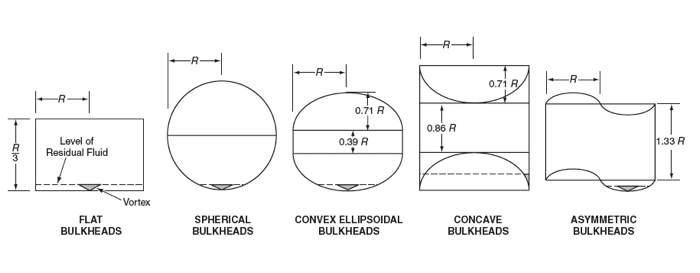
Asymmetric bulkheads are proposed for the ends of vertically oriented cylindrical pressure vessels. These bulkheads, which would feature both convex and concave contours, would offer advantages over purely convex, purely concave, and flat bulkheads (see figure). Intended originally to be applied to large tanks that hold propellant liquids for launching spacecraft, the asymmetric-bulkhead concept may also be attractive for terrestrial pressure vessels for which there are requirements to maximize volumetric and mass efficiencies.
A description of the relative advantages and disadvantages of prior symmetric bulkhead configurations is prerequisite to understanding the advantages of the proposed asymmetric configuration:
- In order to obtain adequate strength, flat bulkheads must be made thicker, relative to concave and convex bulkheads; the difference in thickness is such that, other things being equal, pressure vessels with flat bulkheads must be made heavier than ones with concave or convex bulkheads.
- Convex bulkhead designs increase overall tank lengths, thereby necessitating additional supporting structure for keeping tanks vertical.
- Concave bulkhead configurations increase tank lengths and detract from volumetric efficiency, even though they do not necessitate additional supporting structure.
- The shape of a bulkhead affects the proportion of residual fluid in a tank — that is, the portion of fluid that unavoidably remains in the tank during outflow and hence cannot be used. In this regard, a flat bulkhead is disadvantageous in two respects: (1) It lacks a single low point for optimum placement of an outlet and (2) a vortex that forms at the outlet during outflow prevents a relatively large amount of fluid from leaving the tank.
- A concave bulkhead also lacks a single low point for optimum placement of an outlet.
This work was done by Donald B. Ford of Marshall Space Flight Center.
This is the invention of a NASA employee, and a patent application has been filed. Inquiries concerning license for its commercial development may be addressed to the inventor:
Donald B. Ford
Phone No.: (256) 544-2454
E-mail:
Refer to MFS-31626-1.











