

Future nuclear-powered Ion-Propulsion- System-propelled spacecraft such as Jupiter Icy Moon Orbiter (JIMO) will carry more than 10,000 kg of xenon propellant. Typically, a small percentage of this propellant cannot be used towards the end of the mission because of the pressure drop requirements for maintaining flow. For large missions such as JIMO, this could easily translate to over 250 kg of unusable xenon.
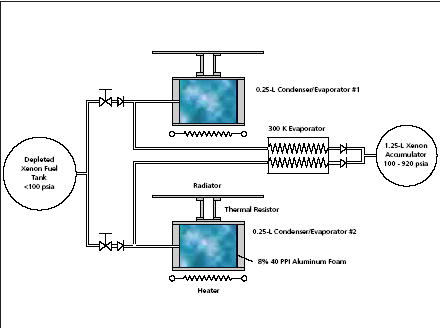
A proposed system, the Xenon Recovery System (XRS), for recovering almost all of the xenon remaining in the tank, would include a cryopump in the form of a condenser/evaporator that would be alternatively cooled by a radiator, then heated electrically. When the pressure of the xenon in the tank falls below 0.7 MPa (100 psia), the previously isolated XRS will be brought online and the gas from the tank would enter the cryopump that is initially cooled to a temperature below saturation temperature of xenon. This causes xenon liquefaction and further cryopumping from the tank till the cryopump is full of liquid xenon.
At this point, the cryopump is heated electrically by small heaters (70 to 80 W) to evaporate the liquid that is collected as high-pressure gas (<7 MPa; 1,000 psia) in an intermediate accumulator. Check valves between the tank and the XRS prevent the reverse flow of xenon during the heating cycle. The accumulator serves as the high-pressure source of xenon gas to the Xenon Feed System (XFS) downstream of the XRS. This cycle is repeated till almost all the xenon is recovered. Currently, this system is being baselined for JIMO.
This work was done by Gani Ganapathi, P. Shakkottai, and Jiunn Jenq Wu of Caltech for NASA’s Jet Propulsion Laboratory. For further information, access the Technical Support Package (TSP) free on-line at www.techbriefs.com/tsp under the Machinery/Automation category. NPO-40613
This Brief includes a Technical Support Package (TSP).
Recovering Residual Xenon Propellant for an Ion Propulsion System
(reference NPO-40613) is currently available for download from the TSP library.
Don't have an account?
Overview
The document is a Technical Support Package from NASA, focusing on the recovery of residual xenon propellant used in ion propulsion systems. The primary objective is to develop a method for compressing depleted xenon propellant from low pressures (approximately 0.82 bar or 12 psia) to higher pressures (up to 55 bar or 800 psia) at a flow rate of 50 mg/s. This process is crucial for enhancing the efficiency and sustainability of ion propulsion systems, which are increasingly used in space exploration.
The xenon recovery system operates through a cycle involving condensation and evaporation. Initially, the low-pressure xenon gas is condensed in a cryopump, which is cooled by a radiator. As the cryopump reaches temperatures below the saturation point of xenon, the gas condenses into a liquid, filling the internal volume of the pump. This process continues until the liquid reaches a predetermined level or time limit. Following the condensation phase, a heating cycle is initiated to evaporate the liquid xenon, allowing it to be compressed into a usable gas.
The document discusses the design considerations for the system, including the number of cryopumps. Increasing the number of cryopumps can reduce the size of the accumulator and overall system mass, although it also necessitates additional shut-off and check valves, which can increase mass. A trade-off study is recommended to optimize the balance between the number of cryopumps and system weight.
Energy efficiency is another critical aspect addressed in the document. The mean radiator cooling power is noted to be close to the minimum cooling power during the cooling cycle, indicating that a significant portion of the cooling time is dedicated to condensing the xenon gas. The use of energy-saving devices, such as heat switches, is also mentioned, which can help manage thermal paths between components to enhance system efficiency.
Overall, the document emphasizes the importance of developing effective xenon recovery systems for ion propulsion, highlighting the potential for improved performance and reduced resource consumption in space missions. It serves as a resource for further research and technological advancements in aerospace applications.











