

The high-power laser diode market has grown rapidly in the last twelve months, a trend that is set to continue throughout 2006 and beyond. The global market for laser systems is forecast to grow by 8% in 2006 to US $5.9 billion, with diode lasers alone growing by 8%.
With this scope, fiber lasers, disk lasers, and direct diode systems have become the first choice across industrial, medical, printing, and automotive sectors. One of the key reasons for this is that all three systems have yet to reach the limit of their pump power and can therefore continue to be scaled to match the power and brightness required by their end applications. The same cannot be said for competitive technologies such as rod lasers, which are limited by the damage threshold of the rod. Fiber lasers, disk lasers, and direct diode systems are limited only by the laser diode power available.
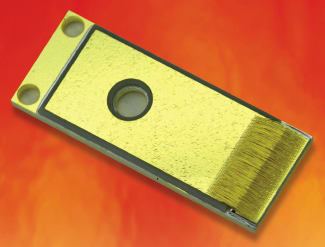
In order to keep pace with the demands set by industrial applications, high-power laser diodes must follow the trend towards higher power and higher brightness, particularly in the 9xx-nm area. Only a year ago, when Bookham introduced its 120W laser diode bars, the industry did not think that power levels above 40 to 50W from a 10-mm-wide bar could be achieved. The industry’s perception is changing and Bookham is now offering a 7W single-emitter pigtailed module.
There are a number of ways in which high-power laser diode manufacturers can achieve the higher power and reliability required by end users. Two methods are E2 facet passivation and AuSn soldering. E2 initially was developed in the late 1980s to enable single emitters to achieve the lifetimes and reliability required by the telecom industry. It was then successfully transferred to bar products. E2 works by preventing the reduction of the front mirror’s damage threshold and therefore averting bar failure through COMD (catastrophic optical mirror damage). The AuSn “hard-solder” interface is especially advantageous in industrial on/off-type operation, where the solder joint is stressed most.
In addition to higher brightness and higher power, high-power laser diode manufacturers must ensure that their products can meet the rigorous demands of their applications. Tests must mimic the usage of the diode, including on/off cycling rather than continuous wave testing. Bookham subjects its laser diodes to on/off cycling tests, ramping the drive current from 0A to the operating current with a repetition rate of 1.33 Hz. These tests indicate for the 120W bars an extrapolated median lifetime above 80,000 hours or 350 MShots, which is in line with the automotive industry’s requirements.
The next challenge to manufacturers will be cooling laser diodes sufficiently to allow for continued increases in brightness and power. In advanced R&D laboratory experiments, the scalability of diode laser bars to several hundreds of watts has been demonstrated. Improved efficiency has aided cooling, but new cooling system designs will be necessary. Bringing the drive current to the bar at a level of hundreds of amperes also requires consideration, so new solutions for dense packaging will be needed.
In addition, manufacturers must continue to meet the above challenges for both multimode single emitters and bars. Most disk and direct diode system manufacturers prefer stacks because of their compactness and lower cost, while fiber laser manufacturers seem to have a preference for pigtailed single-emitter modules that can be spliced easily to the active fiber. Since system and laser manufacturers utilize both configurations, manufacturers must meet these different demands.
In conclusion, the laser diode market is continuing to grow. With increasing numbers and varieties of applications, and continuing requirements for higher brightness, reliability, and power, manufacturers in this sector must continue to innovate and develop new technologies to keep pace with demand.
This article was written by Christian Naumer, senior product line manager, at Bookham, Zurich, Switzerland. For information, contact Mr. Naumer at Christian@











