A method of coherent detection of high-rate pulse-position modulation (PPM) on a received laser beam has been conceived as a means of reducing the deleterious effects of noise and atmospheric turbulence in free-space optical communication using focal-plane detector array technologies. In comparison with a receiver based on direct detection of the intensity modulation of a PPM signal, a receiver based on the present method of coherent detection performs well at much higher background levels.
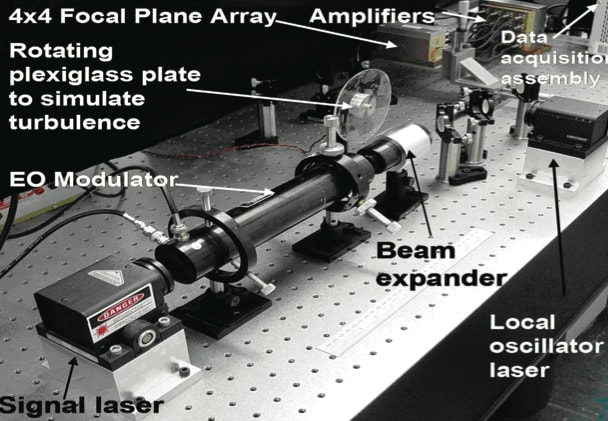

Following quantum-limited coherent detection, the outputs of the individual photodetectors are automatically aligned in phase by use of one or more adaptive array compensation algorithms [e.g., the least-mean-square (LMS) algorithm]. Then the outputs are combined and the resulting signal is processed to extract the high-rate information, as though the PPM signal were received by a single photodetector.
In a continuing series of experiments to test this method (see Fig. 1), the local oscillator has a wavelength of 1,064 nm, and another laser is used as a signal transmitter at a slightly different wavelength to establish an IF of about 6 MHz. There are 16 photodetectors in a 4×4 focal-plane array; the detector outputs are digitized at a sampling rate of 25 MHz, and the signals in digital form are combined by use of the LMS algorithm. Convergence of the adaptive combining algorithm in the presence of simulated atmospheric turbulence for optical PPM signals has already been demonstrated in the laboratory; the combined output is shown in Fig. 2(a), and Fig. 2(b) shows the behavior of the phase of the combining weights as a function of time (or samples). We observe that the phase of the weights has a sawtooth shape due to the continuously changing phase in the down-converted output, which is not exactly at zero frequency.
Detailed performance analysis of this coherent free-space optical communication system in the presence of simulated atmospheric turbulence is currently under way.
This work was done by Victor Vilnrotter and Michela Muñoz Fernández of Caltech for NASA’s Jet Propulsion Laboratory. NPO-40974
This Brief includes a Technical Support Package (TSP).
Coherent Detection of High-Rate Optical PPM Signals
(reference NPO-40974) is currently available for download from the TSP library.
Don't have an account?
Overview
The document titled "Coherent Detection of High-Rate Optical PPM Signals" is a technical support package from NASA's Jet Propulsion Laboratory (JPL) that details research on coherent free-space optical communications systems. The focus is on analyzing the performance of these systems under simulated atmospheric turbulence, which can significantly affect signal integrity.
The research highlights the advantages of laser communications over traditional radio frequency (RF) methods, including higher bandwidth, smaller size, and lower power requirements for a given distance. The document outlines the experimental setup used at JPL, which includes two lasers operating at a wavelength of 1064 nm, a 16-element focal plane detector array, and a data acquisition system capable of recording substantial amounts of data. The experiments aim to assess the Bit Error Rate (BER) performance of the optical communication system.
Key components of the system include coherent detection techniques that preserve the optical frequency and phase of the signal relative to a local oscillator. The document explains how the detected current is proportional to the average optical intensity, and it discusses the signal-to-noise ratio (SNR) for heterodyne detection, which is crucial for understanding the minimum detectable signal in a shot-noise limited scenario.
The research employs a least-mean-square (LMS) algorithm for signal processing, which adapts to optimize the combination of signals received from multiple channels. This adaptive approach is essential for maximizing power and improving SNR in the presence of atmospheric disturbances. The experiments simulate atmospheric turbulence using a rotating pre-distorted plexiglass plate, allowing researchers to observe the effects on signal quality.
The document also includes technical details about the modulation format used for the transmitted laser signal, which is Pulse Position Modulation (PPM). The PPM system is designed to operate at high rates, with specific parameters outlined for the experiments conducted.
Overall, this technical support package provides valuable insights into the challenges and solutions associated with coherent optical communications, particularly in environments where atmospheric conditions can introduce significant variability. The findings have implications for future advancements in optical communication technologies, potentially enhancing their reliability and performance in various applications.