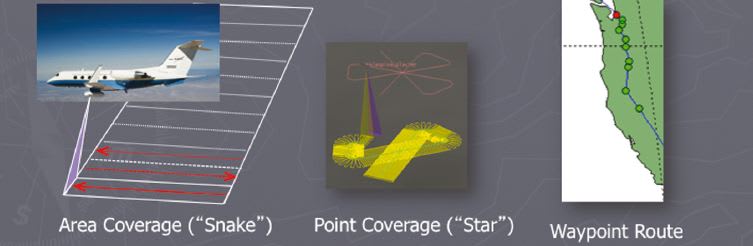
I-FORCAST (Instrument – Field of Regard Coverage Analysis and Simulation Tool) is a flight planning tool specifically designed for quickly verifying the feasibility and estimating the cost of airborne remote sensing campaigns (see figure). Flights are simulated by being broken into three predefined routing algorithms as necessary: mapping in a snaking pattern, mapping the area around a point target (like a volcano) with a star pattern, and mapping the area between a list of points. The tool has been used to plan missions for radar, lidar, and in-situ atmospheric measuring instruments for a variety of aircraft. It has also been used for global and regional scale campaigns and automatically includes landings when refueling is required.
This work was done by Bogdan Oaida, Mohammed O. Khan, and Michael B. Mercury of Caltech for NASA’s Jet Propulsion Laboratory.
This software is available for commercial licensing. Please contact Daniel Broderick of the California Institute of Technology at
This Brief includes a Technical Support Package (TSP).
I-FORCAST: Rapid Flight Planning Tool
(reference NPO-48127) is currently available for download from the TSP library.
Don't have an account?
Overview
The document is a Technical Support Package for I-FORCAST (Instrument - Field Of Regard Coverage Analysis and Scenario Tool), developed by the Jet Propulsion Laboratory (JPL) at the California Institute of Technology. It serves as a rapid flight planning tool aimed at supporting the development of proposals for airborne campaigns, particularly in the context of earth observation missions.
I-FORCAST was created to address the need for quick adjustments in flight planning, allowing for the immediate recalibration of flight times after modifying instrument parameters. The tool was informed by insights gained from the UAVSAR (Unmanned Aerial Vehicle Synthetic Aperture Radar) team, which utilizes a similar high-fidelity planning tool tailored specifically for their aircraft. Key features of I-FORCAST include the ability to visualize and verify flight paths, ensuring that pilots can effectively align with ground tracks and maintain operational efficiency.
The document outlines the problem of estimating the costs associated with airborne campaigns and presents I-FORCAST as a solution. It emphasizes the importance of providing pilots with adequate time to prepare for maneuvers, maintaining a safety margin on aircraft range, and accommodating the aircraft's turning capabilities. The ultimate decision-making authority rests with the pilot, underscoring the tool's role as a supportive resource rather than a directive system.
Additionally, the document highlights the capabilities of the STK (Systems Tool Kit) software, which is integral to I-FORCAST's functionality. It includes visualization examples that demonstrate how the tool can assist in planning and executing flight campaigns effectively.
The Technical Support Package also acknowledges the sponsorship of NASA and provides contact information for further inquiries related to research and technology in this area. It emphasizes the document's purpose of disseminating aerospace-related developments that have broader technological, scientific, or commercial applications.
In summary, the I-FORCAST Technical Support Package presents a sophisticated tool designed to enhance the planning and execution of airborne missions, ensuring that flight parameters can be adjusted rapidly and efficiently while maintaining safety and operational integrity.