Filters that suppress electromagnetic interference (EMI) on signal cables connected to cryogenic electronic equipment can be made from cores consisting of high-permeability materials. The basic principle of operation of these filters is the same as that of the ferrite-core common-mode EMI filters now commonly used on cables that connect computers with peripheral equipment.
The ferrite-core filters are effective at room temperature but not at low temperatures, because their relative permeabilities decrease from ≈15,000 at room temperature to ≈20 at a temperature of 4 K. In cases of cables that connect cryogenic electronic equipment with room-temperature electronic equipment, it has been common practice to place the ferrite filters at the room-temperature ends of the cables. This makes it necessary for the filtered signals to traverse the cables; during such traversal, cross-talk with other cables can cause the filtered signals to become recontaminated with EMI before they reach the cryogenic equipment. Hence, it would be preferable to place the EMI filters at the cryogenic ends of the cables. The present development makes this a viable option.
 An inductive EMI filters blocks EMI due to its impedance to high frequency EMI signals. Since the impedance is proportional to the permeability, a material with high permeability forms the core of such a filter. Several metallic alloys like Cryoperm 10 and VITROVAC are known to have relative permeability exceeding 14,000 at low temperature. However, their relative permeabilities decrease rapidly at frequencies higher than a few hundred hertz due to eddy current, which prevents the magnetic field from penetrating the material. Because ferrite is an insulator, eddy current is not present. Therefore it works at high frequencies. However, all known materials with high permeabilities at low temperatures are metallic. Therefore, for the purpose of constructing cores for low-temperature EMI filters, it is desirable to prepare the high-permeability materials in the form of thin foils or fine powders to reduce the effects of eddy currents. Preliminary measurements and calculations have shown that when foil thicknesses or particle sizes are reduced to <25µm, eddy currents become unimportant.
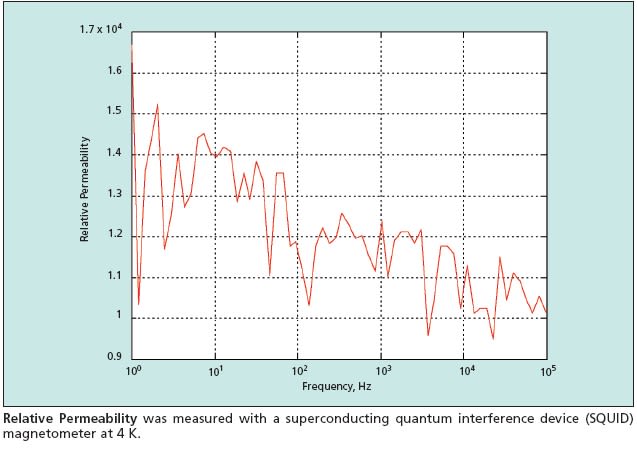
We have performed low-temperature test (see figure) of a cobalt-based magnetic material made by Honeywell called Meglas 2714A, which has very high permeability at room temperature and is available in form of tape-wound cores of various sizes. These cores are wound from 18-µm thick ribbons to reduce eddy current for high-frequency operations. The relative permeability is higher than 10,000 at frequencies up to 100 kHz, the limit of capability of our measurement. EMI filters made from this material should work at low temperature.
This work was done by Talso Chui and Hung Quach of Caltech for NASA's Jet Propulsion Laboratory. For further information, access the Technical Support Package (TSP) free on-line at www.techbriefs.com/tsp under the Electronics/Computers category. NPO-30901
This Brief includes a Technical Support Package (TSP).
EMI Filters for Low-Temperature Applications
(reference NPO-30901) is currently available for download from the TSP library.
Don't have an account?
Overview
The document is a Technical Support Package from NASA's Jet Propulsion Laboratory (JPL) detailing innovations in EMI (Electromagnetic Interference) filters specifically designed for low-temperature applications. It highlights the challenges faced by cold electronics, which, while offering exceptional sensitivity, are highly susceptible to EMI. The document outlines a novel solution involving the use of a donut-shaped core made from Cryoperm-10 material, which maintains high magnetic permeability at low temperatures, making it effective for EMI filtering.
The report emphasizes the limitations of traditional ferrite materials, which lose their magnetic properties when exposed to cold temperatures, rendering them ineffective for low-temperature electronics. The new technology aims to address this issue by utilizing materials that retain their magnetic properties in cold environments, thus improving the performance of low-temperature electronic systems.
The document also discusses the potential applications of this technology, indicating that it could be beneficial for any system utilizing Superconducting Quantum Interference Devices (SQUIDs), which are employed in various fields such as mineral exploration, submarine detection, and high-bandwidth communications. Additionally, it mentions applications in ultra-sensitive infrared sensing and NASA missions that require bolometers for astrophysical observations.
The report includes a section on commercialization, noting that the innovation is at the prototype stage and has been fixed in its final form. It identifies specific markets where the technology could be applied, including low-temperature electronics and fundamental physics research. The document also lists contributors to the project, both from JPL and external collaborators, and provides a funding disclosure indicating that the project is supported by NASA.
Overall, the Technical Support Package serves as a comprehensive overview of the development and potential impact of low-temperature EMI filters, showcasing JPL's commitment to advancing technology that supports aeronautical and space activities. It invites further exploration of the technology's applications and encourages collaboration through NASA's Innovative Partnerships Program.