Previous microstrip-to-waveguide transitions either required a hermetically sealed waveguide configuration, or a balun that needed to be tuned according to the frequency band of interest. In this design, the balun is realized using a double-Y junction to transition from microstrip to coplanar strip feeding a quasi-Yagi dipole array (see figure). The length of the feed (Lf) extending into the waveguide is 15.54 mm. The length of the ground plane below the ULTRALAM substrate is 7.75 mm. The lengths L1, L2, and L3 are 8.50 mm, 4.38 mm, and 2.14 mm, respectively. These lengths were computed via a preliminary optimization aimed at improving the return loss at the band edges.
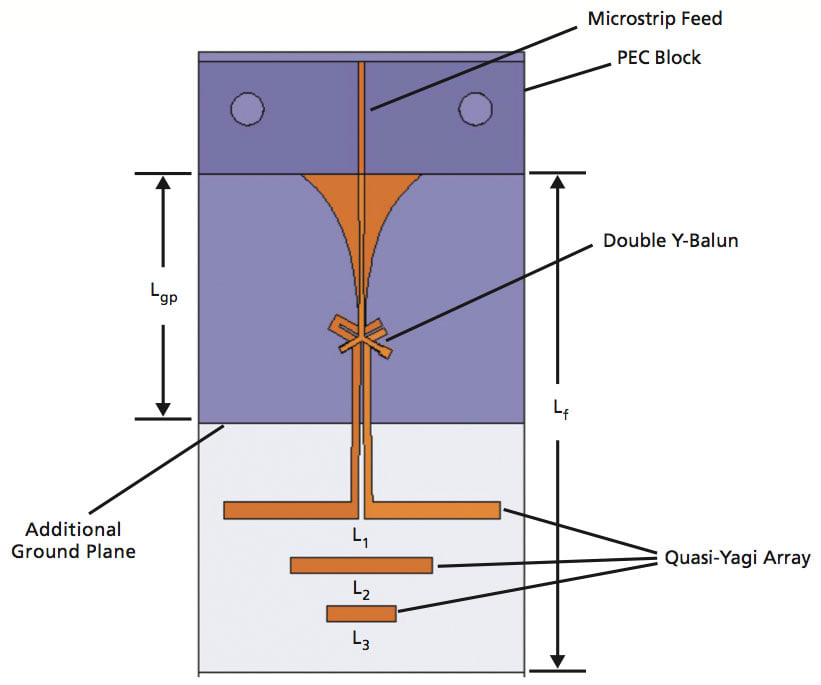
The double-Y balun transitioning from an unbalanced microstrip line to a balanced coplanar strip (CPS) line does not provide inherent impedance transformation; hence, Klopfenstein impedance tapers were synthesized to transition from 50 to 77 Ω in the microstrip section and from 77 to 110 Ω in the CPS section. At the balun junction, the CPS stub lengths were chosen such that the λ/8 resonance is pushed outside the bandwidth of operation. Also, the smallest allowable conductor width and gap spacing were chosen to meet acceptable manufacturing tolerances.
The microstrip-to-waveguide transition has been analyzed numerically using a commercial 3D finite-element electromagnetic solver. The WR-90 waveguide (10.16×22.86×25.56 mm) was modeled as an air box. The 6010 and ULTRALAM substrates were modeled to account for dielectric losses. The microstrip section of the waveguide feed was excited using a 50-Ω lumped port; the output face of the waveguide was modeled as a wave port. The waveguide achieves maximum insertion loss of 0.84 dB, and a minimum insertion loss of 0.32 dB from 8.0 to 12.4 GHz with the ULTRALAM substrate and additional ground. The resulting insertion loss at the band edges is significantly lower. Further improvement in the insertion loss of the waveguide feed can potentially be obtained with continued numerical optimization.
This work was done by Jaikrishna Venkatesan of Caltech for NASA’s Jet Propulsion Laboratory. For more information, download the Technical Support Package (free white paper) at www.techbriefs.com/tsp under the Electronics/Computers category. NPO-42667
This Brief includes a Technical Support Package (TSP).
Novel Microstrip-to-Waveguide Feed Employing a Double-Y Junction
(reference NPO-42667) is currently available for download from the TSP library.
Don't have an account?
Overview
The document presents a technical overview of a novel microstrip-to-waveguide feed designed for microwave applications, specifically focusing on a double-Y junction transition. This work, conducted at NASA's Jet Propulsion Laboratory, addresses the need for effective transitions between different types of transmission lines, such as microstrip and waveguide, which are essential in the design of large-scale power combiners for microwave frequencies.
The introduction highlights the importance of suitable transitions to minimize combining losses in MMIC devices, which are typically packaged for microstrip or coplanar waveguide lines. The proposed design aims to facilitate the excitation of the TE10 mode within a WR-90 waveguide, operating over a frequency range of 8.2 GHz to 12.4 GHz. The transition employs a broadband double-Y microstrip to coplanar strip (CPS) configuration, feeding a quasi-Yagi dipole array.
The design details reveal that the waveguide feed utilizes a combination of a 0.254 mm thick Rogers 6010 substrate and a 0.381 mm thick Rogers ULTRALAM substrate. The ULTRALAM substrate is crucial for providing mechanical strength and mitigating losses due to parasitic modes, which can degrade performance. The numerical modeling of the waveguide transition was conducted using HFSS (High-Frequency Structure Simulator), yielding significant results.
Key findings include a maximum insertion loss of 0.84 dB and a minimum insertion loss of 0.32 dB across the specified frequency range, indicating improved performance compared to previous designs referenced in the literature. The results demonstrate that the transition's performance can be further enhanced through continued numerical optimization. The document emphasizes the necessity of the additional ground plane to suppress parasitic modes, which is vital for the proper operation of the waveguide feed.
In conclusion, the research outlines the feasibility of the double-Y balun transition from microstrip to CPS for waveguide feeds, showcasing its potential for future applications. The document also notes plans for the manufacturing of the waveguide transition and subsequent experimental validation. This work contributes to the ongoing development of advanced microwave technologies, with implications for both aerospace and commercial sectors.