

A digital video camera system has been qualified for use in flight on the NASA supersonic F-15B Research Testbed aircraft. This system is capable of very-high-speed color digital imaging at flight speeds up to Mach 2. The components of this system have been ruggedized and shock-mounted in the aircraft to survive the severe pressure, temperature, and vibration of the flight environment. The system includes two synchronized camera subsystems installed in fuselage mounted camera pods (see Figure 1).
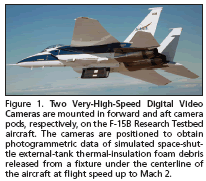 Each camera subsystem comprises a camera controller/recorder unit and a camera head. The two camera subsystems are synchronized by use of an M-Hub™ synchronization unit. Each camera subsystem is capable of recording at a rate up to 10,000 pictures per second (pps). A state-of-the-art complementary metal oxide/semiconductor (CMOS) sensor in the camera head has a maximum resolution of 1,280×1,024 pixels at 1,000 pps. Exposure times of the electronic shutter of the camera range from 1/200,000 of a second to full open. The recorded images are captured in a dynamic random- access memory (DRAM) and can be downloaded directly to a personal computer or saved on a compact flash memory card. In addition to the high-rate recording of images, the system can display images in real time at 30 pps. Inter Range Instrumentation Group (IRIG) time code can be inserted into the individual camera controllers or into the MHub unit. The video data could also be used to obtain quantitative, three-dimensional trajectory information.
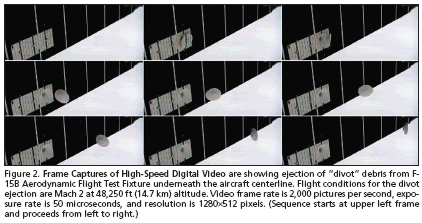 The first use of this system was in support of the Space Shuttle Return to Flight effort. Data were needed to help in understanding how thermally insulating foam is shed from a space-shuttle external fuel tank during launch. The cameras captured images of simulated external tank debris ejected from a fixture mounted under the centerline of the F-15B aircraft. Digital video was obtained at subsonic and supersonic flight conditions, including speeds up to Mach 2 and altitudes up to 50,000 ft (15.24 km). The digital video was used to determine the structural survivability of the debris in a real flight environment and quantify the aerodynamic trajectories of the debris.
This work was done by Stephen Corda, Ting Tseng, Matthew Reaves, Kendall Mauldin, and Donald Whiteman of Dryden Flight Research Center. For further information, access the Technical Support Package (TSP) free on-line at www.techbriefs.com/tsp under the Electronics/Computers category. DRC-05-16
This Brief includes a Technical Support Package (TSP).
Very High-Speed Digital Video Capability for In-Flight Use
(reference DRC-05-16) is currently available for download from the TSP library.
Don't have an account?
Overview
The document discusses NASA's Lifting Insulating Foam Trajectory (LIFT) experiment, which was conducted to study the behavior of insulating foam debris, referred to as "divots," that can be shed from the Space Shuttle's external fuel tank during launch. This research is part of NASA's return-to-flight efforts following the Columbia disaster, where foam debris contributed to the shuttle's failure.
The LIFT experiment utilized the F-15B research testbed aircraft to conduct a series of flight tests at speeds up to Mach 2. The primary objectives were to understand the structural survivability and stability of the foam divots in flight, as well as to quantify their trajectories. The experiment involved the development of an in-flight foam divot ejection system and a high-speed video system capable of capturing the divots' behavior at up to 10,000 frames per second.
During the tests, a total of 38 divots were ejected at various speeds and dynamic pressures, with the data collected being crucial for validating computational fluid dynamics models used in debris transport analysis. The high-speed video system allowed engineers to analyze whether the divots would break up upon ejection and whether they would stabilize in flight or tumble, which significantly affects the kinetic energy they could impart to the shuttle.
The LIFT project was a collaborative effort involving multiple NASA centers, including the Dryden Flight Research Center, Marshall Space Flight Center, and Ames Research Center. Engineers at Dryden designed and tested the divot ejection systems and high-speed video equipment, completing extensive ground tests to refine their approach.
The findings from the LIFT experiment are expected to enhance the understanding of foam debris behavior and improve safety measures for future shuttle launches. The data will also support ongoing research and development efforts aimed at ensuring the reliability and safety of space missions.
Overall, the document highlights NASA's innovative approach to addressing safety concerns related to foam debris, showcasing the agency's commitment to advancing aerospace technology and ensuring the success of its missions.











