A prototype small, lightweight micro Sun sensor (MSS) has been flight qualified as part of the attitude- determination system of a spacecraft or for Mars surface operations. The MSS has previously been reported at a very early stage of development (NPO-30867) in NASA Tech Briefs, Vol. 28, No. 1 (January 2004).
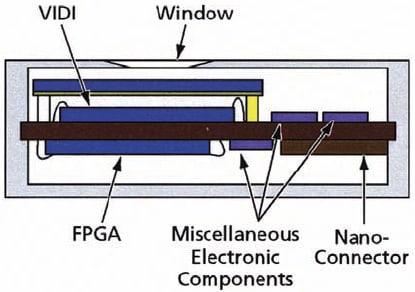
An MSS is essentially a miniature multiple-pinhole electronic camera combined with digital processing electronics that functions analogously to a sundial. A micromachined mask containing a number of microscopic pinholes is mounted in front of an active-pixel sensor (APS). Electronic circuits for controlling the operation of the APS, readout from the pixel photodetectors, and analog-to-digital conversion are all integrated onto the same chip along with the APS. The digital processing includes computation of the centroids of the pinhole Sun images on the APS. The spacecraft computer has the task of converting the Sun centroids into Sun angles utilizing a calibration polynomial.
The micromachined mask comprises a 500-μm-thick silicon wafer, onto which is deposited a 57-nm-thick chromium adhesion- promotion layer followed by a 200-nm-thick gold light absorption layer. The pinholes, 50 μm in diameter, are formed in the gold layer by photolithography. The chromium layer is thin enough to be penetrable by an amount of Sunlight adequate to form measurable pinhole images. A spacer frame between the mask and the APS maintains a gap of ≈1 mm between the pinhole plane and the photodetector plane of the APS.
To minimize data volume, mass, and power consumption, the digital processing of the APS readouts takes place in a single field-programmable gate array (FPGA). The particular FPGA is a radiation-tolerant unit that contains ≈32,000 gates. No external memory is used so the FPGA calculates the centroids in real time as pixels are read off the APS with minimal internal memory. To enable the MSS to fit into a small package, the APS, the FPGA, and other components are mounted on a single two-sided board following chip-on-board design practices (see figure).
This work was done by Carl Christian Liebe, Sohrab Mobasser, Chris Wrigley, Jeffrey Schroeder, Youngsam Bae, James Naegle, Sunant Katanyoutanant, Sergei Jerebets, Donald Schatzel, and Choonsup Lee of Caltech for NASA's Jet Propulsion Laboratory. For more information, download the Technical Support Package (free white paper) at www.techbriefs.com/tsp under the Electronics/Computers category. NPO-43620
This Brief includes a Technical Support Package (TSP).
Flight Qualified Micro Sun Sensor
(reference NPO-43620) is currently available for download from the TSP library.
Don't have an account?
Overview
The document is a Technical Support Package from NASA's Jet Propulsion Laboratory (JPL) concerning the Flight Qualified Micro Sun Sensor, identified by NTR Number 43620. It is part of NASA Tech Briefs, which disseminate information about aerospace-related developments that have potential technological, scientific, or commercial applications.
The Micro Sun Sensor is a significant innovation designed for flight applications, likely aimed at enhancing the capabilities of spacecraft in determining solar position and orientation. This technology is crucial for various space missions, as accurate solar tracking can improve energy efficiency and operational effectiveness.
The document emphasizes compliance with U.S. export regulations, indicating that the information may contain proprietary data and is subject to export control laws. This highlights the importance of safeguarding sensitive technology and ensuring that it is used appropriately.
For those seeking further information, the document provides contact details for the Innovative Technology Assets Management team at JPL, including an email address (iaoffice@jpl.nasa.gov) and a physical mailing address in Pasadena, California. This allows interested parties to inquire about the technology, its applications, and potential collaborations.
Additionally, the document includes a disclaimer stating that neither the U.S. Government nor any representatives assume liability for the use of the information contained within. It also clarifies that any mention of trade names or manufacturers is for identification purposes only and does not imply official endorsement by NASA.
Overall, the Technical Support Package serves as a resource for understanding the Flight Qualified Micro Sun Sensor's capabilities and potential applications in aerospace technology, while also providing a framework for responsible use and dissemination of the information. It reflects NASA's commitment to innovation and collaboration in advancing space exploration technologies.