The NASA Deep Space Network (DSN) uses commercial waveguide windows on the output waveguide of Ka-band (32 GHz) low-noise amplifiers. Mechanical failure of these windows resulted in an unacceptable loss in tracking time.
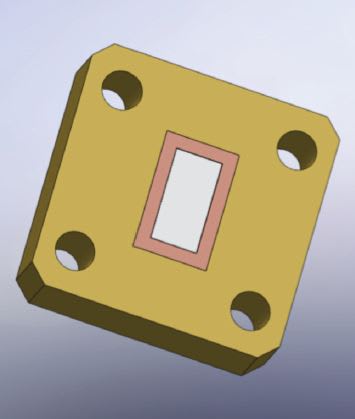
The window is constructed by fabricating a window body by brazing a short length of WR-28 copper waveguide into a standard recta ngu lar fla nge, a nd machining the resulting part to a thickness of 4.6 mm. The foam is machined to a rectangular shape with a dimension of 7.06×3.53 mm. The foam is bonded into the body with a two-part epoxy. After curing, the excess glue and foam are knife-trimmed by hand. The finished window has a loss of less than 0.08 dB (2%) and a return loss of greater than 25 dB at 32 GHz. This meets the requirements for the DSN application. The window is usable for most applications over the entire 26-to-40-GHz waveguide band. The window return loss can be tuned to a required frequency b y varying the thickness of the window slightly.
Most standard waveguide windows use a thin membrane of material bonded into a recess in a waveguide flange, or sandwiched between two flanges with a polymer seal. Designs using the recessed window are prone to mechanical failure over time due to constraints on the dimensions of the recess that allow the bond to fail. Designs using the sandwich method are often permeable to helium, which prohibits the use of helium leak detection.
At the time of this reporting, 40 windows have been produced. Twelve are in operation with a combined operating time of over 30,000 hours without a failure.
This work was done by Michael J. Britclif fe, Theodore R. Hanson, Ezra M. Long, and Steven Montanez of Caltech for NASA’s Jet Propulsion Laboratory. NPO-48372
This Brief includes a Technical Support Package (TSP).
High-Reliability Waveguide Vacuum/Pressure Window
(reference NPO-48372) is currently available for download from the TSP library.
Don't have an account?
Overview
The document is a Technical Support Package from NASA's Jet Propulsion Laboratory (JPL) detailing the High-Reliability Waveguide Vacuum/Pressure Window, identified as NPO-48372. This technology is crucial for applications involving cryogenically cooled microwave devices, such as low noise amplifiers, where maintaining a low-loss microwave path while being impermeable to gases is essential.
Waveguide windows serve as barriers between atmospheric conditions and high vacuum environments, allowing for the transmission of microwave signals with minimal loss. The design challenge lies in creating a window that is nearly transparent to microwave signals while preventing gas infiltration, including helium, which is vital for leak detection processes. Additionally, these windows can be utilized in systems that require pressurization above atmospheric levels, such as high-power transmitters.
The document outlines the performance specifications of the developed window, which boasts an insertion loss of less than 0.08 dB (equivalent to 2 percent) and a return loss greater than 25 dB at a frequency of 32 GHz. These metrics meet the stringent requirements for the Deep Space Network (DSN) applications. The window is effective across a broad frequency range of 26 to 40 GHz, and its return loss can be fine-tuned by adjusting the window's thickness.
Testing has demonstrated the window's reliability, with a helium leak rate of less than 1E-8 cc/second, significantly below the required threshold. Mechanical strength tests involved pressurizing the window to 0.3 MPa (45 PSIG) without any observable damage, providing a safety margin of three times for vacuum and cryogenic applications. To date, 40 windows have been produced, with 12 currently in operation, collectively amassing over 30,000 hours of operational time without failure.
The document emphasizes the collaborative nature of this research, acknowledging the support from the National Aeronautics and Space Administration (NASA) and the California Institute of Technology. It also provides contact information for further inquiries related to the technology and its applications, highlighting the potential for broader technological, scientific, and commercial uses stemming from this aerospace development. Overall, the High-Reliability Waveguide Vacuum/Pressure Window represents a significant advancement in microwave technology, with implications for various high-tech applications.