

Inside this issue
Supplements
Overview
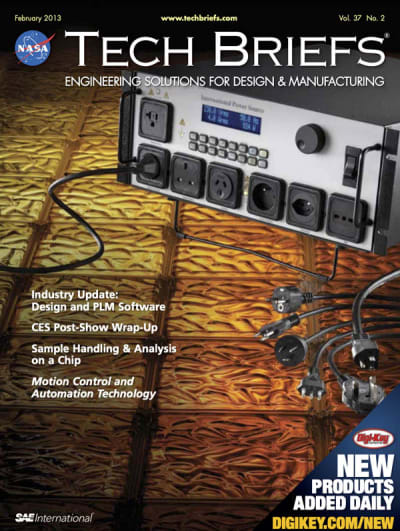
The February 2013 issue of NASA Tech Briefs and Motion Control Technology presents a comprehensive overview of the latest advancements in technology, engineering, and design, particularly focusing on innovations relevant to aerospace and motion control sectors. This edition is rich with insights, product highlights, and expert opinions that cater to professionals and enthusiasts alike.
Key Highlights:
-
Advancements in Design and PLM Software: The issue discusses the latest developments in Product Lifecycle Management (PLM) software, emphasizing how these tools are transforming the design process. Enhanced collaboration features, real-time data access, and improved project management capabilities are making it easier for teams to innovate and streamline workflows. The integration of PLM with other engineering tools is also highlighted, showcasing how it can lead to more efficient product development cycles.
-
Insights from CES: The Consumer Electronics Show (CES) is a focal point in this issue, where cutting-edge technologies and trends are showcased. The magazine covers notable innovations that could influence aerospace applications, including advancements in consumer electronics that may find their way into aerospace systems. The intersection of consumer technology and aerospace engineering is explored, highlighting how trends in one sector can inspire developments in another.
-
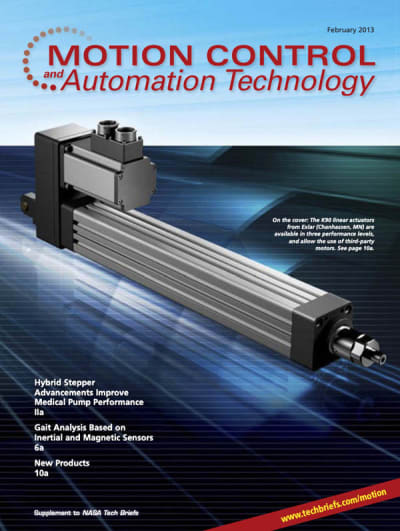
Innovative Technologies in Motion Control: Motion control technology is a significant theme in this issue. The magazine features articles on the latest motion control systems, including servo motors, actuators, and control algorithms. These technologies are crucial for precision in aerospace applications, robotics, and automation. The issue delves into how these systems are being optimized for better performance, energy efficiency, and reliability.
New Products and Features: A section dedicated to new products showcases the latest offerings from various manufacturers. This includes advanced sensors, control systems, and software tools designed to enhance the capabilities of engineers and designers. Each product is accompanied by a brief description of its features and potential applications, providing readers with valuable insights into the tools available for their projects.
-
Expert Opinions and Case Studies: The magazine includes interviews and articles from industry experts who share their perspectives on current trends and future directions in technology. Case studies illustrate successful implementations of new technologies in real-world scenarios, offering practical insights into how these innovations can be applied effectively.
-
Emerging Trends in Aerospace: The issue also addresses emerging trends in the aerospace industry, such as the increasing focus on sustainability and the development of more efficient aircraft designs. Innovations in materials science, such as lightweight composites and advanced manufacturing techniques, are discussed as key factors driving these changes.
-
Educational Resources: In addition to technical articles, the magazine provides educational resources for professionals looking to enhance their skills. This includes information on upcoming webinars, workshops, and conferences that focus on the latest technologies and best practices in the industry.
-
Networking Opportunities: The issue encourages readers to engage with the broader community through various networking opportunities. This includes information on industry events, forums, and online platforms where professionals can connect, share knowledge, and collaborate on projects.
In summary, the February 2013 issue of NASA Tech Briefs and Motion Control Technology serves as a valuable resource for professionals in the aerospace and motion control fields. It combines technical insights, product information, and expert opinions to provide a well-rounded view of the current state of technology and its future directions. The magazine not only highlights the latest innovations but also encourages readers to think critically about how these advancements can be applied to their work, fostering a culture of continuous learning and improvement in the industry.
Features
-
Application Briefs
Tech Briefs
-
Physical Sciences
Rover Low Gain Antenna Qualification for Deep Space Thermal Environments
Automated, Ultra-Sterile Solid Sample Handling and Analysis on a Chip
Spectrally and Radiometrically Stable, Wideband, Onboard Calibration Source
Data Transfer for Multiple Sensor Networks Over a Broad Temperature Range
Using Combustion Synthesis to Reinforce Berms and Other Regolith Structures
Three-Axis Attitude Estimation With a High-Bandwidth Angular Rate Sensor
-
Manufacturing & Prototyping
High-Reliability Waveguide Vacuum/Pressure Window
Methods of Fabricating Scintillators With Radioisotopes for Beta Battery Applications
Magnetic Shield for Adiabatic Demagnetization Refrigerators (ADR)
-
Software
Gaseous Nitrogen Orifice Mass Flow Calculator
An Extensible, User- Modifiable Framework for Planning Activities
-
Materials
High-Temperature, Lightweight, Self- Healing Ceramic Composites for Aircraft Engine Applications
Treatment to Control Adhesion of Silicone-Based Elastomers
High-Temperature Adhesives for Thermally Stable Aero-Assist Technologies
-
Information Sciences
Measurements of Ultra-Stable Oscillator (USO) Allan Deviations in Space
Validation of Proposed Metrics for Two-Body Abrasion Scratch Test Analysis Standards
Measuring and Estimating Normalized Contrast in Infrared Flash Thermography
X-Ray Detection and Processing Models for Spacecraft Navigation and Timing
RUSHMAPS: Real-time Uploadable Spherical Harmonic Moment Analysis for Particle Spectrometers
Automated 3D Damaged Cavity Model Builder for Lower Surface Acreage Tile on Orbiter
Powered Descent Guidance With General Thrust-Pointing Constraints
-
Mechanics & Machinery
Rock Gripper for Sampling, Mobility, Anchoring, and Manipulation
-
Electronics & Computers
Adaptive Phase Delay Generator
CMOS-Compatible SOI MESFETS for Radiation-Hardened DC-to-DC Converters
Products
-
Applications











