The HiiHat toolbox developed for CAT/ENVI provides principal investigators direct, immediate, flexible, and seamless interaction with their instruments and data from any location. Offering segmentation and neutral region division, it facilitates the discovery of key end-members and regions of interest larger than a single pixel.
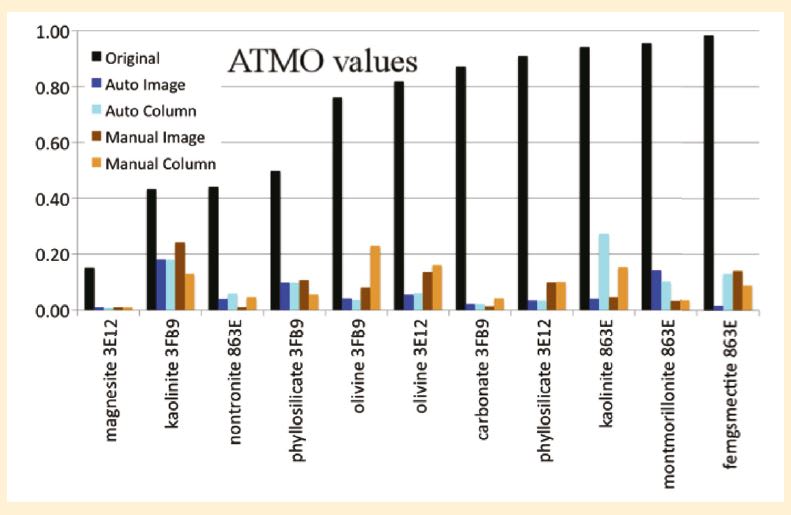
Crucial to the analysis of hyperspectral data from Mars or Earth is the removal of unwanted atmospheric signatures. For Mars and the Compact Reconnaissance Imaging Spectrometer for Mars (CRISM), residual atmospheric CO2 absorption is both directly problematic and indicative of processing errors with implications to the scientific utility of any particular image region. Estimating this residual error becomes key both in selecting regions of low distortion, and also to select mitigating methods, such as neutral region division. This innovation, the ATMO estimator, provides a simple, 0-1 normalized scalar that estimates this distortion (see figure). The metric is defined as the coefficient of determination of a quadratic fit in the region of distorting atmospheric absorption (≈2 μm). This mimics the behavior of existing CRISM team mineralogical indices to estimate the presence of known, interesting mineral signatures. This facilitates the ATMO metric’s assimilation into existing planetary geology workflows.
This work was done by Lukas Mandrake and David R. Thompson of Caltech for NASA’s Jet Propulsion Laboratory.
This software is available for commercial licensing. Please contact Dan Broderick at
This Brief includes a Technical Support Package (TSP).
Advanced Multimission Operations System (ATMO)
(reference NPO-47670) is currently available for download from the TSP library.
Don't have an account?
Overview
The document is a Technical Support Package for the Advanced Multimission Operations System (ATMO) developed by NASA's Jet Propulsion Laboratory (JPL). It serves to disseminate information regarding aerospace-related developments that have potential technological, scientific, or commercial applications. The package includes contributions from researchers at JPL and Wesleyan University, highlighting their work on Automatic Neutral Region Detection using Superpixels.
Key components of the document include an overview of the Compact Reconnaissance Imaging Spectrometer (CRISM), which operates in the 1.0-4.0 micron range and consists of 433 bands. CRISM is designed to identify rare target minerals, such as carbonates, and to characterize mafic mineralogy. The document discusses the challenges associated with CRISM, including uncertain constituents and low signal-to-noise ratios, which can affect the accuracy of mineral identification.
The document also details the quantification of spectral contrast using CRISM summary indices, which are essential for mineral identification. Various minerals are listed along with their corresponding CRISM summary products, such as magnesite, olivine, phyllosilicate, kaolinite, and smectite, among others. This information is crucial for understanding the mineral composition of planetary surfaces, particularly in the context of Mars exploration.
Additionally, the document emphasizes the importance of the ATMO system in enhancing the capabilities of NASA's missions. It outlines the need for compliance with U.S. export regulations and acknowledges government support for the research presented. The package is intended for a wide audience, including those interested in innovative technology and partnerships within NASA.
Overall, the Technical Support Package provides a comprehensive overview of the ATMO system and its applications in mineral identification and planetary exploration. It highlights the collaborative efforts of researchers and the significance of their findings in advancing our understanding of extraterrestrial geology. The document serves as a resource for further information and assistance related to aerospace technology and research initiatives at JPL.