In an improvement of the visual-targettracking software used aboard a mobile robot (rover) of the type used to explore the Martian surface, an affine-matching algorithm has been replaced by a combination of a normalized-cross- correlation (NCC) algorithm and a template-image- magnification algorithm. Although neither NCC nor template-image magnification is new, the use of both of them to increase the degree of reliability with which features can be matched is new. In operation, a template image of a target is obtained from a previous rover position, then the magnification of the template image is based on the estimated change in the target distance from the previous rover position to the current rover position (see figure). For this purpose, the target distance at the previous rover position is determined by stereoscopy, while the target distance at the current rover position is calculated from an estimate of the current pose of the rover. The template image is then magnified by an amount corresponding to the estimated target distance to obtain a best template image to match with the image acquired at the current rover position.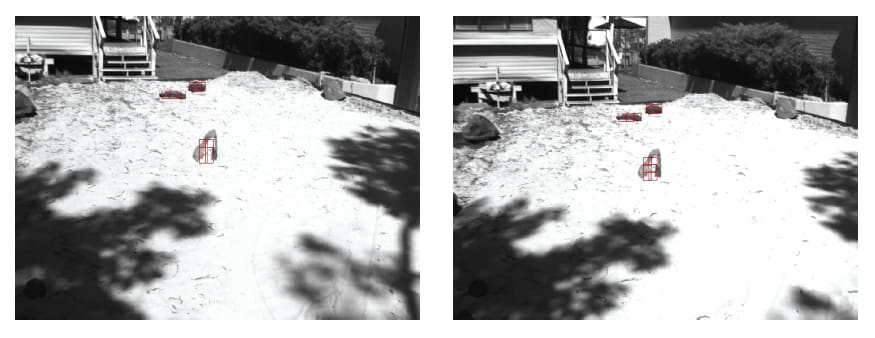
This program was written by Won Kim, Adnan Ansar, and Richard Madison of Caltech for NASA's Jet Propulsion Laboratory. For further information, access the Technical Support Package (TSP) free online at www.techbriefs.com/tsp under the Software category.
This software is available for commercial licensing. Please contact Karina Edmonds of the California Institute of Technology at (626) 395-2322. Refer to NPO-42682.
This Brief includes a Technical Support Package (TSP).
Improvement in Visual Target Tracking for a Mobile Robot
(reference NPO-42682) is currently available for download from the TSP library.
Don't have an account?
Overview
The document titled "Technical Support Package for Improvement in Visual Target Tracking for a Mobile Robot" (NPO-42682) presents advancements in visual target tracking technology, particularly as it pertains to mobile robots, such as those used in NASA's Mars Exploration Rover (MER) missions. The focus is on the validation and integration of this technology into flight missions, emphasizing its reliability and performance.
The validation process described in the document adopts a "white box" approach, allowing the validation team to examine the system at a component level. This method enables the identification of performance reliabilities, error budgets, and potential anomalies. The team iteratively suggests critical bug fixes and enhancements until the system reaches a stabilized state, culminating in a final validation report for flight projects to review.
Key findings from the validation indicate that the Normalized Cross-Correlation (NCC) method, particularly when combined with template image magnification, demonstrates the highest reliability in visual tracking. This technology has been successfully tested in various scenarios, including straightforward, sideways, and in-place rover motions. As a result of these promising validation results, the visual target tracking technology is being integrated into the MER software, with plans for implementation in early 2006.
The document also outlines the software architecture of the MER flight software (FSW), which is primarily written in C, with the Navigation (NAV) module utilizing C++. The integration of the visual tracking technology involves the CLARAty software, which serves as an interface to the MER C code, facilitating the incorporation of various tracking algorithms.
In conclusion, the document highlights the importance of the technology validation process in ensuring the successful infusion of new technologies into flight missions. The advancements in visual target tracking not only enhance the capabilities of mobile robots but also have broader implications for aerospace-related developments. The information is part of NASA's Commercial Technology Program, aimed at making aerospace innovations accessible for wider technological, scientific, and commercial applications. For further assistance and information, the document provides contact details for the NASA Scientific and Technical Information Program Office.