

SweepSAR, a novel radar architecture that depends on a DBF (digital beamforming) array, requires calibration accuracies that are order(s) of magnitude greater than is possible with traditional techniques, such as a priori characterization of TR (transmit/receive) modules in thermal vacuum chambers, or simple loop-back of the calibration signal. The advantages of a SweepSAR architecture are so great that it is worth applying significant resources to calibration efforts.
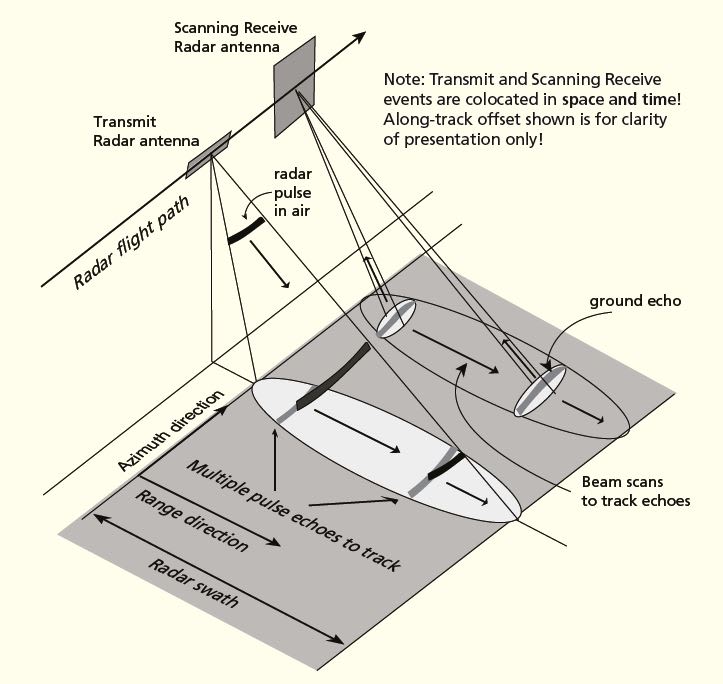
Inherent to the DBF array is the individual digitization of each of the array’s receiver channels. Current systems typically combine all of the analog signals in the array into one or two analog channels, which are then digitized and processed. All signal conditioning performed prior to digitization is done using analog hardware (which is less precise than digital signal conditioning and dependent on temperature). The DBF digitizes every signal prior to combining, and can therefore analyze and correct received signals, as well as analyze signals that are being transmitted through analog hardware (by sampling a copy and digitizing). Each channel of a DBF also has a powerful processor. With this combination, one is able to digitize, analyze, and correct each channel prior to its being combined.
A unique factor is the ability to digitize and analyze (in real time) each of the array’s channels independently, allowing one to achieve unprecedented knowledge of each channel’s performance (gain and phase), and since the combining is done digitally, each receive channel can be corrected prior to combining. This enables an unprecedented level of accuracy and control through onboard processing.
SweepSAR promises significant increases in instrument capability for solid earth and biomass remote sensing, while reducing mission mass and cost. This new instrument concept requires new methods for calibrating the multiple channels, which must be combined onboard, in real time. New methods are being developed for digitally calibrating digital beam-forming arrays to reduce development time, risk, and cost of precision calibrated TR modules for array architectures by accurately tracking modules’ characteristics through closed-loop digital calibration, thus tracking systematic changes regardless of temperature.
This work was done by James P. Hoffman, Louise A. Veilleux, Eva Peral, Chung-Lun Chuang, and Scott J. Shaffer of Caltech for NASA’s Jet Propulsion Laboratory. NPO-48310
This Brief includes a Technical Support Package (TSP).
Digitally Calibrated TR Modules Enabling Real-Time Beamforming SweepSAR Architectures
(reference NPO-48310) is currently available for download from the TSP library.
Don't have an account?
Overview
The document is a Technical Support Package from NASA’s Jet Propulsion Laboratory (JPL) that focuses on Digitally Calibrated Transmit-Receive (TR) Modules designed to enable Real-Time Beamforming for SweepSAR (Synthetic Aperture Radar) architectures. It is part of NASA Tech Briefs, specifically referenced as NPO-48310, and is intended to disseminate information about aerospace-related developments with broader technological, scientific, or commercial applications.
The document outlines the advancements in radar technology, particularly in the context of DESDynI-class radar instruments, which are aimed at improving Earth observation capabilities. The TR modules are digitally calibrated to enhance the performance of radar systems, allowing for more precise and efficient data collection. This technology is particularly relevant for applications in remote sensing and environmental monitoring.
The document includes contributions from various authors, including James Hoffman, Eva Peral, Louise Veilleux, Dragana Perkovic, and Scott Shaffer, who are involved in radar science and engineering at JPL. It emphasizes the importance of real-time beamforming capabilities, which allow for dynamic adjustments in radar signal processing, leading to improved imaging and data quality.
Additionally, the document contains references to individual beam imagery and hardware components, such as the reflector, feed array, and transmit antenna, which are integral to the SweepSAR system. It also mentions the first results from an airborne SweepSAR demonstration conducted at Ka-band, showcasing the practical applications of this technology.
The Technical Support Package serves as a pre-decisional document intended for planning and discussion purposes, indicating that the information may still be subject to further development and refinement. It also includes a notice regarding the liability and rights associated with the use of the information contained within the document, clarifying that the U.S. Government does not assume liability for its use.
For further inquiries or assistance, the document provides contact information for the Innovative Technology Assets Management office at JPL, encouraging collaboration and engagement with the research community.
In summary, this document highlights significant advancements in radar technology through the development of digitally calibrated TR modules, which enhance the capabilities of real-time beamforming in radar systems, with a focus on applications in Earth observation and remote sensing.











