Inside this issue
Supplements
Overview
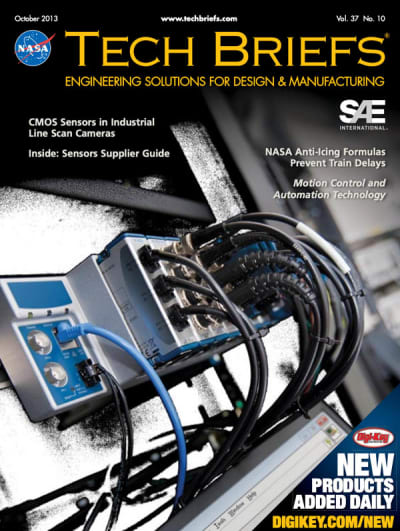
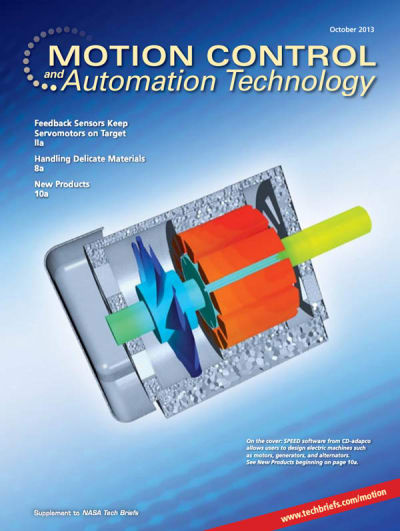
The October 2013 issue of NASA Tech Briefs and Motion Control and Automation Technology presents a wealth of information on advancements in technology, particularly in the fields of automation, control systems, and innovative engineering solutions. This edition highlights several key topics and products that are shaping the future of these industries.
Key Features:
-
Feedback Sensors for Servomotors: One of the standout articles discusses the importance of feedback sensors in maintaining the accuracy and performance of servomotors. These sensors play a crucial role in ensuring that servomotors operate within their designated parameters, which is essential for applications requiring precision, such as robotics and automated manufacturing. The article delves into various types of feedback sensors, their operational principles, and how they contribute to improved control and efficiency in motion systems.
-
Handling Delicate Materials: Another significant topic covered in this issue is the handling of delicate materials. The article explores techniques and technologies that enable the safe and efficient manipulation of fragile components in various industries, including electronics and pharmaceuticals. It emphasizes the need for specialized equipment and methodologies to prevent damage during processing and transport, highlighting innovations that enhance the reliability of these operations.
NASA Anti-Icing Formulas: The magazine also features a compelling piece on NASA's development of anti-icing formulas designed to prevent train delays caused by ice accumulation. This research is particularly relevant for regions that experience harsh winter conditions, where ice can significantly disrupt transportation systems. The article outlines the scientific principles behind these formulas and their potential applications in improving the safety and reliability of rail transport.
-
CMOS Sensors in Industrial Line Scan Cameras: The issue includes an insightful discussion on the use of CMOS sensors in industrial line scan cameras. These sensors are pivotal in high-speed imaging applications, allowing for the rapid capture of images in manufacturing processes. The article details the advantages of CMOS technology over traditional CCD sensors, including lower power consumption, higher frame rates, and improved image quality, making them ideal for various automation and inspection tasks.
-
New Products Showcase: The magazine features a section dedicated to new products that have recently entered the market. This includes innovative tools, components, and systems that can enhance automation and control processes. Notable mentions include advanced software solutions for designing electric machines, such as motors and generators, which are essential for modern engineering applications. The showcase provides readers with insights into the latest technologies that can be integrated into their projects.
-
Supplier Guide: Additionally, the issue contains a comprehensive supplier guide, offering readers a valuable resource for finding manufacturers and suppliers of various components and technologies relevant to motion control and automation. This guide is particularly useful for engineers and procurement professionals seeking reliable partners for their projects.
Navigation and Accessibility: The digital format of this magazine allows for easy navigation through its contents. Readers can utilize features such as zooming in on pages, searching for specific topics, and quickly accessing the table of contents. This user-friendly design enhances the reading experience, making it easier to find relevant information.
Conclusion: Overall, the October 2013 issue of NASA Tech Briefs and Motion Control and Automation Technology serves as a vital resource for professionals in the fields of engineering, automation, and technology. With its focus on cutting-edge innovations, practical applications, and industry insights, this edition equips readers with the knowledge and tools necessary to stay at the forefront of technological advancements. Whether you are involved in research, product development, or operational management, the information presented in this issue is invaluable for driving progress and efficiency in your work.
Features
-
Application Briefs
Spacesuit Simulator Meets NASA Training Needs
Tech Briefs
-
Physical Sciences
A Short-Range Distance Sensor with Exceptional Linearity
Fast, Large-Area, Wide-Bandgap UV Photodetector for Cherenkov Light Detection
Miniature Trace Gas Detector Based on Microfabricated Optical Resonators
Enhancing Microwave Spectroscopy in Astrophysics Applications
JWST Integrated Science Instrument Module Alignment Optimization Tool
Radar Range Sidelobe Reduction Using Adaptive Pulse Compression Technique
Digitally Calibrated TR Modules Enabling Real-Time Beamforming SweepSAR Architectures
Electro-Optic Time-to-Space Converter for Optical Detector Jitter Mitigation
Partially Transparent Petaled Mask/Occulter for Visible-Range Spectrum
-
Manufacturing & Prototyping
Non-Magnetic, Tough, Corrosion- and Wear-Resistant Knives From Bulk Metallic Glasses and Composites
-
Software
Mission Data System Java Edition Version 7
Adaptive Distributed Environment for Procedure Training (ADEPT)
-
Materials
Applications for Gradient Metal Alloys Fabricated Using Additive Manufacturing
Passivation of Flexible YBCO Superconducting Current Lead With Amorphous SiO₂ Layer
-
Information Sciences
Commercial Non-Dispersive Infrared Spectroscopy Sensors for Sub-Ambient Carbon Dioxide Detection
Predicting Aircraft Ice Formation with Simulation
Educational NASA Computational and Scientific Studies (enCOMPASS)
Coarse-Grain Bandwidth Estimation Scheme for Large-Scale Network
-
Mechanics & Machinery
Method to Increase Performance of Foil Bearings Through Passive Thermal Management
Propellant-Flow-Actuated Rocket Engine Igniter
Unibody Composite Pressurized Structure
Lightweight Liquid Helium Dewar for High-Altitude Balloon Payloads
High-Efficiency Nested Hall Thrusters for Robotic Solar System Exploration
-
Electronics & Computers
Millimeter-Wave Localizers for Aircraft-to-Aircraft Approach Navigation
Impedance Discontinuity Reduction Between High-Speed Differential Connectors and PCB Interfaces
-
Applications