A new type of composite material has been proposed for membranes that would constitute the reflective surfaces of planned lightweight, single curvature (e.g., parabolic cylindrical) reflectors for some radar and radio communication systems. The proposed composite materials would consist of polyimide membranes containing embedded grids of high strength (e.g., carbon) fibers. The purpose of the fiber reinforcements, as explained in more detail below, is to prevent wrinkling or rippling of the membrane.
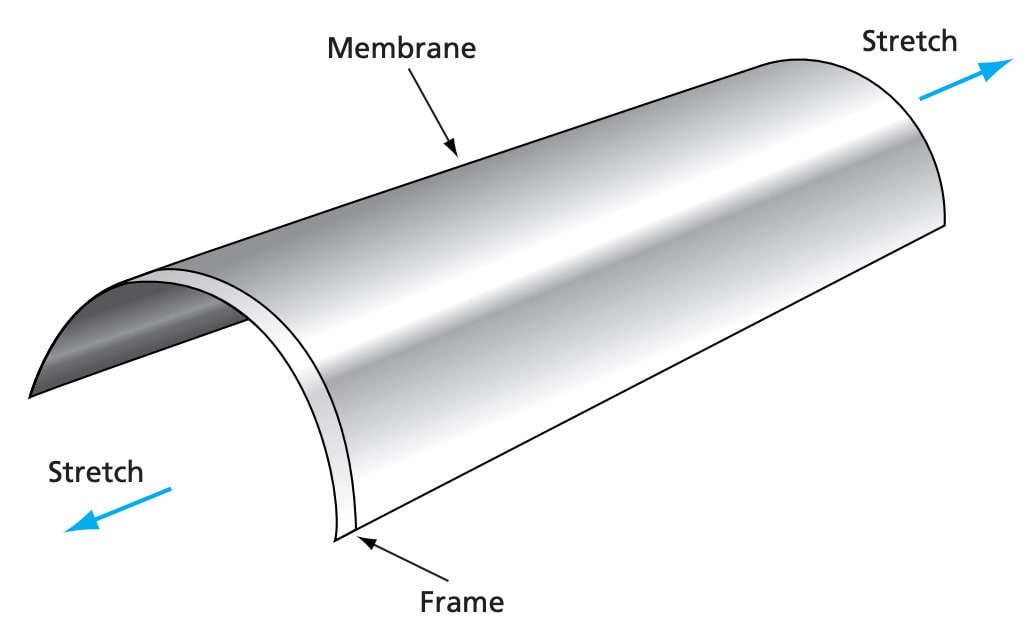
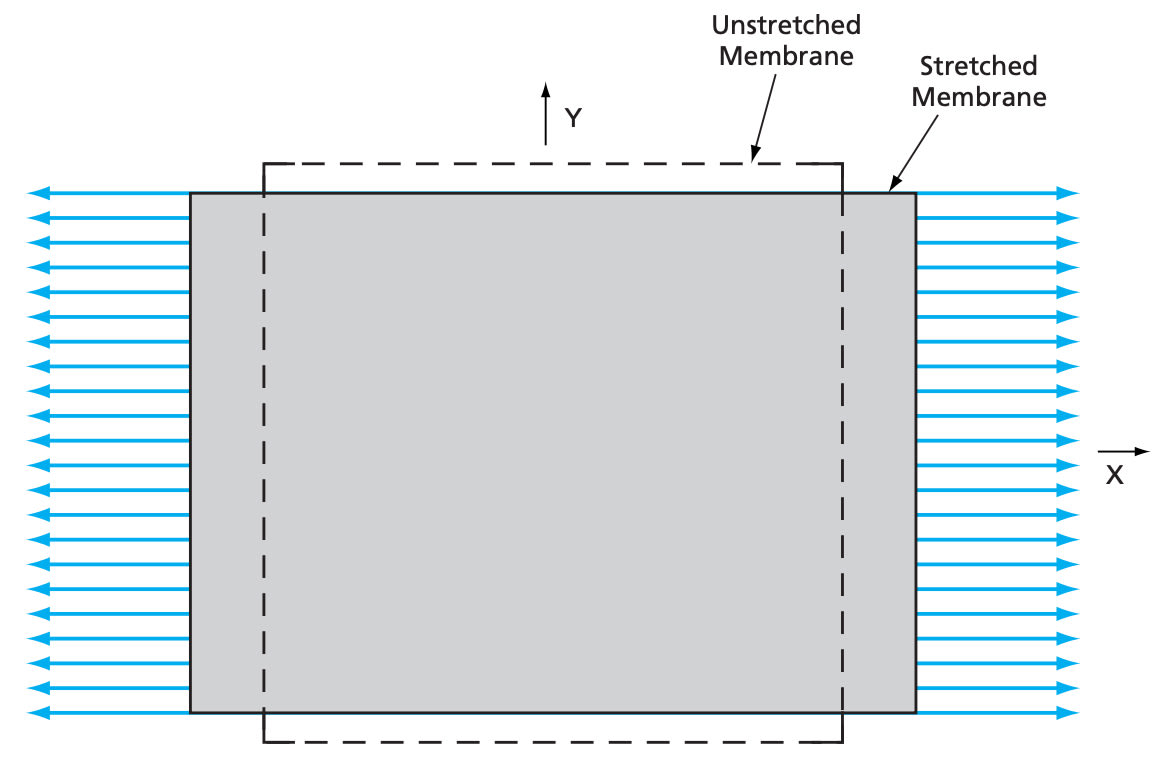
A membrane single curvature reflector is made by stretching a reflective membrane between frame ends that define the specified curvature (see Figure 1). The stretching is necessary to impart the stiffness needed to maintain the required curvature. Unavoidably, the stretching also induces a negative (compressive) strain, proportional to the Poisson’s ratio of the membrane material, in the direction perpendicular to the stretch direction (see Figure 2). The negative strain gives rise to wrinkles and/or ripples. In the case of a precise radar or radio communication reflector, the degradation of performance by ripples or wrinkles would be unacceptable.
In a membrane according to the proposal, the embedded reinforcing fibers would be meshed in an isogrid pattern. The design parameters of the fibers and the pattern would be chosen so that the fibers would carry much of the stretching load in such a manner as to reduce or eliminate the compressive strains in the directions perpendicular to stretching. From a macroscopic perspective, the reduction of compressive strains could be characterized by a corresponding reduction in the effective Poisson’s ratio.
As a preliminary test of the proposal, computational simulations of effects of stretching were performed for two membranes, denoted the plain and isogrid membranes. The plain membrane was made of 2-mil (≈0.05-mm)-thick polyimide, without reinforcing fibers. The isogrid membrane was identical to the plain membrane except that it contained an embedded mesh of high modulus of elasticity carbon fibers. In the simulations, the membranes were stretched along one direction and their contractions along a direction perpendicular to the stretching direction were observed. For the plain membrane, the contraction perpendicular to the stretching direction was 0.33 times the stretch: in other words, the effective Poisson’s ratio was 0.33, which is typical of commercially available membrane materials. For the isogrid membrane, the effective Poisson’s ratio was found to be 0.05. Further study will be necessary to determine whether this much reduction in the effective Poisson’s ratio is sufficient to prevent wrinkles and ripples and whether further reductions in the effective Poisson’s ratio can be achieved.
This work was done by Houfei Fang and Michael Lou of Caltech for NASA’s Jet Propulsion Laboratory. For further information, access the Technical Support Package (TSP) free on-line at www.techbriefs.com/tsp under the Materials category.
NPO-40035
This Brief includes a Technical Support Package (TSP).
Isogrid Membranes for Precise, Singly Curved Reflectors
(reference NPO-40035) is currently available for download from the TSP library.
Don't have an account?
Overview
The document titled "Isogrid Membranes for Hi-Precision Single-Curvature Reflectors" is a technical support package from NASA, focusing on the development of advanced membrane materials for aerospace applications. It addresses the challenges associated with creating large, high-precision parabolic reflectors required for future NASA missions, such as the Dual Anamorphic Reflector Telescope (DART) and the Second-Generation Precipitation Radar (PR-II).
A key issue with traditional membrane materials, such as Kapton and Mylar, is their isotropic and homogeneous nature, which leads to undesirable effects when stretched. When a membrane is elongated in one direction, it contracts in the perpendicular direction due to its Poisson's ratio, typically around 0.33 for these materials. This contraction can cause local buckling, resulting in wrinkles and ripples that degrade the optical and radio frequency performance of the reflectors.
To overcome these limitations, the document introduces isogrid membrane technology. This innovative approach involves embedding high-strength fibers into the membrane material in a specific isogrid pattern. This design allows the membrane to carry stretching loads in one direction without inducing compression in the perpendicular direction, effectively reducing the Poisson's ratio to as low as 0.05. This significant reduction in the Poisson's ratio minimizes the contraction effects, thereby eliminating wrinkles and ripples.
The document details a preliminary study where finite-element models were used to analyze two small Kapton film membranes—one plain and one isogrid-membrane. The results showed that while the plain membrane exhibited a y-contraction equal to 0.33 times the x-elongation, the isogrid-membrane's contraction was only 0.05 times the x-elongation. This demonstrates the effectiveness of the isogrid design in enhancing membrane performance.
In summary, the isogrid membrane technology represents a significant advancement in the field of aerospace engineering, providing a solution to the challenges posed by traditional membrane materials. By reducing the Poisson's ratio and enhancing the bending stiffness of the membranes, this technology aims to ensure the successful deployment of high-precision reflectors for future NASA missions, ultimately improving their performance and reliability.