Typical lighter-than-air vehicles utilizing a superpressure design such as balloons, aerostats, or blimps, have one or more fittings attached to the gas containment skin that can serve as load attachment points or inflation/vent ports. These fittings are often sealed to the skin with a silicone gasket and a room temperature vulcanizing (RTV) adhesive. This type of seal works very well over the temperature range encountered in the Earth’s atmosphere (–60 to +40 °C). However, balloons designed to operate at Titan or Mars would encounter temperatures much colder than those found on Earth, making this type of seal inadequate.
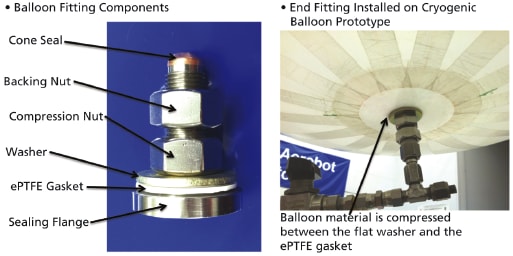
The end fitting is used as a fill-port for a superpressure cryogenic balloon prototype. The fill-port end fitting is a stainless steel component that has a circular flat region that holds the gasket in compression against the balloon film material; a raised annular section on the circular flat region that compresses the seal by 67% in the assembled configuration; a 37° cone connection on the fill port that seals with a common AN fitting attached to the gas supply; and a threaded stem that uses a nut and flat washer to compress the seal during installation into the balloon. The fitting uses a Gore GR expanded PTFE gasket that is 0.063-in. (≈1.6-mm) thick to seal the balloon film material against the balloon fitting.
The new seal applies technology used in cryogenic piping systems to create a helium tight balloon fitting capable of operating down to at least –180 °C (limit of testing). The seal incorporates a feature (the raised annulus) that was specifically designed to compress a continuous portion of the gasket to the optimum thickness so that it does not leak due to thermal contraction difference between the seal materials at cryogenic temperatures. There is a plateau in the deflection-stress curve when the gasket is compressed to 67% of its original thickness. The plateau in the compression curve assures that a gap will not be created in the seal due to differences in thermal contraction between the stainless steel end fitting and the ePTFE gasket as the temperature drops to cryogenic values. A constant pressure is maintained between the gasket and the end fitting over a wide temperature range, ensuring the seal does not leak.
Since the raised annulus feature compresses only a portion of the gasket, it is self-evident when the seal is properly seated during assembly. The torque required to turn the compression nut sharply increases when the gasket is seated in the fitting. This makes it easy to determine when the seal is sufficiently tightened in assembly.
This work was done by Jeffery L. Hall and Michael T. Pauken of Caltech for NASA’s Jet Propulsion Laboratory. NPO-49165
This Brief includes a Technical Support Package (TSP).
Cryogenic Balloon End Fitting Seal
(reference NPO-49165) is currently available for download from the TSP library.
Don't have an account?
Overview
The document is a Technical Support Package from NASA's Jet Propulsion Laboratory (JPL) concerning the Cryogenic Balloon End Fitting Seal, identified as NPO-49165. It outlines the challenges and solutions related to the design and testing of superpressure balloons intended for operation in extreme environments, such as those found on Titan (Saturn's moon) and Mars.
Traditional lighter-than-air vehicles, like balloons and blimps, typically use silicone gaskets and Room Temperature Vulcanizing (RTV) adhesives to seal fittings attached to their gas containment skins. While effective in Earth’s atmospheric temperature range (-60°C to +40°C), these materials fail at cryogenic temperatures below -60°C, leading to cracking and leaks. This limitation necessitates the development of new sealing technologies to ensure the integrity of balloons operating in much colder environments.
The document details a specific test plan aimed at demonstrating the integrity of the balloon envelope and the end-fitting seal under cryogenic conditions. The test involves placing a balloon prototype in a cryogenic chamber, maintaining a helium super-pressure of approximately 3500 Pascals during the cool-down phase, and monitoring the balloon's pressure and temperature over a 72-hour period. The goal is to verify that the balloon remains leak-free, which is critical for the success of missions that require long-duration flights in harsh extraterrestrial atmospheres.
The research is conducted under the auspices of NASA and the California Institute of Technology (Caltech), emphasizing the collaboration between these institutions in advancing aerospace technology. The document also serves as a resource for technology transfer, indicating that the findings may have broader applications beyond space exploration.
For further inquiries or assistance regarding this technology, the document provides contact information for the Innovative Technology Assets Management at JPL. It also includes a disclaimer regarding the use of the information contained within, clarifying that the U.S. Government does not assume liability for its application.
In summary, this Technical Support Package highlights the innovative approaches being developed to enhance the performance and reliability of cryogenic balloons, which are essential for future exploration missions to Titan and Mars.