

There is a need to perform accurate, high-temperature, complex dielectric constant measurements at microwave frequencies on materials, such as those on the surface of Venus (surface temperature 460 °C). One approach is to excite and detect a TE10n mode resonance in a waveguide cavity heated in a high-temperature furnace. The standard way is to use commercial high-temperature transition adapters attached to cavity end plates containing small iris holes that weakly couple microwave energy into and out of the cavity. These high-temperature transition adapters are not simple to make, and are rather large in size. The addition of the transition adapter units to the waveguide cavity leads to a long combined system that in many cases makes it difficult, if not impossible, to insert in conventional high-temperature furnaces.
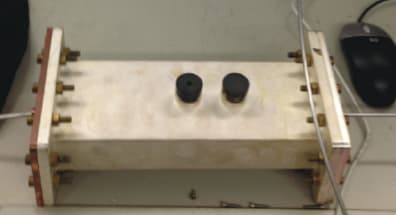
This work was done by Martin B. Barmatz and David E. Steinfeld of Caltech for NASA’s Jet Propulsion Laboratory. NPO-49262
This Brief includes a Technical Support Package (TSP).
Exciting and Detecting Electromagnetic Energy in a High-Temperature Microwave Cavity
(reference NPO-49262) is currently available for download from the TSP library.
Don't have an account?
Overview
The document outlines research conducted at NASA's Jet Propulsion Laboratory (JPL) focused on exciting and detecting electromagnetic energy in high-temperature microwave cavities. The primary goal of this research is to measure the dielectric and magnetic properties of materials at elevated temperatures, which is essential for various aerospace applications.
To achieve this, the researchers developed a high-temperature resonant cavity equipped with specialized cables capable of transmitting electromagnetic energy at temperatures exceeding 300°C, with some cables tested to operate successfully up to 500°C. A significant challenge in this field has been the failure of conventional cables at high temperatures due to the hydroscopic nature of sealing compounds, which can alter the characteristic impedance upon cooling.
The document discusses the use of the ASTM D 2520 method, which involves a cavity perturbation approach. This method measures the resonant frequency and quality factor of a cavity with and without a sample inserted, allowing for the determination of the complex dielectric or magnetic constants of the material being tested. The researchers also explored alternatives to traditional coax-to-waveguide adapters, which are typically several inches long, by proposing a simpler coupling method. This involves replacing the iris hole with a small hole in the center of an end plate, allowing a cylindrical high-temperature coax to directly couple electromagnetic energy into the cavity.
The findings from this research not only enhance the ability to perform high-temperature measurements but also have broader applications beyond just permittivity and permeability measurements. The document emphasizes the importance of these advancements in the context of aerospace technology and materials science.
Overall, this research represents a significant step forward in the ability to conduct high-temperature electromagnetic measurements, which can lead to improved material characterization and performance in extreme environments. The work is part of a broader effort by NASA to leverage innovative technologies for aerospace applications, ensuring that the findings are accessible for commercial and scientific use. The document serves as a technical support package, providing insights into the methodologies and potential applications of the research conducted at JPL.











