An alternative design for dielectric optical microresonators and a relatively simple process to fabricate them have been proposed. The proposed microresonators would exploit the same basic physical phenomena as those of microtorus optical resonators and of the microsphere optical resonators described in several prior NASA Tech Briefs articles. The resonances in such devices are associated with the propagation of electromagnetic waves along circumferential.paths in "whispering-gallery" modes. The main advantage afforded by the proposal is that the design and the fabrication process are expected to be amenable to production of multiple microresonators having reproducible spectral parameters — including, most notably, high values of the resonance quality factor (Q) and reproducible resonance frequencies.
 High-Q optical microresonators are key components in many contemplated advanced optoelectronic applications, including high-stability, narrow-line-width microlasers; spectrometers; remote-sensing systems; memory devices; and optical delay lines. In all such applications, there are requirements for stable and repeatable spectra that contain the resonance spectral lines of interest and do not contain unwanted lines: in other words, there are requirements for microresonators that exhibit high Q with reproducible sparse spectra. Although prior microsphere and microtorus optical resonators have been shown to have the potential to satisfy these requirements, the techniques used heretofore to fabricate them, involving melting individual resonators under manual control, do not yield reproducible spectral parameters and, therefore, are not suitable for production of multiple, functionally identical units.
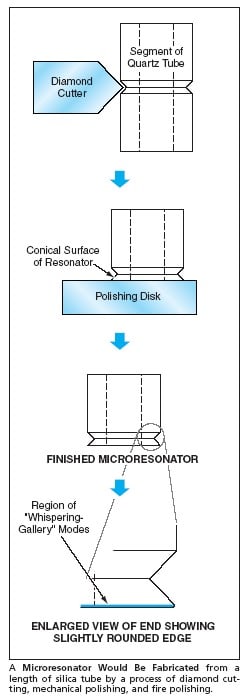
The figure depicts a microresonator and the fabrication thereof according to the proposal. In preparation for fabrication of a batch of microresonators, one would choose a silica tube of precisely calibrated diameter (typically about 6 mm), so that all the resonators in the batch could be relied upon to have the same diameter. One would cut the tube into shorter segments — one for each resonator. By use of a diamond cutter, a circumferential V groove would be made on the outer surface of each segment. By polishing with a diamond disk, all the material would be removed from one end of the segment (the lower end in the figure), up to the edge of the groove. Thus, what would remain at the polished end of the tube would be a quasi-toroidal resonator structure having a conical outer surface.
The edge region would be fire-polished by use of a hydrogen/oxygen torch to eliminate the roughness of the cut edge and conical surface and the residual roughness of the mechanically polished end face of the tube segment. This smoothing of the surface would reduce the loss of light propagating in whispering-gallery modes, thereby helping to ensure high Q (anticipated to be 109). The fire polishing would also round the edge slightly, but the radius of curvature of the edge would be small enough that the spectrum would remain sparse.
This work was done by Anatoliy Savchenkov, Vladimir Iltchenko, Lute Maleki, and Dimitri Kossakovski of Caltech for NASA's Jet Propulsion Laboratory. For further information, access the Technical Support Package (TSP) free on-line at www.techbriefs.com/tsp under the Physical Sciences category.
In accordance with Public Law 96-517, the contractor has elected to retain title to this invention. Inquiries concerning rights for its commercial use should be addressed to:
Innovative Technology Assets Management
JPL
Mail Stop 202-233
4800 Oak Grove Drive
Pasadena, CA 91109-8099
(818) 354-2240
E-mail:
Refer to NPO-30588, volume and number of this NASA Tech Briefs issue, and the page number.
This Brief includes a Technical Support Package (TSP).
Manufacture of Sparse-Spectrum Optical Microresonators
(reference NPO-30588) is currently available for download from the TSP library.
Don't have an account?
Overview
The document discusses the manufacture of sparse-spectrum optical microresonators, focusing on a novel microfabrication technique developed by NASA's Jet Propulsion Laboratory. These microresonators are crucial components in various optical applications, including high-stability microlasers, spectroscopy, remote sensing, and memory devices. The primary challenge addressed is the need for high Q-factor optical microcavities that exhibit stable and repeatable spectral parameters, free from unwanted resonances.
Traditional methods of creating whispering gallery mode resonators, such as microspheres and microtori, involve hand-melting individual resonators, which limits scalability and consistency in spectral parameters. The proposed solution is to utilize a cone-shaped microresonator design that allows for the production of resonators with identical spectral properties. This design is advantageous due to its small size and sparse spectrum, resulting from the small radius of curvature at the edge of the cone.
The fabrication process begins with a precisely calibrated silica tube, from which thin belt-like samples are cut using a diamond cutter. This process creates two axisymmetrical channels, leading to slightly asymmetrical shapes. The samples are then polished to remove rough edges and surfaces, followed by flame polishing to achieve a smooth finish. This thermal treatment not only smooths the surface but also reshapes the cone edges, minimizing surface roughness and reducing radiation loss.
The document emphasizes the simplicity and cost-effectiveness of this fabrication technique, which enables the production of multiple microresonators with identical shapes and spectral properties. The resulting microresonators can achieve a quality factor (Q) of 10^6 or higher, making them suitable for high-performance optical applications.
In summary, the document outlines a significant advancement in the fabrication of optical microresonators, presenting a method that combines precision, reproducibility, and cost-effectiveness. This innovation has the potential to enhance the performance of various optical devices, paving the way for broader applications in technology and science. The work is part of NASA's efforts to leverage aerospace-related developments for wider technological and commercial use.