

Most optical systems require antennas with directive patterns. This means that the physical area of the antenna will be large in terms of the wavelength. When non-cooled systems are used, the losses of microstrip or coplanar waveguide lines impede the use of standard patch or slot antennas for a large number of elements in a phased array format.
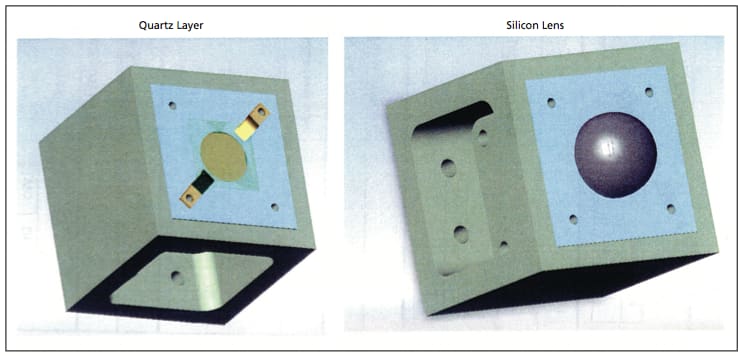
Antennas excited by a waveguide (TE10) mode makes use of dielectric superlayers to increase the directivity. These antennas create a kind of Fabry-Perot cavity between the ground plane and the first layer of dielectric. In reality, the antenna operates as a leaky wave mode where a leaky wave pole propagates along the cavity while it radiates. Thanks to this pole, the directivity of a small antenna is considerably enhanced.
The antenna consists of a waveguide feed, which can be coupled to a mixer or detector such as a Schottky diode via a standard probe design. The waveguide is loaded with a double-slot iris to perform an impedance match and to suppress undesired modes that can propagate on the cavity. On top of the slot there is an air cavity and on top, a small portion of a hemispherical lens. The fractional bandwidth of such antennas is around 10 percent, which is good enough for heterodyne imaging applications.
The new geometry makes use of a silicon lens instead of dielectric quarter wavelength substrates. This design presents several advantages when used in the submillimeter-wave and terahertz bands:
- Antenna fabrication compatible with lithographic techniques.
- Much simpler fabrication of the lens.
- A simple quarter-wavelength matching layer of the lens will be more efficient if a smaller portion of the lens is used.
- The directivity is given by the lens diameter instead of the leaky pole (the bandwidth will not depend any more on the directivity but just on the initial cavity).
The feed is a standard waveguide, which is compatible with proven Schottky diode mixer/detector technologies.
The development of such technology will benefit applications where submillimeter-wave heterodyne array designs are required. The main fields are national security, planetary exploration, and biomedicine. For national security, wideband submillimeter radars could be an effective tool for the standoff detection of hidden weapons or bombs concealed by clothing or packaging. In the field of planetary exploration, wideband submillimeter radars can be used as a spectrometer to detect trace concentrations of chemicals in atmospheres that are too cold to rely on thermal imaging techniques. In biomedicine, an imaging heterodyne system could be helpful in detecting skin diseases.
This work was done by Goutam Chattopadhyay, John J. Gill, Anders Skalare, Choonsup Lee, and Nuria Llombart, and Peter H. Siegel of Caltech for NASA’s Jet Propulsion Laboratory.
In accordance with Public Law 96-517, the contractor has elected to retain title to this invention. Inquiries concerning rights for its commercial use should be addressed to:
Innovative Technology Assets Management JPL Mail Stop 202-233 4800 Oak Grove Drive
Pasadena, CA 91109-8099 E-mail:
Refer to NPO-46969, volume and number of this NASA Tech Briefs issue, and the page number.
This Brief includes a Technical Support Package (TSP).
Dielectric Covered Planar Antennas at Submillimeter Wavelengths for Terahertz Imaging
(reference NPO-46969) is currently available for download from the TSP library.
Don't have an account?
Overview
The document is a Technical Support Package from NASA's Jet Propulsion Laboratory (JPL) detailing advancements in dielectric covered planar antennas designed for submillimeter wavelengths, specifically for terahertz imaging applications. It is part of NASA Tech Briefs (NPO-46969) and aims to disseminate aerospace-related developments with broader technological, scientific, or commercial applications.
The research is conducted by a team of experts, including Nuria Llombart, Anders Skalare, Goutam Chattopadhyay, Choonsup Lee, John Gill, and Peter Siegel, who are affiliated with the California Institute of Technology. The document emphasizes the importance of these antennas in enhancing imaging capabilities at terahertz frequencies, which are crucial for various applications, including remote sensing, security screening, and biomedical imaging.
Key components discussed include the design of antennas featuring layers of materials such as quartz and silicon. The document outlines the performance characteristics of these antennas, including impedance behavior and frequency response, which are critical for optimizing their functionality in terahertz imaging. For instance, it mentions the impedance characteristics of silicon super-layers and their comparison to quartz super-layers, indicating that the performance is closely aligned, which is beneficial for practical applications.
The document also includes technical specifications, such as the thickness of the quartz layer (65 micrometers) and air thickness (275 micrometers), which are essential for achieving single-mode waveguide performance. Graphical data is presented, showcasing the frequency response and S11 parameters, which are vital for understanding the efficiency and effectiveness of the antennas.
Overall, this Technical Support Package serves as a comprehensive resource for researchers and engineers interested in the development and application of dielectric covered planar antennas. It highlights the collaborative efforts of JPL and Caltech in advancing technology that can significantly impact various fields, including aerospace, telecommunications, and medical imaging. The document encourages further exploration and innovation in this area, providing contact information for those seeking additional insights or collaboration opportunities.











