

This ultrasonic, pulse-echo probe can sustain as high as 250 °C, and uses a piezoelectric transducer to generate and receive the ultrasonic pulses. The transducer is made of a piezoelectric material with high Curie temperature, and the probe is configured such that it is operated as air-backed and, thus, has minimum losses of power.
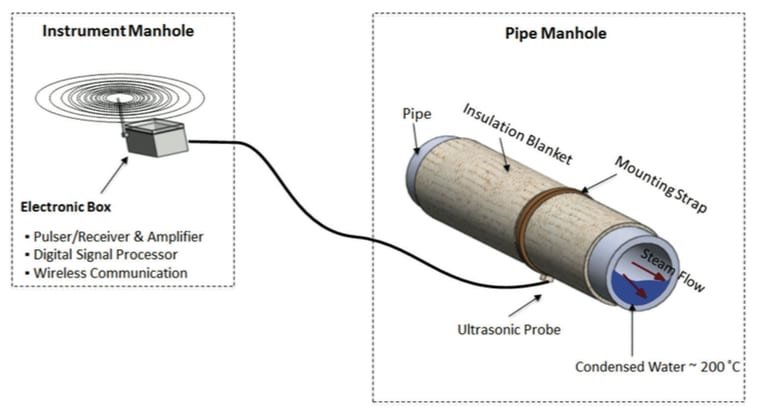
The health monitoring system working at high temperatures >200 °C requires high-performance piezoelectric transducers as the steam pipes involve several issues such as the effect of the pipe curvature that causes ultrasonic wave losses and increased attenuation at high temperatures. These effects greatly reduce the sensitivity, preventing the ultrasound wave from propagating through material media in steam pipe systems.
In order to meet the requirements of high Curie point and high piezoelectric properties, a modified Navy type II (known as PZT5A) was selected because this material family offers a combination of high piezoelectric properties and high Curie temperatures. Based on the preliminary results of tests up to 250 °C, a probe that was developed using a Type II piezoelectric transducer yielded satisfactory bandwidth and sensitivity with high thermal stability.
Although both ceramics showed similar transducer performance below 250 °C, TRS203 ceramics possess higher transition temperature compared to conventional type II ceramics, allowing for sensing over a broader temperature range.
This work was done by Yoseph Bar-Cohen, Xiaoqi Bao, and Stewart Sherrit of Caltech; and Hyeong Jae Lee, Post Doc., for NASA’s Jet Propulsion Laboratory.
In accordance with Public Law 96-517, the contractor has elected to retain title to this invention. Inquiries concerning rights for its commercial use should be addressed to:
Innovative Technology Assets Management
JPL
Mail Stop 321-123
4800 Oak Grove Drive
Pasadena, CA 91109-8099
E-mail: This email address is being protected from spambots. You need JavaScript enabled to view it.
Refer to NPO-49045.
This Brief includes a Technical Support Package (TSP).

High-Temperature Ultrasonic Probe for In-Service Health Monitoring of Steam Pipes
(reference NPO49045) is currently available for download from the TSP library.
Don't have an account?
Overview
The document outlines the development of a High-Temperature Ultrasonic Probe designed for in-service health monitoring of steam pipes, specifically addressing the needs of Consolidated Edison (Con-Edison) in New York City. The probe is a significant advancement in nondestructive evaluation (NDE) technology, capable of operating at temperatures up to 250°C. It utilizes an ultrasonic pulse-echo method to measure the height of water condensation through the wall of steam pipes without compromising their structural integrity.
The motivation behind this invention stems from the lack of reliable commercial probes that can function effectively in high-temperature environments. The technology is a spin-off from prior research and development funded by NASA, which focused on high-temperature ultrasonic devices. The probe's design incorporates a piezoelectric transducer made from materials with high Curie temperatures, allowing it to generate and receive ultrasonic pulses efficiently. The configuration of the probe minimizes power losses by operating as an air-backed system.
The primary problem addressed by this invention is the need for a monitoring system that can provide real-time data on water condensation levels in aging steam pipes, which is crucial for preventing accidents and system failures. The probe is designed to measure condensation height while accounting for factors such as water flow and cavitation, ensuring accurate readings without the need for invasive procedures.
The document also highlights the novelty of the probe, emphasizing its ability to sustain high temperatures and its application in health monitoring systems. The feasibility of the technology has been demonstrated in laboratory settings, showcasing its potential for future applications, including missions to high-temperature environments on other planets, such as Venus.
Overall, this High-Temperature Ultrasonic Probe represents a significant technological advancement in the field of health monitoring for steam systems, with implications for both terrestrial and extraterrestrial applications. The document serves as a technical support package, providing insights into the probe's development, functionality, and potential impact on safety and efficiency in steam pipe systems.











