

An effective, in-service health monitoring system is needed to track water condensation in real time through the walls of steam pipes. The system is required to measure the height of the condensed water from outside the pipe, while operating at temperatures that are as high as 250 °C. The system needs to account for the effects of water flow and cavitation. In addition, it is desired that the system does not require perforating the pipes and thereby reducing the structural integrity.
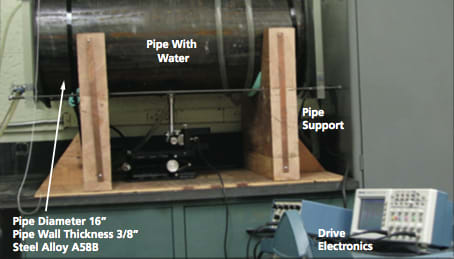
The system performs nondestructive monitoring through the walls of steam pipes, and automatically measures the height of condensed water while operating at the high-temperature conditions of 250 °C. For this purpose, the ultrasonic pulse-echo method is used where the time-of-flight of the wave reflections inside the water are measured, and it is multiplied by the wave velocity to determine the height. The pulse-echo test consists of emitting ultrasonic wave pulses from a piezoelectric transducer and receiving the reflections from the top and bottom of the condensed water. A single transducer is used as a transmitter as well as the receiver of the ultrasonic waves. To obtain high resolution, a broadband transducer is used and the frequency can be in the range of 2.25 to 10 MHz, providing sharp pulses in the time domain allowing for higher resolution in identifying the individual reflections.
The pulse-echo transducer is connected to both the transmitter (function generator), which sends electric signals to generate the elastic wave, and the receiver, which amplifies the attenuated reflected waves that are converted to electric signals. To avoid damage to the receiver, the large signal from the generator is blocked by an electronic switching mechanism from reaching the receiving circuitry. To assure the operation of the transducer at the required temperature range, the piezoelectric transmitter/receiver is selected with a Curie temperature that is much higher. In addition, the system can be improved by introducing a heat sink between the transducer and the steam pipe, reducing the temperature requirements on the transducer.
This work was done by Yoseph Bar-Cohen, Shyh-Shiuh Lih, Mircea Badescu, Xiaoqi Bao, Stewart Sherrit, James S. Scott, Julian O. Blosiu, and Scott E. Widholm of Caltech for NASA’s Jet Propulsion Laboratory.
In accordance with Public Law 96-517, the contractor has elected to retain title to this invention. Inquiries concerning rights for its commercial use should be addressed to:
Innovative Technology Assets Management JPL Mail Stop 202-233 4800 Oak Grove Drive Pasadena, CA 91109-8099 E-mail:
NPO-47518
This Brief includes a Technical Support Package (TSP).

In-Service Monitoring of Steam Pipe Systems at High Temperatures
(reference NPO-47518) is currently available for download from the TSP library.
Don't have an account?
Overview
The document outlines a novel health monitoring system for steam pipes, designed to operate in-service and track the height of condensed water through the pipe wall at high temperatures, specifically up to 250°C. This system addresses the critical need for real-time monitoring in aging steam pipe systems, particularly for Consolidated Edison (ConEd) in New York City, where the risk of accidents and system failures is heightened due to the age and condition of the infrastructure.
The monitoring system utilizes ultrasonic waves in a pulse-echo configuration to acquire data on reflected signals. By processing this data through autocorrelation, the system can accurately determine the height of condensed water while accounting for disturbances such as water flow and cavitation. The use of a high-temperature piezoelectric transducer, which can withstand temperatures above the operational range, is a key feature of the system. This design allows for non-invasive monitoring, preserving the structural integrity of the pipes without the need for perforation.
The document also highlights the potential dangers associated with water hammer, a phenomenon caused by the accumulation of condensed water in horizontal steam pipes. This can lead to significant damage to the piping system, including vents and elbows, due to the high forces generated by the movement of water slugs. The proposed monitoring system aims to mitigate these risks by providing continuous data on water levels, enabling timely interventions.
The feasibility of the system has been demonstrated in laboratory settings, and it is positioned as a spin-off from NASA's research and development efforts on high-temperature ultrasonic devices, which could have applications in extreme environments, such as future missions to Venus.
Overall, the document emphasizes the importance of this monitoring technology for ensuring the safety and reliability of steam pipe systems, which are crucial for heating and power supply in urban environments. The innovative approach combines advanced materials and ultrasonic technology to provide a solution that meets the demands of high-temperature operations while enhancing operational safety.











