

X500/LDAP Directory Replication Utility is a computer program for replicating information between X.500 and LDAP directories. [X.500 is an international standard for on-line directory services. LDAP (Lightweight Directory Access Protocol) is a simple directory access protocol.] The utility can be used to replicate an object of any type from X.500 to LDAP or from LDAP to X.500. The program uses the LDAP version 2 protocol, which is capable of working with both X.500 and LDAP directories. The program can provide any or all of the following services: (1) replicate only modified objects; (2) force replication of all objects; (3) replicate individual objects, one level of objects, or a subtree of objects; (4) filter sets of objects to select ones to be replicated; (5) remove and/or modify object classes from objects that are replicated; and (6) select and/or limit attributes that are replicated. The program includes a separate program that is used to remove objects that are no longer required to be replicated.
This program was written by Thomas Wolfe of Caltech for NASA’s Jet Propulsion Laboratory. For further information, access the Technical Support Package (TSP) free on-line at www.techbriefs.com/tsp under the Software category.
This software is available for commercial licensing. Please contact Don Hart of the California Institute of Technology at (818) 393- 3425. Refer to NPO-30430.
This Brief includes a Technical Support Package (TSP).
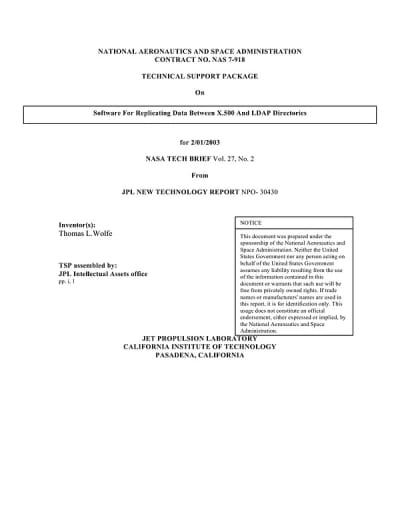
Software for Replicating Data Between X.500 and LDAP Directories
(reference NPO-30430) is currently available for download from the TSP library.
Don't have an account?
Overview
The document outlines a Technical Support Package (TSP) from NASA, specifically detailing software developed for replicating data between X.500 and LDAP directories. This software, created by Thomas L. Wolfe of Caltech for NASA's Jet Propulsion Laboratory, addresses the need for efficient data replication between these two directory services, which utilize incompatible protocols.
The primary motivation for developing this utility stems from the necessity to keep information synchronized across different directory systems. As objects within these directories change, the software ensures that updates are reflected in both X.500 and LDAP directories. The replication utility is designed to be flexible, accommodating various user requirements and differences in directory schemas. It allows for the modification of object classes and attributes during the replication process, ensuring that only relevant data is transferred.
Key features of the replication utility include:
- Selective Replication: The software can replicate only modified objects, force replication of all objects, or target individual objects, one level of objects, or entire subtrees.
- Filtering Capabilities: Users can filter which objects are replicated, allowing for a more tailored data management approach.
- Attribute Management: The utility enables users to select and limit the attributes that are replicated, as well as modify or remove object classes from the replicated objects.
- Bidirectional Replication: It supports replication in both directions, making it versatile for various data management needs.
Additionally, the document mentions a separate removal utility that can eliminate objects that are no longer needed for replication, further enhancing data management efficiency.
The software is available for commercial licensing, and inquiries regarding its use can be directed to the appropriate NASA offices. The document emphasizes that the work was conducted under the auspices of NASA and does not imply any endorsement of specific commercial products.
Overall, this TSP provides a comprehensive overview of a significant software tool that facilitates the integration and management of directory services, addressing a critical need in data replication and synchronization across different systems. For further details, users are encouraged to access the TSP online.







