Inside this issue
Supplements
Overview
The March 2015 edition of NASA Tech Briefs presents a wealth of innovative technologies and research developments across various fields, particularly focusing on imaging technology and photonics. This issue highlights significant advancements, notable projects, and the ongoing evolution of scientific tools that enhance our understanding of the world and beyond.
Key Features and Highlights:
-
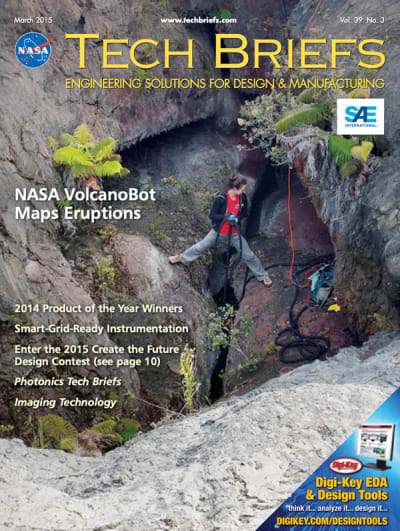
NASA VolcanoBot: One of the standout features of this issue is the introduction of the NASA VolcanoBot, a robotic system designed to map volcanic eruptions. This technology aims to improve safety and efficiency in monitoring volcanic activity, providing critical data that can help predict eruptions and mitigate risks to nearby populations.
-
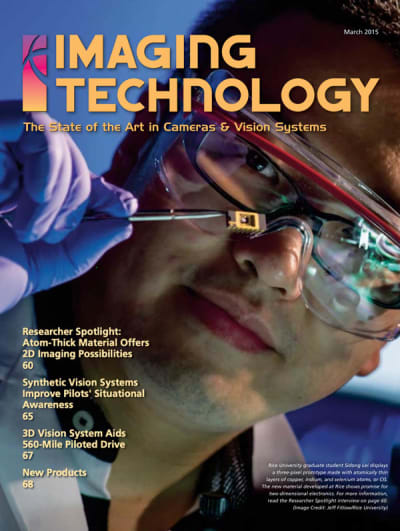
Researcher Spotlight on Atom-Thick Materials: The magazine showcases a groundbreaking development from Rice University, where graduate student Sidong Lei has created a three-pixel prototype using atomically thin layers of copper, indium, and selenium (CIS). This new material holds promise for two-dimensional electronics, potentially revolutionizing the field by enabling smaller, more efficient electronic devices. The spotlight includes an interview with the researcher, providing insights into the implications of this technology for future applications in imaging and electronics.
-
Synthetic Vision Systems: Another significant topic covered is the development of synthetic vision systems that enhance pilots' situational awareness. These systems integrate various data sources to provide a comprehensive view of the environment, improving decision-making and safety during flight operations. The article discusses how these technologies can be integrated into existing aircraft systems and their potential to transform aviation safety.
3D Vision Systems: The issue also features a report on a 3D vision system that successfully aided a 560-mile piloted drive. This technology demonstrates the capabilities of advanced imaging systems in real-world applications, showcasing how they can assist in navigation and enhance the driving experience.
-
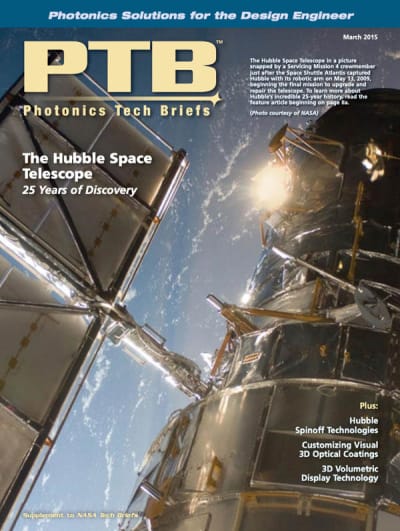
Hubble Space Telescope: Celebrating 25 years of discovery, the Hubble Space Telescope is featured prominently in this issue. The article reflects on Hubble's incredible journey, its contributions to astronomy, and the spinoff technologies that have emerged from its missions. Readers are invited to explore the telescope's legacy and the ongoing research that continues to expand our understanding of the universe.
-
Photonics Solutions for Design Engineers: The magazine includes a section dedicated to photonics solutions tailored for design engineers. This segment discusses the latest advancements in optical technologies, including custom 3D optical coatings and volumetric display technology. These innovations are crucial for various applications, from consumer electronics to advanced scientific instruments.
-
New Products and Innovations: The issue concludes with a roundup of new products that have emerged in the market, showcasing the latest tools and technologies available to engineers and researchers. This section provides a glimpse into the future of engineering and technology, highlighting products that can enhance productivity and innovation.
Conclusion:
The March 2015 edition of NASA Tech Briefs serves as a comprehensive resource for professionals and enthusiasts in the fields of technology, engineering, and science. With its focus on cutting-edge research, innovative products, and significant advancements in imaging and photonics, this issue not only informs but also inspires readers to explore the possibilities that these technologies present. The combination of practical applications, such as the NASA VolcanoBot and synthetic vision systems, alongside groundbreaking research on materials and the legacy of the Hubble Space Telescope, underscores the dynamic nature of technological progress and its impact on our understanding of the world.
Overall, this issue encapsulates the spirit of innovation and discovery that drives the fields of technology and engineering, making it a valuable read for anyone interested in the future of these disciplines.
Features
-
Application Briefs
System Concept Studies Will Aid NASA in Asteroid Redirect Mission
-
Articles
Tech Briefs
-
Physical Sciences
-
Machinery & Automation
Hands-Free Control Interfaces for an Extravehicular Jetpack
Artificial Immune System-Based Approach for Air Combat Maneuvering
Rule-Based Analytic Asset Management for Space Exploration Systems (RAMSES)
-
Manufacturing & Prototyping
Fabrication of Single-Mode, Distributed-Feedback, Interband Cascade Lasers
-
Information Sciences
Post-Flight Analysis Statistical Heating (PFlASH)
Magnetic Sensitivity of a Ka-Band Isolator Measured Using the GRAIL Testbed
Open-Source, Platform-Neutral BLAS Library
JPL Unified Methodology Process (JUMP)
-
Mechanics & Machinery
Design for Improving the Flatness of Solar Sails
Reactionless Drive Tube Sampling Device and Deployment Method
-
Electronics & Computers
Self-Diagnostic Accelerometer Field Programmable Gate Array
Capacitively Coupled, High-Voltage Current Sensing for Extreme Environments
-
Sensors/Data Acquisition
Multivariate Time Series Search Capability to Identify Complex Patterns in Large Datasets
NGDCS Linux Application for Imaging-Spectrometer Data Acquisition and Display
Kepler Community Data Analysis Tools
Detection of Carried and Dropped Objects in Surveillance Video
Signal Processing Software for Remote Vital Sign Monitoring
Visualization of fMRI Network Data
Viewpoints Software for Visualization of Multivariate Data
Controlling Fast Acquisition Hardware to Pre-Position a Satellite to Constrain Baseband Searches
Products
Sponsored
-
Applications
-
Articles
Researcher Spotlight: AtomThick Material Offers 2D Imaging Possibilities
Synthetic Vision Systems Improve Pilots' Situational Awareness
-
Applications