A lightweight reflectarray antenna that would enable simultaneous operation at frequencies near 7.115 GHz and frequencies near 32 GHz is undergoing development. More precisely, what is being developed is a combination of two reflectarray antennas — one for each frequency band — that share the same aperture. (A single reflectarray cannot work in both frequency bands.) The main advantage of the single dual-band reflectarray is that it would weigh less and occupy less space than do two single-band reflectarray antennas.
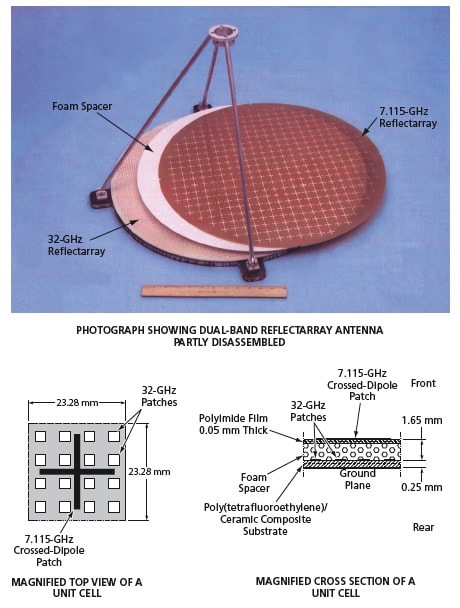
In tests of the prototype antenna, it was found that the front (7.115-GHz reflectarray) caused a 1.8-dB reduction in the 32-GHz gain, while the effect of the rear (32-GHz) reflectarray on the 7.115-GHz performance was negligible. It was also concluded, on the basis of the test data, that there is a need to refine understanding of interactions between the individual reflectarrays and to refine their designs accordingly.
This work was done by Mark Zawadzki and John Huang of Caltech for NASA's Jet Propulsion Laboratory.
This Brief includes a Technical Support Package (TSP).

Lightweight Reflectarray Antenna for 7.115 and 32 GHz
(reference NPO-40689) is currently available for download from the TSP library.
Don't have an account?
Overview
The document discusses the development of a dual-band inflatable reflectarray antenna designed for deep-space communication, specifically operating at X-band (7.115 GHz) and Ka-band (32 GHz) frequencies. This innovation, identified as NPO 40689, addresses the current limitations of existing antennas, which typically operate in a narrow frequency range and cannot efficiently function across both bands simultaneously.
The motivation behind this development stems from the increasing requirements for reliable communication systems in deep-space missions. Traditional reflectarrays, while lightweight and stowable, have struggled with bandwidth limitations, making them unsuitable for dual-band applications. The proposed solution is a dual-band inflatable reflectarray that maintains low mass while effectively operating at both X and Ka bands.
The design features a unique configuration where an X-band crossed-dipole reflectarray is placed above a Ka-band microstrip patch reflectarray. Both components are etched onto thin membranes, with the X-band array on a 2-mil thick Kapton layer and the Ka-band array on a 10-mil thick layer of Roger's RO3003 substrate. A foam spacer, made of 65-mil thick Rohacell 71HF foam, is incorporated between the two layers to simulate the vacuum conditions expected in space.
The crossed-dipole reflectarray is strategically designed to fit in the spaces between the Ka-band patches, ensuring that it does not obstruct the radiation emitted from the Ka-band array. This innovative arrangement allows for efficient operation across both frequency bands without compromising performance.
The document also includes information about the authors, Zawadzki and Huang, and notes that the work was presented at the PIERS 2003 conference in Honolulu, Hawaii. It emphasizes the potential applications of this technology beyond aerospace, suggesting that the advancements in lightweight reflectarray antennas could have broader technological, scientific, and commercial implications.
In summary, the dual-band inflatable reflectarray antenna represents a significant advancement in antenna technology for deep-space communication, offering a lightweight, efficient solution that meets the growing demands of modern space missions. The design's innovative approach to integrating X and Ka-band functionalities positions it as a valuable asset for future aerospace endeavors.