An effort to develop large-aperture, wide-angle-scanning reflectarray antennas for microwave radar and communication systems is underway. In an antenna of this type as envisioned, scanning of the radiated or incident microwave beam would be effected through mechanical rotation of the passive (reflective) patch antenna elements, using microelectro-mechanical systems (MEMS) stepping rotary actuators typified by piezoelectric micromotors. It is anticipated that the cost, mass, and complexity of such an antenna would be less than, and the reliability greater than, those of an electronically scanned phased-array antenna of comparable beam-scanning capability and angular resolution.
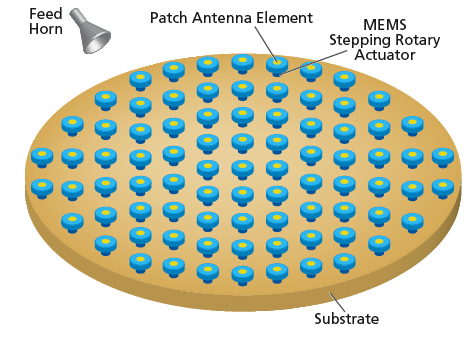
Another reflectarray characteristic, essential to the present development, is that if the patch elements are rotated in unison, then the beam radiated by the antenna can be steered in elevation and azimuth through angular displacements of as much as ±50°. In an antenna of the type under development, the patch elements would be phase-sensitive in the sense mentioned above, would be circularly polarized, and would be mounted on the shafts of MEMS stepping rotary actuators (see figure). The maximum range of element rotation needed for wide-angle beam scanning would be only about ±180°, and scanning could be effected by use of relatively coarse rotational steps.
This work was done by Houfei Fang, John Huang, and Mark W. Thomson of Caltech for NASA’s Jet Propulsion Laboratory.
NPO-45971
This Brief includes a Technical Support Package (TSP).
Wide-Angle-Scanning Reflectarray Antennas Actuated by MEMS
(reference NPO-45971) is currently available for download from the TSP library.
Don't have an account?
Overview
The document discusses the development of Wide-Angle-Scanning Reflectarray Antennas actuated by Micro-Electro-Mechanical Systems (MEMS), identified as NASA Technical Support Package NPO-45971. The primary motivation behind this technology is to create an affordable and currently unavailable capability for wide-angle beam scanning in large-aperture high-frequency RF antennas. This innovation aims to provide a simpler, more reliable, and cost-effective alternative to traditional electronically-scanned arrays (ESAs), which have not met performance expectations for large or high-frequency applications.
The reflectarray technology utilizes passive patch elements arranged in a geometric pattern to efficiently reflect RF signals within a specific bandwidth. By employing MEMS miniature angular stepper actuators beneath these patch elements, the system can actively rotate them in unison. This coordinated movement allows for the steering of re-radiated RF signals in both elevation and azimuth directions, achieving excellent scan performance with a range of ±50º. The required rotation for the elements is approximately ±180º, which can be implemented in relatively coarse steps.
A significant advantage of this technology is its ability to eliminate the need for expensive transmit/receive (T/R) amplifier modules, high-loss phase shifters, and complex beam-formers typically associated with conventional ESAs. As a result, thousands of elements in a large-aperture reflectarray can be manufactured at a significantly lower cost and with higher efficiency. This addresses a long-standing challenge faced by mission planners and designers in the aerospace sector, where physically slewing antennas on spacecraft is impractical for high slew rates.
The document highlights the novelty of combining MEMS actuator technology with reflectarray principles to achieve wide-angle beam scanning. This advancement is particularly relevant for the space community, where the demand for efficient and effective RF communication systems is critical. The research and technology presented in this document are part of NASA's Commercial Technology Program, aimed at making aerospace-related developments accessible for broader technological, scientific, and commercial applications.
For further inquiries or assistance, the document provides contact information for the Innovative Technology Assets Management at JPL, emphasizing the collaborative nature of this research and its potential impact on future aerospace technologies.