

A type of reflectarray antenna now undergoing development is based on the concept of a reflector membrane that is stretched flat by attaching it to an inflatable frame (see figure). Antennas of this type are meant to serve as lightweight, compactly stowable, reliable alternatives to conventional antennas with rigid reflector structures or mechanically deployed mesh reflectors. Originally intended for use aboard spacecraft for microwave communications, these antennas might also prove useful in terrestrial low-power, lightweight microwave systems in cases in which reflector-surface distortions caused by gravitation and wind could be tolerated.
The reflectarray in an antenna of this type is a planar array of microstrip patches printed on a thin circular membrane. An inflatable circular toroidal tube is attached to the edge of the membrane; when inflated, the tube stretches the membrane flat and supports the membrane in the operational configuration. Inflatable tripod tubes attached to the inflatable torus serve as struts to support a feed horn that illuminates the reflectarray. The patches of the reflectarray are shaped and sized to make the reflected electromagnetic field cophasal, so that the antenna operates with high gain.
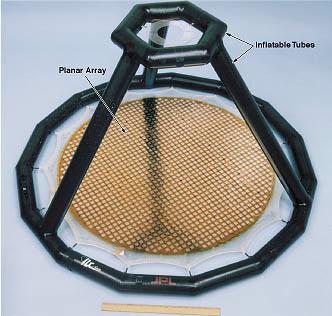
It must be emphasized that surface of an antenna of this type is designed to be flat - in contradistinction to the paraboloidal shape of a conventional antenna reflector. In a previous attempt to deploy an inflatable antenna with a paraboloidal reflector surface, the surface figure deviated from the required paraboloid by far more than the maximum allowable error. In the present case, achievement of the desired precision in the surface figure is not difficult; the desired flatness is readily maintained by stretching the membrane.
A prototype with an overall size of about 1 m, designed for operation in the X band, has been built and tested. The inflatable antenna structure should be mass-producible at low cost.
This work was done by John Huang and Alfonso Feria of Caltech for NASA's Jet Propulsion Laboratory. NPO-20433
This Brief includes a Technical Support Package (TSP).

Inflatable reflectarray antennas
(reference NPO20433) is currently available for download from the TSP library.
Don't have an account?
Overview
The document presents a detailed overview of a one-meter X-band inflatable microstrip reflectarray antenna developed by John Huang and Alfonso Feria at the Jet Propulsion Laboratory (JPL), California Institute of Technology. This innovative antenna is designed for future deep space telecommunication applications and aims to provide a lightweight, compact, and cost-effective solution for high-gain antennas in spacecraft.
The inflatable microstrip reflectarray features a circularly polarized design and consists of three main components: a thin-membrane reflectarray surface, an inflatable feed-strut tripod structure, and a circular inflatable torus that supports the reflectarray surface. The reflectarray surface is made of two layers of thin membranes, with copper patches etched onto a Kapton membrane. These patches are designed to achieve dual linear polarization, allowing the antenna to radiate circular polarization effectively.
Key performance metrics of the antenna include a surface tolerance of ±1.3 mm, a mass of 1.2 kg, a bandwidth of at least 3%, a peak sidelobe level, and a peak cross-polarization of -18 dB, with a radiation efficiency of 37%. The document notes that areas for improvement in radiation efficiency have been identified for future iterations of the design.
The inflatable structure is advantageous because it maintains a flat reflecting surface, which is easier to manage than the curved surfaces of traditional parabolic antennas, especially in the challenging space environment. The inflatable components are made from urethane-coated Kevlar material, and the tubes are pressurized to 5 psi for deployment. To address potential pressure loss due to leakage or other factors, various rigidization techniques are being explored, including hydro-gel materials, epoxy coatings, and stretched aluminum structures.
The document also highlights the broader implications of inflatable antenna technology, suggesting that these antennas could serve not only in space applications but also in terrestrial low-power microwave systems where lightweight and compact designs are beneficial. Overall, the inflatable microstrip reflectarray represents a significant advancement in antenna technology, promising enhanced performance and deployment capabilities for future missions.











