

W-band active phased array antennas have a very small inter-element pitch (≈2 mm). In this innovation, instead of trying to integrate isolators into the unit cell to separate transmit and receive signals, an interlaced triangular grid of metal patch elements has been developed. The isolation between transmit elements and receive elements has been demonstrated to be on the order of 25 dB or more, precluding the need for discrete isolator circuits. Using metal patch technology, the element and associated interconnect loss has been demonstrated to be 0.5 dB at 94 GHz, which represents an efficiency of 89%.
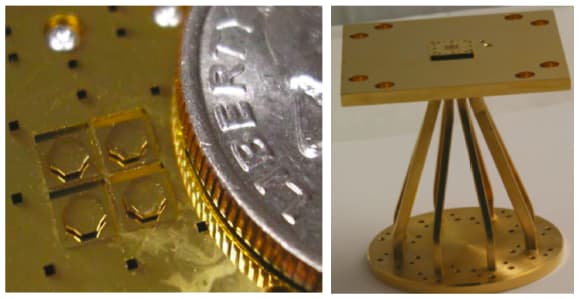
Metal patch elements and interconnects are constructed using PolyStrata®, a wafer-level, multi-layer, micro-fabrication process. Structures up to a millimeter in thickness, with dimensional control on the order of microns across multiple centimeters, are readily fabricated using this technique. Antenna arrays comprising hundreds of elements at W-band can be fabricated using this process. The antenna elements are probe-fed, half-wavelength patches supported on a relatively large cylindrical column at the patch center. This concept is an adaptation of an antenna element originally designed for the Juno microwave radiometer for dual-polarized operation at W-band. There is one probe for each orthogonal polarization, connected to a 50-ohm recta-coax interconnect. The patch elements are recessed in a shallow cavity, which helps to improve isolation. Impedance matching is accomplished by adjusting probe position and by removing material from the corners of the patch. The elimination of dielectric in the construction of the antenna eliminates hysteresis losses and improves tuning accuracy (due to the uncertainty in the dielectric constant). This makes for a highly precise, low-loss antenna element.
A metal patch unit cell prototype was recently developed at JPL for application to a cloud and precipitation scanning radar instrument. The unit cell was designed to interface with a WR10 test-fixture for testing purposes. The unit cell prototype produced measurements that agree very closely to HFSS predictions. The interlacing of elements in a triangular grid for this prototype limits scan angles to less than 16 degrees, which is sufficient for the intended application.
This work was done by Neil F. Chamberlain, Mauricio Sanchez Barbetty, and Gregory A. Sadowy of Caltech for NASA’s Jet Propulsion Laboratory.
In accordance with Public Law 96-517, the contractor has elected to retain title to this invention. Inquiries concerning rights for its commercial use should be addressed to:
Innovative Technology Assets Management
JPL
Mail Stop 321-123
4800 Oak Grove Drive
Pasadena, CA 91109-8099
E-mail: This email address is being protected from spambots. You need JavaScript enabled to view it.
Refer to NPO-49396
This Brief includes a Technical Support Package (TSP).
Dual-Polarized W-Band Metal Patch Antenna Element for Phased Array Applications
(reference NPO-49396) is currently available for download from the TSP library.
Don't have an account?
Overview
The document is a Technical Support Package from NASA's Jet Propulsion Laboratory (JPL) detailing the development and performance of a Dual-Polarized W-Band Metal Patch Antenna Element designed for phased array applications. This antenna technology is particularly relevant for high-frequency applications, such as those used in space exploration and remote sensing.
The document outlines the inherent advantages of the metal patch design, which eliminates the need for dielectric materials, thereby enhancing tuning accuracy and reducing loss performance. The W-band antennas, operating at 94 GHz, were developed for a future cloud precipitation radar instrument and demonstrate impressive specifications, including frequency accuracy better than 0.25% and low insertion loss of less than 0.6 dB. Additionally, the same polarization isolation exceeds 26 dB, which negates the requirement for isolator circuits and facilitates electronic scanning capabilities.
The document also references several key publications and presentations by Neil Chamberlain and colleagues, highlighting their contributions to the field through various conferences and technical briefs. Notable works include studies on the Juno Microwave Radiometer's patch array antennas, which were instrumental in measuring radiation from the galactic plane shortly after the Juno spacecraft's launch in 2011.
Furthermore, the document mentions the patent assignments related to the metal patch antenna technology, including Patent No. 8,169,371 assigned to NASA in May 2012 and a provisional patent application filed by Caltech in March 2014. These patents underscore the innovative nature of the technology and its potential applications in aerospace and beyond.
The Technical Support Package serves as a resource for understanding the advancements in antenna technology developed under NASA's Commercial Technology Program, aimed at making aerospace-related developments accessible for broader technological, scientific, and commercial applications. It emphasizes the collaborative efforts of researchers at JPL and Caltech, showcasing their commitment to pushing the boundaries of aerospace technology.
Overall, this document encapsulates the significant strides made in the design and application of metal patch antennas, highlighting their relevance in modern aerospace systems and their potential for future innovations.











