

LiCoPO4 has been found to be a promising active cathode material for high-energy-density, thin-film, rechargeable electrochemical power cells. The potential of the charge/discharge plateau of a cell containing an LiCoPO4 cathode is 4.8 V — a value that compares favorably with the corresponding value of 3.8 V of a state-of-the art cell containing an LiCoO2 cathode.
In preparation for tests to determine the viability of LiCoPO4 as a cathode material, all-solid-state thin-film cells containing LiCoPO4 thin-film cathodes were fabricated on single-crystal silicon substrates coated with silicon nitride. All of the cell layers except the anode were deposited in a planar, three-target, radio-frequency magnetron sputtering chamber that was evacuated to a base pressure of less than 2 × 10⁻⁶ torr (≈2.7 × 10⁻⁴ Pa) by use of a turbomolecular pumping system.

In each cell, the first deposited layer was a Ti adhesion layer followed by a Pt current collector, both patterned by use of a shadow mask. Next, the active cathode layer was formed by sputtering LiCoPO4 onto the cathode current collector from an LiCoPO4 target that had been prepared in a subprocess that included heating of a stoichiometric mixture of Co3O4, (NH4)2HPO4, and Li2CO3 powders. In some cases, the workpieces were heated to various temperatures in air to anneal the LiCoPO4. Next, a solid electrolyte film of Li3.3PO3.8N0.22 (“Lipon”) was deposited onto the cathode layer by sputtering from a Li3PO4 target in N2. Finally, a lithium metal anode layer was thermally evaporated onto the electrolyte through a second shadow mask to complete the cell.
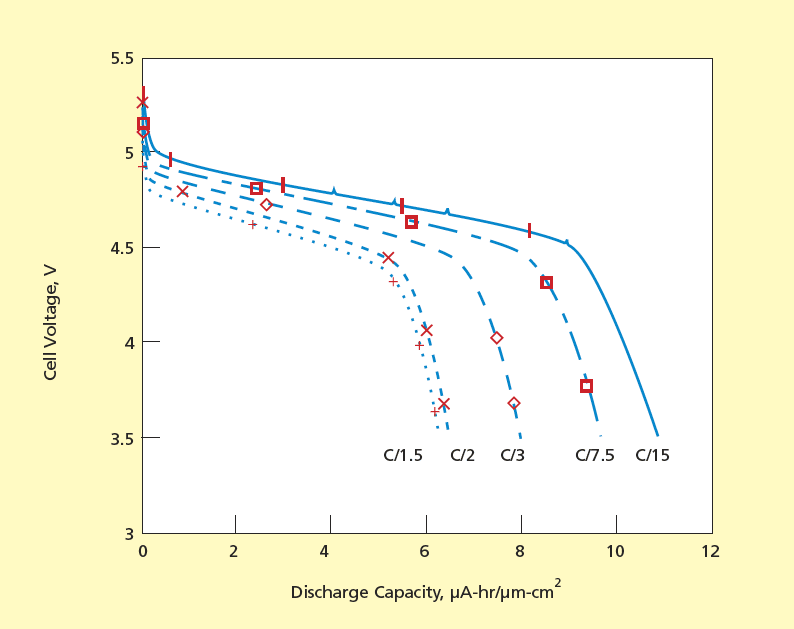
Thin-film batteries with LiCoPO4 cathodes that were annealed for one hour at 700 °C had dramatically improved performance compared with unannealed cathode cells with single high-voltage charge/discharge plateau at about 4.8 V (see Figure 1). The cell capacity at C/15 (where C is the current expressed in multiples of the rated capacity of the battery) was measured to be 11 μA·h/μm·cm2, based on an active cell area of 0.48 cm2 and a cathode thickness of 0.285 μm prior to annealing. A weak relationship is found between cell voltage and discharge current rate (see Figure 2). The thin-film cells employing the LiCoPO4 cathodes are capable of multiple charge/discharge cycles, and have no significant capacity fade with cycling over at least the first few tens of cycles. Further cycle life studies are currently underway to better estimate the capacity fade with cycling.
In accordance with Public Law 96-517, the contractor has elected to retain title to this invention. Inquiries concerning rights for its commercial use should be addressed to
Innovative Technology Assets Management
JPL
Mail Stop 202-233
4800 Oak Grove Drive
Pasadena, CA 91109-8099
(818) 354-2240
E-mail: This email address is being protected from spambots. You need JavaScript enabled to view it.
Refer to NPO-40117, volume and number of this NASA Tech Briefs issue, and the page number.
This Brief includes a Technical Support Package (TSP).
LiCoPO4 Cathode Layers for Thin-Film Batteries
(reference NPO-40117) is currently available for download from the TSP library.
Don't have an account?
Overview
The document discusses the development and fabrication of thin-film batteries utilizing LiCoPO₄ (lithium cobalt phosphate) as a cathode material, highlighting its advantages over traditional battery technologies. Thin-film batteries are distinct from conventional batteries in that their performance metrics focus more on energy per unit area rather than gravimetric and volumetric energy densities. This is crucial because the mass and volume of the substrate and encapsulation layers can significantly exceed those of the active battery materials.
The document outlines the fabrication process of LiCoPO₄ layers, which involves sputtering techniques and thermal treatments. The LiCoPO₄ target is created by mixing and heating specific stoichiometric amounts of cobalt oxide, ammonium phosphate, and lithium carbonate, followed by a series of grinding and heating steps to achieve the desired material properties. The resulting powder is then processed into a pellet form, which is subsequently mounted onto an aluminum backing plate.
One of the key innovations reported is the successful fabrication of thin-film batteries that exhibit a high voltage charge/discharge plateau of 4.8V, significantly higher than the 3.8V plateau of state-of-the-art LiCoO₂ cathodes. This enhanced voltage capability is attributed to the unique properties of LiCoPO₄, making it a promising candidate for next-generation battery applications.
The document also addresses the challenges associated with preparing RF magnetron sputtered ceramic films, particularly those containing polyanions like LiCoPO₄. It notes that while sputtering can produce thin films at an atomic level, the process can lead to issues such as disproportionation of sputtered species due to varying sputter yields.
Overall, the research emphasizes the potential of LiCoPO₄ as a high-performance cathode material for thin-film batteries, capable of multiple charge/discharge cycles and offering improved energy density. The findings are positioned within the broader context of advancing battery technologies, with implications for various applications beyond aerospace, including consumer electronics and electric vehicles. The document serves as a technical support package under NASA's Commercial Technology Program, aiming to disseminate aerospace-related developments with wider technological and commercial relevance.







