MoO3 has shown promise as a cathode material that can extend the upper limit of operating temperature of rechargeable lithium thin-film electrochemical cells. Cells of this type are undergoing development for use as energy sources in cellular telephones, wireless medical sensors, and other, similarly sized portable electronic products. The LiCoO2 and LiMn2O4 cathodes heretofore used in these cells exhibit outstanding cycle lives (of the order of hundreds of thousands of cycles) at room temperature, but operation at higher temperatures reduces their cycle lives substantially: for example, at a temperature of 150 °C, cells containing LiCoO2 cathodes lose half their capacities in 100 charge/discharge cycles.
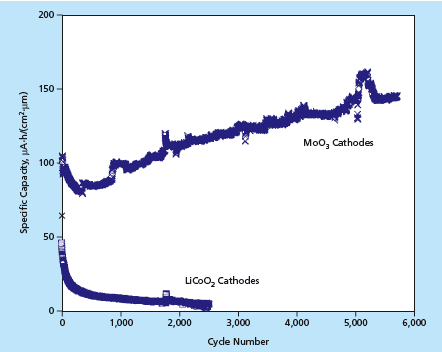
The superiority of MoO3 as a cathode material was demonstrated in experiments on lithium thin-film cells fabricated on glass slides. Each cell included a layer of Ti (for adhesion to the glass slide), a patterned layer of Pt that served as a cathode current collector, a cathode layer of MoO3, a solid electrolyte layer of Li3.3PO3.8N0.22 (“LiPON”), and an anode layer of Li. All the layers were deposited by magnetron sputtering except for the Li layer, which was deposited by thermal evaporation.
These cells, along with similar ones containing LiCoO2 cathodes, were subjected to several tests, including measurements of specific capacity in charge/discharge cycling at a temperature of 150 °C. The results of these measurements, plotted in the figure, showed that whereas specific capacity of the cells containing LiCoO2 cathodes faded to about half its initial value after only 100 cycles, the specific capacity of the cells containing the MoO3 cathodes faded only slightly during the first few hundred cycles and thereafter not only recovered to its initial value but continued to increase up to at least 5,500 cycles.
This work was done by William West and Jay Whitacre of Caltech for NASA’s Jet Propulsion Laboratory. For more information, download the Technical Support Package (free white paper) at www.techbriefs.com/tsp under the Materials category.
In accordance with Public Law 96-517, the contractor has elected to retain title to this invention. Inquiries concerning rights for its commercial use should be addressed to:
Innovative Technology Assets Management
JPL
Mail Stop 202-233
4800 Oak Grove Drive
Pasadena, CA 91109-8099
(818) 354-2240
E-mail: This email address is being protected from spambots. You need JavaScript enabled to view it.
Refer to NPO-41099, volume and number of this NASA Tech Briefs issue, and the page number.
This Brief includes a Technical Support Package (TSP).
MoO3 Cathodes for High-Temperature Lithium Thin-Film Cells
(reference NPO-41099) is currently available for download from the TSP library.
Don't have an account?
Overview
The document is a Technical Support Package from NASA's Jet Propulsion Laboratory (JPL) concerning MoO₃ (Molybdenum Trioxide) cathodes for high-temperature lithium thin-film cells, identified by NTR Number 41099. It is part of NASA Tech Briefs, which disseminate aerospace-related technological advancements with potential broader applications in various fields.
The focus of this document is on the development of long cycle life elevated temperature thin-film batteries, which are crucial for applications that require reliable energy storage under extreme conditions. These batteries are particularly relevant for space missions and other environments where traditional battery technologies may fail due to high temperatures or prolonged use.
The document emphasizes the innovative aspects of using MoO₃ as a cathode material, which can enhance the performance and longevity of lithium thin-film batteries. The use of such materials is part of NASA's broader initiative to explore and develop technologies that can support future aerospace missions while also having commercial viability.
Additionally, the Technical Support Package provides contact information for further inquiries, specifically directing interested parties to the Innovative Technology Assets Management office at JPL. This office can provide additional insights and assistance regarding the research and technology discussed in the document.
The document also includes a disclaimer stating that the information is provided under the Commercial Technology Program of NASA and that the U.S. Government does not assume liability for the use of this information. It clarifies that any mention of trade names or manufacturers is for identification purposes only and does not imply official endorsement by NASA.
In summary, this Technical Support Package outlines significant advancements in battery technology through the use of MoO₃ cathodes, highlighting their potential for high-temperature applications and long cycle life. It serves as a resource for those interested in the intersection of aerospace technology and commercial applications, encouraging further exploration and collaboration in this innovative field.