Two-dimensional active-pixel-spectral lidar (TAPSL) is a proposed remote-sensing technique for obtaining spatially, spectrally, and temporally resolved information about terrain or other targets. Operating aboard an airborne or spaceborne platform above the Earth or a remote planet, a TAPSL system would be used to gather data on geological, biological, and chemical phenomena that manifest themselves through characteristic optical emission spectra.
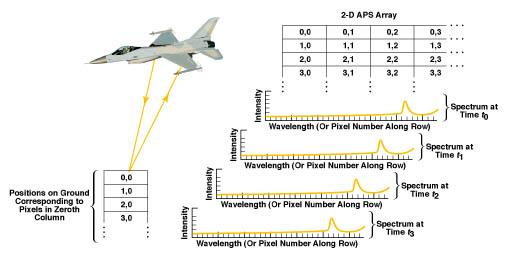
A TAPSL system would include a single-frequency laser that would illuminate a target. The light returning from the target would include an elastically scattered component (the spectral component at the original laser frequency) that could be used for ranging as in conventional lidar. The return would also include inelastically scattered (Raman-shifted and fluorescent) spectral components that would be characteristic of the target material in response to excitation by the laser.
The light returning from the target would be detected by a rectangular array of active-pixel sensors (APSs) that would be sensitive to visible and near-infrared light. The APS would operate in conjunction with miniaturized electronic control, readout, and pixel-data-processing circuits. Before impinging on the APS array, the light would pass through a diffraction grating oriented to disperse the light along the rows of pixels. Consequently, the frequency or wavelength of the light received by each pixel could be identified from the position of the pixel along its row (see figure). Optionally, the system could be operated without the laser to obtain the reflected-sunlight spectrum and/or the thermal spectrum of the target.
As described thus far, the system would derive information about the relative position of the target in the manner of conventional lidar. However, if a lens were used to image the target scene onto the APS, then the position of each pixel along a column could be used to obtain spatial resolution along the corresponding axis on the target; this approach could be useful if the laser beam did not provide sufficient resolution, or if it were desired to scan the terrain in "pushbroom" fashion. Alternatively, it might be possible to vary the time gate of each pixel with position along each column to obtain additional resolution for ranging or spectral analysis.
This work was done by Quiesup Kim of Caltech for NASA's Jet Propulsion Laboratory.
NPO-20737.
This Brief includes a Technical Support Package (TSP).
Two-Dimensional Active-Pixel Spectral Lidar
(reference NPO20737) is currently available for download from the TSP library.
Don't have an account?
Overview
The document outlines the Two-Dimensional Active-Pixel Spectral Lidar (TAPSL) project, led by Principal Investigator Quiesup Kim at NASA's Jet Propulsion Laboratory (JPL). TAPSL is designed to measure the dynamics of geological, biological, and chemical phenomena on Earth and in space by analyzing their characteristic optical emission spectra. This innovative system employs a single-frequency laser in conjunction with advanced optical techniques to classify materials through Raman and fluorescence spectroscopy.
The TAPSL concept aims to create a non-destructive analytical tool capable of identifying molecular species, particularly biomarker compounds, which are crucial for various scientific investigations. The technology is expected to enhance the capabilities of intelligent robotic operations, allowing for more sophisticated data collection and analysis in diverse environments.
The document also describes the test bed for TAPSL, which will be housed at JPL for baseline research. JPL will provide the necessary active matrix detectors and other signal components to integrate into the test bed after thorough testing of the subsystems. This collaborative effort aims to ensure that the TAPSL system is robust and effective for its intended applications.
Additionally, the document includes a disclaimer stating that references to specific commercial products or services do not imply endorsement by the U.S. Government or NASA. It emphasizes that the work was conducted under a contract with NASA and outlines the limitations of liability regarding the information presented.
Overall, TAPSL represents a significant advancement in remote sensing technology, with the potential to improve our understanding of various phenomena through detailed spectral analysis. The project aligns with future NASA missions, particularly those focused on the search for life, and highlights the importance of innovative technologies in expanding our scientific knowledge and capabilities.