

The figure depicts an example of a proposed type of optoelectronic oscillator (OEO) based on some of the same principles as those described in the preceding article. In the proposed OEOs as in the OEOs of the preceding article, transparent (e.g., glass) microspheres that exhibit "whispering-gallery" electromagnetic modes at the laser wavelengths of the oscillators would be utilized as high-Q (where Q is the resonance quality factor and is the measure of energy storage time) resonator/delay elements in the oscillator feedback loops.
The microspheres, which have submillimeter diameters, would replace the fiber-optic delay lines that have been used in previously developed OEOs. A typical fiber-optic delay line is of the order of 1 km long and is wound on a spool about 3 cm in diameter and 5 cm long. The proposed OEOs could readily be miniaturized because, in the absence of the bulky fiber-optic delay lines, all of their otherwise microscopic optical and electronic components could be integrated on single chips.
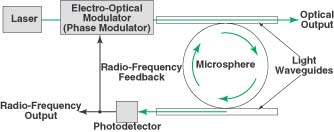
In a microsphere, propagation in a long fiber is replaced by equivalent circulation of light by total internal reflection in "whispering-gallery" modes. This light propagates in equatorial planes near the surface. It has been demonstrated experimentally that Q ≈ 1010 can be achieved in a glass microsphere, limited only by absorption of light in the glass.
In the OEO shown in the figure, the microsphere would be incorporated into the oscillator feedback loop via evanescent-wave coupling with optical waveguides. In one operational scenario, light from the output of a phase modulator would be coupled into the microsphere to excite two modes, corresponding to a carrier signal and a sideband; it would be possible to do this because deviations from perfect sphericity would create modes with a frequency difference falling in the microwave range. The beat note between the two modes would appear at the output of the photodetector and would constitute the desired microwave signal. Some of the beat-note power would be fed back to the modulator to sustain the oscillation.
This work was done by Lute Maleki, Steve Yao, and Vladimir Iltchenko of Caltech for NASA's Jet Propulsion Laboratory.
In accordance with Public Law 96-517, the contractor has elected to retain title to this invention. Inquiries concerning rights for its commercial use should be addressed to
Intellectual Property group
JPL
Mail Stop 202-233
4800 Oak Grove Drive
Pasadena, CA 91109
(818) 354-2240
Refer to NPO-20592
This Brief includes a Technical Support Package (TSP).
Miniature Optoelectronic Oscillators Based on Microspheres
(reference NPO20592) is currently available for download from the TSP library.
Don't have an account?
Overview
The document is a NASA Technical Support Package detailing research on miniature optoelectronic oscillators based on microspheres, prepared under contract NAS 7−918. Authored by Lutfollah Maleki, Vladimir S. Iltchenko, and Xiaotian Steve Yao, the report highlights innovative advancements in the field of optoelectronics, specifically focusing on the use of microspheres to create highly efficient oscillators.
The primary problem addressed in the document is the limitations of traditional fiber-optic delay lines in oscillator design. The proposed solution involves utilizing tiny glass microspheres that exploit "whispering-gallery" modes, where light travels along the surface of the sphere, allowing for high-quality resonance and efficient light propagation. This method offers significant advantages in terms of size reduction and performance enhancement compared to conventional technologies.
The report emphasizes the novelty of this approach, showcasing how microspheres can lead to the development of compact and high-performance optoelectronic devices. The potential applications of these miniature oscillators are vast, ranging from telecommunications to advanced sensing technologies, where size and efficiency are critical.
Additionally, the document includes a disclaimer stating that references to specific commercial products or manufacturers do not imply endorsement by the United States Government or the Jet Propulsion Laboratory (JPL). It also clarifies that the work was conducted at JPL under NASA's sponsorship, ensuring that the research aligns with governmental standards and objectives.
Overall, this technical brief serves as a foundational document for understanding the advancements in miniature optoelectronic oscillators, providing insights into the research's significance, methodology, and potential impact on future technologies. The findings could pave the way for new innovations in the integration of optical and electronic systems, ultimately contributing to the evolution of high-tech applications in various fields.











