

A proposed electro-optical image-processing system would enable remote viewing of an object through a multimode optical fiber, as though the fiber were a conventional image-transmitting optic like a lens or prism. Ordinarily, it would be impractical to use a multimode optical fiber as an imaging probe or imaging optic because image information would become distorted (scrambled) during propagation along the fiber. The proposed system would provide compensation for this scrambling. Fiber-optic imaging probes of this type could be made very thin and could be particularly useful as minimally invasive probes in medical diagnosis.
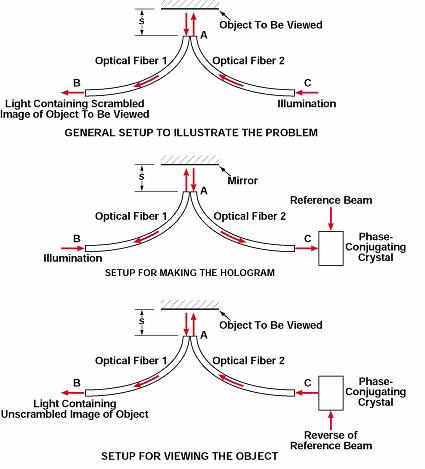
The system (see figure) would include two multimode optical fibers, which would be terminated side by side at one end (point A) facing the object that one seeks to view. The tips of the fibers would lie at a short distance,s, from the object. A source of light at point C would illuminate the object via fiber 2. An observer at point B would attempt to view the illuminated object through fiber 1. The problem is to predistort the illumination (prescramble the amplitudes and phases of the fiber-optic waveguide modes of the illuminating electromagnetic field) in such a way as to compensate for the scrambling that occurs during transmission of the image along fiber 1 from point A to point B, so that the image of the object would arrive unscrambled at point B.
The solution would involve the generation and use of a hologram in a phase-conjugating crystal at point C. First, a flat mirror would be placed facing the tips of the optical fibers, where the object would later be placed for viewing. A source of light would be placed at point A (where the observer would later be stationed). Light from this source would travel through fiber 1 to point A, where it would be reflected into fiber 2. Upon emerging from fiber 2 at point C, the light would enter the crystal. At the same time, the crystal would be illuminated with a reference (plane-wave) beam of light. Interference between the reference beam and the light emerging from fiber 2 would produce the desired hologram, which would encode the information about scrambling in both fibers 1 and 2.
Once the hologram had been generated, one could exploit the phase-conjugation principle to reverse the propagation of the optical signal and thus reverse scrambling. The crystal would be illuminated with the phase conjugate of the reference beam (in essence, a beam of the same wavelength propagating along the reverse of the path of the reference beam); this would cause reverse-propagation with unscrambling of light from point C back to point A, then back to point B. If the mirror were replaced by the object to be viewed, then the reverse-propagating light would illuminate the object and the image of the object would spatially modulate the reverse-propagating beam, such that an undistorted image of the object would appear at the completion of reverse propagation and unscrambling at point B.
This work was done by Deborah Jackson of Caltech for NASA's Jet Propulsion Laboratory. For further information, access the Technical Support Package (TSP) free on-line at www.techbriefs.com under the Physical Sciences category, or circle no. 177 on the TSP Order Card in this issue to receive a copy by mail ($5 charge).
NPO-19671
This Brief includes a Technical Support Package (TSP).
Multimode Optical Fiber as Imaging Probe
(reference NPO19671) is currently available for download from the TSP library.
Don't have an account?
Overview
The document presents a technical support package from NASA, specifically from the Jet Propulsion Laboratory (JPL), detailing advancements in the use of multimode optical fibers as imaging probes. The primary focus is on a novel electro-optical image-processing system that enables remote viewing of objects through these fibers, addressing the common issue of image distortion that occurs during transmission.
Traditionally, multimode optical fibers have been impractical for imaging applications due to modal dispersion, which scrambles the optical phases and distorts the transmitted image. This document outlines a solution to this problem, allowing for all-optical two-dimensional image transmission from one point to another over a single multimode fiber. The proposed system involves calibrating the optical path phase scrambling using a phase conjugate crystal, which helps to create a predistorted beam that negates the effects of the fiber's modal dispersion.
The significance of this technology lies in its potential applications across various fields, including communications, optical interconnections, and medical diagnostics. The ability to transmit clear images through fibers could facilitate remote imaging in challenging environments, such as small spaces or during planetary exploration. It could also enhance surgical procedures by providing real-time in vivo diagnostics and long-term monitoring of physiological conditions.
The document highlights the importance of this technology for remote imaging applications, emphasizing its utility in scenarios where direct access to the imaging site is limited. For instance, it could be used in robotic optical imaging sensors for planetary surface exploration or for inspections in aging aircraft, allowing for more frequent and less invasive evaluations.
In summary, this NASA technical support package outlines a promising advancement in optical fiber technology that could transform imaging capabilities in various sectors. By overcoming the limitations of multimode fibers, this system opens new avenues for remote viewing and diagnostics, making it a significant contribution to the field of optical imaging.











