

Thermally actuated hydraulic pumps have been proposed for diverse applications in which direct electrical or mechanical actuation is undesirable and the relative slowness of thermal actuation can be tolerated. The proposed pumps would not contain any sliding (wearing) parts in their compressors and, hence, could have long operational lifetimes.
The basic principle of a pump according to the proposal is to utilize the thermal expansion and contraction of a wax or other phase-change material in contact with a hydraulic fluid in a rigid chamber. Heating the chamber and its contents from below to above the melting temperature of the phase-change material would cause the material to expand significantly, thus causing a substantial increase in hydraulic pressure and/or a substantial displacement of hydraulic fluid out of the chamber. Similarly, cooling the chamber and its contents from above to below the melting temperature of the phase-change material would cause the material to contract significantly, thus causing a substantial decrease in hydraulic pressure and/or a substantial displacement of hydraulic fluid into the chamber. The displacement of the hydraulic fluid could be used to drive a piston.
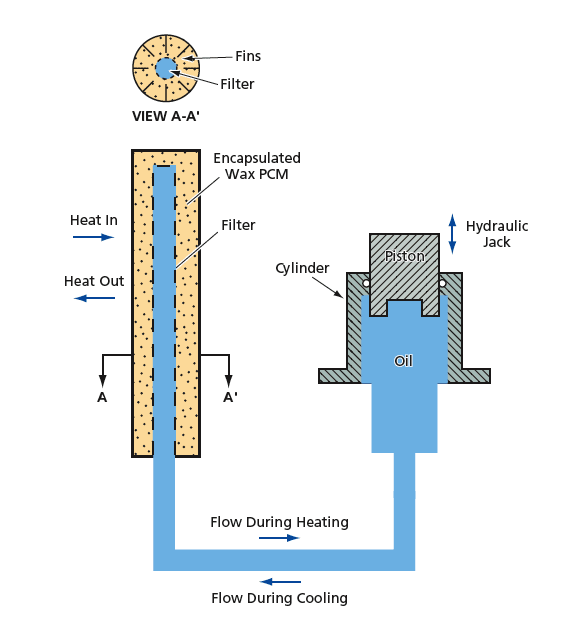
The figure illustrates a simple example of a hydraulic jack driven by a thermally actuated hydraulic pump. The pump chamber would be a cylinder containing encapsulated wax pellets and containing radial fins to facilitate transfer of heat to and from the wax.
The plastic encapsulation would serve as an oil/wax barrier and the remaining interior space could be filled with hydraulic oil. A filter would retain the encapsulated wax particles in the pump chamber while allowing the hydraulic oil to flow into and out of the chamber.
In one important class of potential applications, thermally actuated hydraulic pumps, exploiting vertical ocean temperature gradients for heating and cooling as needed, would be used to vary hydraulic pressures to control buoyancy in undersea research vessels. Heretofore, electrically actuated hydraulic pumps have been used for this purpose. By eliminating the demand for electrical energy for pumping, the use of the thermally actuated hydraulic pumps could prolong the intervals between battery charges, thus making it possible to greatly increase the durations of undersea exploratory missions.
This work was done by Jack Jones, Ronald Ross, and Yi Chao of Caltech for NASA's Jet Propulsion Laboratory.
In accordance with Public Law 96-517, the contractor has elected to retain title to this invention. Inquiries concerning rights for its commercial use should be addressed to:
Innovative Technology Assets Management
JPL
Mail Stop 202-233
4800 Oak Grove Drive
Pasadena, CA 91109-8099
(818) 354-2240
E-mail: This email address is being protected from spambots. You need JavaScript enabled to view it.
Refer to NPO-40844, volume and number of this NASA Tech Briefs issue, and the page number.
This Brief includes a Technical Support Package (TSP).
Thermally Actuated Hydraulic Pumps
(reference NPO-40844) is currently available for download from the TSP library.
Don't have an account?
Overview
The document is a Technical Support Package from NASA's Jet Propulsion Laboratory (JPL) detailing the development of thermally actuated hydraulic pumps, specifically under the reference NPO-40844. It addresses the limitations of traditional electrical hydraulic pumps used in ocean subsurface sea gliders, which typically operate for only 2-4 weeks and cover about 1000 km before requiring battery recharging. The document outlines the challenges faced in creating a thermally powered glider capable of operating for up to 5 years and covering 40,000 km, noting that previous attempts have been unsuccessful.
The proposed solution involves utilizing thermal differences in the ocean to manipulate a phase change material (PCM), specifically wax, which expands when heated and contracts when cooled. This expansion and contraction can pressurize a hydraulic fluid, enabling the control of buoyancy in underwater vessels. The wax is encapsulated in flexible plastic tubes and separated from the hydraulic fluid by a membrane to prevent contamination. When the PCM melts due to heat, it expands and forces hydraulic fluid into a hydraulic jack, allowing the vessel to descend. Conversely, when cooled, the PCM shrinks, pulling hydraulic fluid back and enabling ascent.
The document emphasizes the novelty of this approach, as it eliminates the need for electrical power or mechanical components, which are common in conventional hydraulic systems. The heat-powered hydraulic pump operates without moving parts in the compressor, reducing wear and maintenance issues. This innovative design aims to enhance the operational efficiency and longevity of underwater research vehicles, making them more viable for long-term oceanographic studies.
Additionally, the document provides contact information for further inquiries and emphasizes that the information is part of NASA's Commercial Technology Program, aimed at disseminating aerospace-related developments with broader technological applications. It also includes a disclaimer regarding the use of the information and the absence of liability from the U.S. Government.
In summary, the document presents a promising advancement in hydraulic pump technology that could significantly improve the capabilities of underwater research vehicles, addressing critical challenges in ocean exploration and data collection.











