A proposed system for exploiting the ocean thermal gradient to generate power would be based on the thawing-expansion/ freezing-contraction behavior of a wax or perhaps another suitable phase-change material. The power generated by this system would be used to recharge the batteries in a battery-powered unmanned underwater vehicle [UUV (essentially, a small exploratory submarine robot)] of a type that has been deployed in large numbers in research pertaining to global warming. A UUV of this type travels between the ocean surface and various depths, measuring temperature and salinity.
This proposed system would be an alternative to another proposed ocean thermal energy conversion (OTEC) system that would serve the same purpose but would utilize a thermodynamic cycle in which CO2 would be the working fluid. That system is described in “Utilizing Ocean Thermal Energy in a Submarine Robot” (NPO-43304), immediately following this brief. The main advantage of this proposed system over the one using CO2 is that it could derive a useful amount of energy from a significantly smaller temperature difference.
At one phase of its operational cycle, the system now proposed would utilize the surface ocean temperature (which lies between 15 and 20 °C over most of the Earth) to melt a wax (e.g., pentadecane) that has a melting/freezing temperature of about 10 °C. At the opposite phase of its operational cycle, the system would utilize the lower ocean temperature at depth (e.g., between 4 and 7 °C at a depth of 300 m) to freeze the wax. The melting or freezing causes the wax to expand or contract, respectively, by about 8 volume percent.
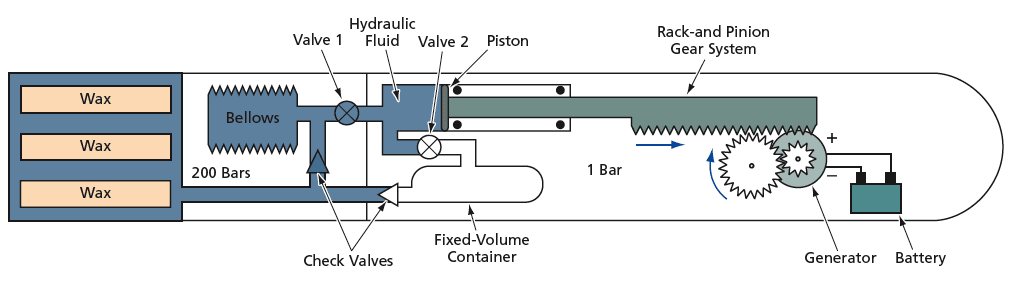
The operational cycle is best described by reference to the figure. The wax would be contained in tubes that would be capable of expanding and contracting with the wax. The wax-containing tubes would be immersed in a hydraulic fluid. Near the ocean surface, the expansion of the wax upon heating to >10 °C would push hydraulic fluid into a bellows in a chamber pressurized to about 200 bars (about 20 MPa). Valve 1 would then be opened, allowing the pressurized hydraulic fluid to push against a piston that, in turn, would push a rack-and-pinion gear system to spin a generator to charge a battery. Next, valve 2 would be opened, allowing the hydraulic fluid to drain into a fixed-volume container. Later, upon cooling to <10 °C at depth, the contraction of the wax upon freezing would cause hydraulic fluid to flow from the fixed-volume chamber into the chamber containing the wax tubes, thus completing the cycle.
This work was done by Jack Jones and Yi Chao of Caltech for NASA’s Jet Propulsion Laboratory.
In accordance with Public Law 96-517, the contractor has elected to retain title to this invention. Inquiries concerning rights for its commercial use should be addressed to:
Innovative Technology Assets
Management
JPL
Mail Stop 202-233
4800 Oak Grove Drive
Pasadena, CA 91109-8099
(818) 354-2240
E-mail: This email address is being protected from spambots. You need JavaScript enabled to view it.
Refer to NPO-43500, volume and number of this NASA Tech Briefs issue, and the page number.
This Brief includes a Technical Support Package (TSP).
Alternative OTEC Scheme for a Submarine Robot
(reference NPO-43500) is currently available for download from the TSP library.
Don't have an account?
Overview
The document titled "TSP for NPO 43500: Phase Change Material Thermal Power Generator" from NASA's Jet Propulsion Laboratory discusses an innovative approach to harnessing ocean thermal energy for power generation, specifically aimed at recharging batteries for Unmanned Underwater Vehicles (UUVs). The primary challenge addressed is the significant temperature difference between warmer surface ocean waters (approximately 15-20 °C) and colder deep waters (around 4-7 °C), which can be utilized to generate electricity.
The document outlines various Ocean Thermal Energy Conversion (OTEC) systems, including both open and closed cycle designs that typically use working fluids like ammonia or CO2. A notable focus is on a phase change material (PCM) thermal power generator that operates without a turbine expander, allowing it to function effectively even with smaller temperature differentials. This is particularly relevant as traditional CO2 power cycles require a minimum temperature difference of about 15 °C for efficient operation.
The proposed solution involves using a wax, such as pentadecane, which melts at 10 °C. By leveraging the warmer upper ocean temperatures, the wax can be melted, causing it to expand and push hydraulic fluid into a piston connected to a power turbine generator. When the fluid is cooled below 10 °C, the wax freezes and contracts, allowing the hydraulic fluid to return to its original chamber, thus completing the cycle. This mechanism can generate power efficiently with ocean temperatures as low as 12 °C.
The document also highlights the novelty of this approach, as current UUVs rely on batteries for propulsion and can only operate underwater for limited durations. The PCM thermal power generator could significantly extend the operational time of UUVs by providing a sustainable energy source, enabling them to remain submerged for longer periods without the need for frequent recharging.
In summary, the document presents a promising alternative OTEC scheme that utilizes phase change materials to generate power from ocean temperature differences, potentially revolutionizing energy generation for underwater vehicles and enhancing their operational capabilities. This technology aligns with broader goals of sustainable energy solutions and advancements in underwater exploration.