

Pulse shepherding is a nonlinear signal-propagation phenomenon that can occur when several pulses of light at different wavelengths are launched simultaneously or nearly simultaneously along the same single-mode optical fiber under suitable conditions. As its name suggests, pulse shepherding involves the use of one pulse (denoted the shepherd pulse) to "herd" together a number of other pulses that propagate along with it.
Pulse shepherding could likely be exploited to ensure the simultaneity of arrival of pulses at different wavelengths that represent parallel bits of data in a wavelength-division-multiplexing digital communication system — in other words, to "herd" together the bit pulses of each byte. Without pulse shepherding, wavelength dispersion in the fiber material causes pulses traveling at different wavelengths to arrive at somewhat different times; in a high-speed digital system with a long optical fiber, differences between times of arrival can become excessive relative to the byte period.
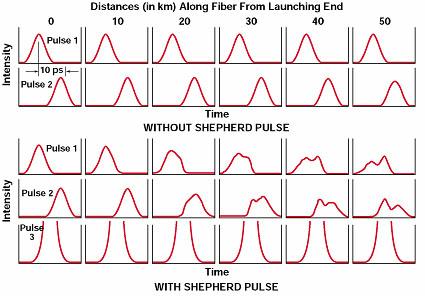
Discovered through theoretical analysis and computer simulation, pulse shepherding involves cross phase modulation, which is an unavoidable interaction between copropagating pulses that arises from nonlinearity in the response of the fiber-optic material. In cross phase modulation, copropagating pulses affect each other through the intensity dependence of the index of refraction. Cross phase modulation does not cause exchange of energy among the pulses, but it does affect the shapes and relative locations of the pulses. In designing for pulse shepherding, one designs the optical fiber to eliminate group-velocity mismatches among the wavelength channels and selects the timing, amplitudes, and shapes of the pulses in the various wavelength channels to exploit cross modulation to bring and keep the pulses together as they propagate.
In the theoretical analysis, the copropagation of M pulses is modeled by M simultaneous, coupled, nonlinear equations. The solution is generated numerically by the split-step Fourier method, which involves a forward-stepping process in which the solution is first advanced using only the nonlinear parts of the equations, then advanced using only the linear parts of the equations. The Fourier transform in this method is generated by the fast-Fourier-transform technique.
The figure illustrates the results of these computations for an example of two Gaussian-shaped pulses of 10-ps duration, propagating both without and with a third (shepherd) pulse along a suitably designed optical fiber 50 km long. In this example, pulse 1 at a wavelength of 1.550 µm is launched at one pulse duration before pulse 2 at a wavelength of 1.546 µm. In the absence of a shepherd pulse, the pulses 1 and 2 remain separated throughout their travel. When pulse 3 (the shepherd pulse) at a wavelength of 1.542 µm and at twice the amplitude of pulses 1 and 2 is launched midway between pulses 1 and 2, the three pulses become increasingly aligned with each other as they travel along the fiber. It is as though the shepherd pulse were pulling backward on the leading pulse and pulling forward on the trailing pulse.
The figure also illustrates another interesting phenomenon: if one uses too strong a shepherd pulse in an attempt to pull pulses 1 and 2 together sooner, one may not succeed. Instead, pulses 1 and 2 could be broken up, with one part of each pulse becoming shepherded and the remainder continuing to propagate by itself.
This work was done by Larry Bergman and Cavour Yeh of Caltech for NASA's Jet Propulsion Laboratory. For further information, access the Technical Support Package (TSP) free on-line at www.techbriefs.com under the Electronic Components and Circuits category, or circle no. 175 on the TSP Order Card in this issue to receive a copy by mail ($5 charge).
In accordance with Public Law 96-517, the contractor has elected to retain title to this invention. Inquiries concerning rights for its commercial use should be addressed to
Technology Reporting Office
JPL
Mail Stop 122-116
4800 Oak Grove Drive
Pasadena, CA 91109
(818) 354-2240
Refer to NPO-19987, volume and number of this NASA Tech Briefs issue, and the page number.
This Brief includes a Technical Support Package (TSP).
Pulse Shepherding in Nonlinear Fiber Optics
(reference NPO19987) is currently available for download from the TSP library.
Don't have an account?
Overview
The document presents research on a novel technique for pulse propagation in single-mode optical fibers, specifically addressing the challenges associated with wavelength-division multiplexing (WDM). Traditional WDM systems convert parallel input pulses into a series of single pulses before transmitting them on different wavelength beams. In contrast, this research focuses on a bit-parallel WDM (BP-WDM) format, which allows for the simultaneous launching of parallel pulses on different wavelengths without the need for conversion to a serial format.
The primary objective of the invention is to maintain time alignment of these parallel pulses as they travel through the fiber. Time alignment is crucial for ensuring that the data transmitted remains coherent and can be accurately interpreted at the receiving end. The proposed solution involves the introduction of a "shepherd pulse," which acts to "herd" the parallel pulses of a given signal byte together, thereby promoting their in-flight alignment.
The document outlines the technical disclosure of the invention, detailing the problem of maintaining pulse alignment and the innovative solution provided by the shepherd pulse. The underlying principle of this technique is based on the nonlinear interaction of co-propagating beams within the single-mode fiber. This interaction allows the shepherd pulse to effectively guide the other pulses, ensuring they remain synchronized throughout their journey.
The research was conducted by the Center for Space Microelectronics Technology at the Jet Propulsion Laboratory, California Institute of Technology, and was sponsored by the Ballistic Missile Defense Organization in collaboration with NASA. The authors express gratitude to Dr. W. P. Brown for his assistance in developing the soliton program related to this research.
Overall, the document highlights a significant advancement in optical communication technology, with the potential to enhance the efficiency and reliability of data transmission in high-speed networks. By leveraging the unique properties of nonlinear optics, this technique could pave the way for more robust and faster communication systems, addressing the growing demands for bandwidth and speed in modern telecommunications.











