“Parametric Studies” and “Data Table Plot View” are the names of software modules in the Satellite Orbit Analysis Program (SOAP). Parametric Studies enables parameterization of as many as three satellite or ground-station attributes across a range of values and computes the average, minimum, and maximum of a specified metric, the revisit time, or 21 other functions at each point in the parameter space. This computation produces a one-, two-, or three-dimensional table of data representing statistical results across the parameter space. Inasmuch as the output of a parametric study in three dimensions can be a very large data set, visualization is a paramount means of discovering trends in the data (see figure).
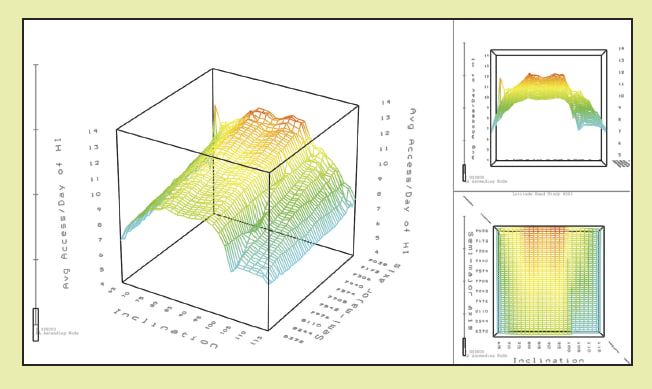
Data Table Plot View enables visualization of the data table created by Parametric Studies or by another data source: this module quickly generates a display of the data in the form of a rotatable three-dimensional-appearing plot, making it unnecessary to load the SOAP output data into a separate plotting program. The rotatable three-dimensional-appearing plot makes it easy to determine which points in the parameter space are most desirable. Both modules provide intuitive user interfaces for ease of use.
This work was done by Robert Carnright, Adam Loverro, and Robert Oberto of Caltech and David Stodden and John Coggi of The Aerospace Corporation for NASA’s Jet Propulsion Laboratory.
The release of this software is controlled by the Air Force at Space and Missiles Center (SMC) in Los Angeles, California. The point of contact at SMC is 1Lt Matthew Nelson ( e-mail address:
Refer to NPO-45059.
This Brief includes a Technical Support Package (TSP).
Parametric-Studies and Data-Plotting Modules for the SOAP
(reference NPO-45059) is currently available for download from the TSP library.
Don't have an account?
Overview
The document titled "MBED SOAP Parametric Trades Enhancement," presented by Robert Carnright from JPL on October 6, 2005, outlines the objectives and advancements of the SOAP Parametric Trade Project initiated in July 2005. The project was launched to address the challenges faced by mission analysts in conducting trade studies, which were often too compute and labor-intensive. Analysts previously had to manually create numerous parameter variations, leading to results that could only be generated over extended periods, such as nights and weekends.
To enhance the efficiency of these studies, the project aimed to develop a more responsive architecture that would facilitate interactive design studies. The architecture and requirements were developed by JPL, while the Aerospace Corporation was tasked with modifying the necessary software. The project was sponsored by key figures including Terry Anderson and Bob Oberto, with its performance period concluding at the end of FY 2005.
Future plans for the project include the establishment of a 1024-node Dell Linux cluster equipped with 1024 Xeon processors, which is expected to provide at least a 100-fold speedup in processing capabilities. This significant enhancement in computational power is intended to make computer time available free of charge to users, with initial capabilities anticipated to be operational by February 2006.
The document also acknowledges the contributions of several individuals involved in the project, including Terri Anderson (MBED Task Lead), Bob Oberto (Advanced Design Team Manager), and Adam Loverro (HRDF Whiz from Aerospace Corp).
Overall, the document emphasizes the importance of improving the efficiency and responsiveness of mission trade studies through advanced computational resources and software modifications. By addressing the limitations of previous methodologies, the SOAP Parametric Trade Project aims to streamline the design process for future missions, ultimately enhancing the capabilities of NASA's analytical efforts in aerospace exploration.