Two reports present updated information on a robotic system that extends the dexterity of a microsurgeon. The system was described in two articles in NASA Tech Briefs, Vol. 21, No. 10 (October 1997); namely, "Telerobot Control for Microsurgery" (NPO-19823), on page 46 and "Force-Feedback Device for Microsurgery" (NPO-19822), on page 86. To recapitulate, the surgeon manipulates a handle on a master robot arm, causing a slave robot arm to manipulate a surgical tool on a much finer scale, with hand tremor filtered out. The force of contact between the surgical tool and the patient's tissue is amplified and fed back to the surgeon's hand through the master robot arm.
This work was done by Curtis Boswell, Hari Das, Robert Steele, Timothy Ohm, and Edward Barlow of Caltech and Steve Charles of MicroDexterity Systems, Inc., for NASA's Jet Propulsion Laboratory.
In accordance with Public Law 96-517, the contractor has elected to retain title to this invention. Inquiries concerning rights for its commercial use should be addressed to
Technology Reporting Office
JPL
Mail Stop 122-116
4800 Oak Grove Drive
Pasadena, CA 91109
(818) 354-2240
Refer to NPO-20408
This Brief includes a Technical Support Package (TSP).
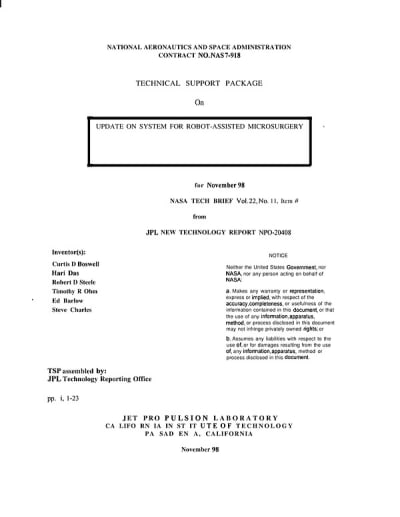
Update on system for robot-assisted microsurgery
(reference NPO20408) is currently available for download from the TSP library.
Don't have an account?
Overview
The document provides an update on a robotic system designed to enhance the dexterity of microsurgeons, developed through collaboration between researchers at NASA's Jet Propulsion Laboratory (JPL) and Dr. Steve Charles, a vitreo-retinal surgeon. This system, known as the Robot Assisted MicroSurgery (RAMS) telerobotic workstation, aims to assist surgeons in performing intricate microsurgical procedures with greater precision and control.
The RAMS system operates through a master-slave configuration. The surgeon manipulates a handle on a master robot arm, which translates the movements to a slave robot arm that controls a surgical tool with high precision. This setup filters out hand tremors and amplifies the force of contact between the surgical tool and the patient’s tissue, providing feedback to the surgeon. The system comprises several subsystems: a mechanical subsystem (including motors and linkages), two electronic subsystems (power amplifiers and servo-control hardware), and a high-level software subsystem.
The document details the capabilities of the RAMS system, including its application in simulated surgeries. A specific example mentioned is the removal of a microscopic 0.015-inch diameter particle from a simulated eye, demonstrating the system's precision in delicate procedures. The report also discusses the potential of the RAMS system as a training simulator for microsurgeons, allowing for the evaluation of surgical performance and research into manual dexterity.
The work is credited to a team of researchers, including Curtis Boswell, Hari Das, Robert Steele, Timothy Ohm, and Edward Barlow from Caltech, alongside Dr. Steve Charles from MicroDexterity Systems, Inc. The document emphasizes the innovative nature of the RAMS system, highlighting its compact size, lightweight design, and high precision, which are crucial for microsurgical applications.
In conclusion, the document serves as a technical brief on the advancements in robotic assistance for microsurgery, showcasing the potential for improved surgical outcomes and training methodologies in the field of medicine. The ongoing research and development in this area signify a promising future for robotic systems in enhancing surgical capabilities.