

In a proposed alternative to previous approaches to making hot-shoe contacts to the legs of thermoelectric devices, one relies on differential thermal expansion to increase contact pressures for the purpose of reducing the electrical resistances of contacts as temperatures increase. The proposed approach is particularly applicable to thermoelectric devices containing p-type (positive-charge-carrier) legs made of a Zintl compound (specifically, Yb14MnSb11) and n-type (negative-charge-carrier) legs made of SiGe.
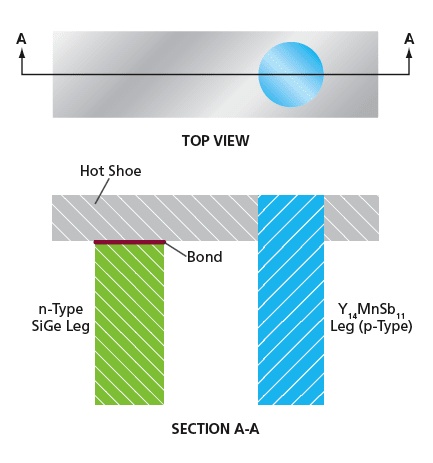
The figure depicts a thermoelectric unicouple according to the proposed approach. By use of established techniques, the n-type SiGe leg would be bonded to the hot shoe, which would be made of Si, Mo, or graphite. However, the Yb14MnSb11 leg would not be bonded to the hot shoe: instead, the Yb14MnSb11 leg would be inserted in a precisely fit hole in the hot shoe. The precision of the fit would be such that upon assembly at room temperature, the contact pressure between the hot shoe and the Yb14MnSb11 leg would be low. During heating up to a hotshoe operating temperature of 1,000 °C, the thermal expansion of the Yb14MnSb11 leg would exceed that of the hole by an amount that would increase the contact pressure to >100 MPa. This pressure would suffice to keep the thermal and electrical contact resistances acceptably low.
Optionally, if the hot shoe were made of Si or Mo, the contact resistances could be made even lower by adding a thin, reactive layer of a metal at the interface between the Yb14MnSb11 leg and the hot shoe. Another option would be to taper the hole and the mating portion of the Yb14MnSb11 leg and to pressfit the leg and the hot shoe together at room temperature, thereby providing for maintenance of at least some pressure and prevention of separation during thermal cycling.
This work was done by Jeffrey Sakamoto of Caltech for NASA’s Jet Propulsion Laboratory. NPO-44896
This Brief includes a Technical Support Package (TSP).
Expansion Compression Contacts for Thermoelectric Legs
(reference NPO-44896) is currently available for download from the TSP library.
Don't have an account?
Overview
The document titled "Expansion Compression Contacts for Thermoelectric Legs" is a Technical Support Package from NASA's Jet Propulsion Laboratory, detailing advancements in the bonding and integration of thermoelectric materials, specifically Zintl and silicon-germanium (SiGe), into high-temperature applications. The primary focus is on establishing effective contact resistances in the range of 10–100 microOhm-cm², although initial measurements indicated a resistance of 530 microOhm-cm², which is significantly higher than the target.
The document outlines a novel approach to metallizing high-temperature, reactive thermoelectric materials, emphasizing the importance of managing the coefficients of thermal expansion (CTE) between the thermoelectric materials and the hot shoe components, typically made of silicon, molybdenum (Mo), or graphite. The design leverages the large CTE difference to create significant compressive stress, which in turn reduces electrical resistance through enhanced physical pressure, eliminating the need for bulky heat rejection hardware that was common in previous technologies.
Experimental results are presented, including a study on the Zintl leg coupled with a Mo hot shoe. The findings indicate that while there are significant shear stresses at the interface, the overall design maintains tolerances that prevent catastrophic failure. Post-scanning electron microscopy (SEM) analysis revealed minimal reaction between the Zintl elements and the Mo hot shoe, suggesting a stable interface conducive to long-term performance.
The document also discusses the advantages of the new approach over traditional spring-loaded hardware, which adds unnecessary mass to the system. The innovative method described generates pressures exceeding 100 MPa, significantly improving contact quality without increasing the overall weight of the thermoelectric generator.
In conclusion, this Technical Support Package provides valuable insights into the challenges and solutions associated with integrating advanced thermoelectric materials into aerospace applications. It highlights the potential for improved efficiency and performance in thermoelectric generators, paving the way for future developments in this field. The research is part of NASA's broader efforts to enhance technology for space exploration and other applications, with implications for both scientific and commercial use.











