Next-generation high-temperature thermoelectric-power-generating devices will employ segmented architectures and will have to reliably withstand thermally induced mechanical stresses produced during component fabrication, device assembly, and operation. Thermoelectric materials have typically poor mechanical strength, exhibit brittle behavior, and possess a wide range of coefficient of thermal expansion (CTE) values. As a result, the direct bonding at elevated temperatures of these materials to each other to produce segmented leg components is difficult, and often results in localized microcracking at interfaces and mechanical failure due to the stresses that arise from the CTE mismatch between the various materials. Even in the absence of full mechanical failure, degraded interfaces can lead to increased electrical and thermal resistances, which adversely impact conversion efficiency and power output.
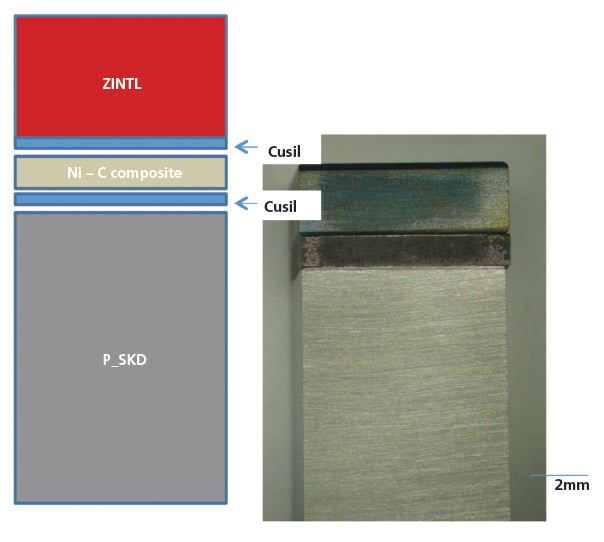
Nickel-coated graphite powders were hot-pressed to form a nickel-graphite composite material. A freestanding thermoelectric segmented leg was fabricated by brazing the compliant pad layer between the high-temperature p- Zintl and low-temperature p-SKD TE segments using Cu-Ag braze foils. The segmented leg stack was heated in vacuum under a compressive load to achieve bonding.
The novelty of the innovation is the use of composite material that re duces the thermomechanical stresses encountered in the construction of high-efficiency, high-temperature thermoelectric devices. The compliant pad enables the bonding of dissimilar thermoelectric materials while maintaining the desired electrical and thermal properties essential for efficient device operation. The modulus, CTE, electrical, and thermal conductances of the composite can be controlled by varying the ratio of nickel to graphite.
This work was done by Samad A. Firdosy, Billy Chun-Yip Li, Vilupanur A. Ravi, Jean- Pierre Fleurial, Thierry Caillat, and Harut Anjunyan of Caltech for NASA’s Jet Propulsion Laboratory.
In accordance with Public Law 96-517, the contractor has elected to retain title to this invention. Inquiries concerning rights for its commercial use should be addressed to:
Innovative Technology Assets Management
JPL
Mail Stop 321-123
4800 Oak Grove Drive
Pasadena, CA 91109-8099
E-mail: This email address is being protected from spambots. You need JavaScript enabled to view it.
NPO-48621
This Brief includes a Technical Support Package (TSP).
Nickel-Graphite Composite Compliant Interface and/or Hot Shoe Material
(reference NPO-48621) is currently available for download from the TSP library.
Don't have an account?
Overview
The document is a Technical Support Package from NASA's Jet Propulsion Laboratory (JPL) detailing the Nickel-Graphite Composite Compliant Interface and/or Hot Shoe Material (NPO-48621). It outlines advancements in thermoelectric materials aimed at improving thermal-to-electric energy conversion efficiency, particularly in high-temperature applications.
The primary focus is on a composite material that mitigates thermo-mechanical stresses encountered in high-efficiency thermoelectric devices. This composite, made from graphite powders pre-coated with nickel, is designed to bond dissimilar thermoelectric materials while preserving essential electrical and thermal properties. The coefficient of thermal expansion (CTE) of the composite can be adjusted by varying the ratio of nickel to graphite, allowing for optimal compatibility with the materials being joined.
The document describes the fabrication process of a free-standing thermoelectric segmented leg, which involves hot pressing the nickel-graphite composite at temperatures between 600 - 1200 °C under significant pressure. The compliant pad layer is used to bond high-temperature (p-Zintl) and low-temperature (p-SKD) thermoelectric segments, utilizing a Cusil-ABA braze to ensure a strong connection. This innovative approach has resulted in crack-free segmented leg assemblies, enhancing the reliability and performance of thermoelectric devices.
The technical background emphasizes the importance of achieving high Carnot efficiency by operating across large temperature differentials, which is critical for applications in aerospace and other high-performance environments. The document also references various sources for further reading on the thermophysical properties of materials and the specific methodologies employed in the development of the composite.
Overall, the Technical Support Package serves as a comprehensive resource for understanding the capabilities and applications of the Nickel-Graphite Composite Compliant Interface, highlighting its potential to revolutionize thermoelectric device architecture and maximize energy conversion efficiency. It is intended for use in both scientific and commercial contexts, promoting wider technological advancements stemming from aerospace research. For additional inquiries or information, the document provides contact details for NASA's Innovative Partnerships Office.