

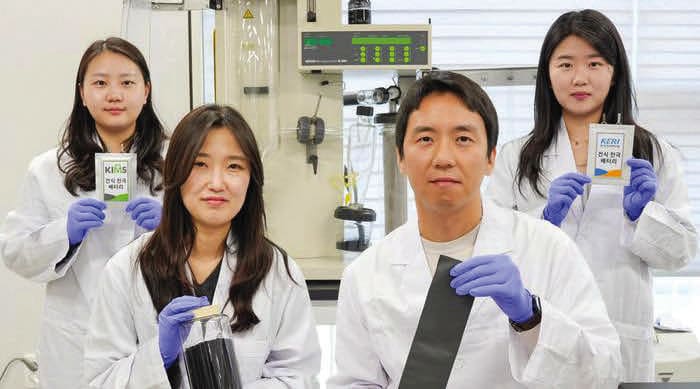
Secondary battery electrodes are made by mixing active materials that store electrical energy, conductive additives that help the flow of electricity, and binders, which act as a kind of adhesive. There are two methods for mixing these materials: the wet process, which uses solvents, and the dry process, which mixes solid powders without solvents. The dry process is considered more environmentally friendly than the wet process and has gained significant attention as a technology that can increase the energy density of secondary batteries. However, until now, there have been many limitations to achieving a uniform mixture of active materials, conductive additives, and binders in the dry process.
To solve this problem, KERI and KIMS applied spray drying technology, which has already been proven for mass production in the food and pharmaceutical industries, to the dry process. First, the researchers at KIMS mixed the active materials and conductive additives in a liquid slurry form and then sprayed them into a high-temperature chamber made of glass tubes. The principle is that the solvent evaporates instantly due to the high temperature inside the chamber, leaving only a uniformly mixed composite powder of active materials and conductive additives. This method is the same process used in the mass production of instant coffee, where coffee concentrate is sprayed and hot air is applied to produce solid powder.
The composite powder of active materials and conductive additives made using the spray drying technique was transformed into high-capacity electrodes by the researchers at KERI, who possess extensive know-how and expertise in dry-electrode processes. The researchers mixed the composite of active materials and conductive additives with binders, then carried out a process called fibrillation, in which the binders are stretched into threads using specially designed equipment. Through this delicate process, the active materials-conductive and additives-binders were better woven together as a structure and could be precisely combined. Finally, the researchers went through a calendaring process, where the combined active materials, conductive additives, and binders were made into a thin film with uniform density, ultimately producing electrodes for batteries.
This process makes it possible to achieve optimal mixing between the internal materials of the secondary battery, reducing the amount of conductive additives, and instead filling that space with active materials, which are directly related to battery capacity.
The researchers reduced the amount of conductive additives from the 2-5 percent range reported in existing dry electrode-related literature to as low as 0.1 percent, through numerous experiments. They also successfully achieved a level of 98 percent for the content of active materials. In addition, the dry electrodes manufactured using this method achieved an areal capacity of approximately 7 mAh/cm², which is double that of commercial electrodes (2-4 mAh/cm²).
Senior Researcher Insung Hwang from KERI’s Next Generation Battery Research Center explained the significance of the research results, stating that the optimal combination of electrode materials can enhance energy density and performance, and that this technology has great potential, as it can be applied to next-generation batteries such as solid-state batteries and lithium-sulfur batteries.
Senior Researcher Jihee Yoon from KIMS’ Convergence and Composite Materials Research Division stated, “Through follow-up research, we plan to reduce process costs, improve mass production capabilities, and increase technology maturity, with the goal of eventually transferring the technology to industry.”
For more information, contact Insung Hwang at











