

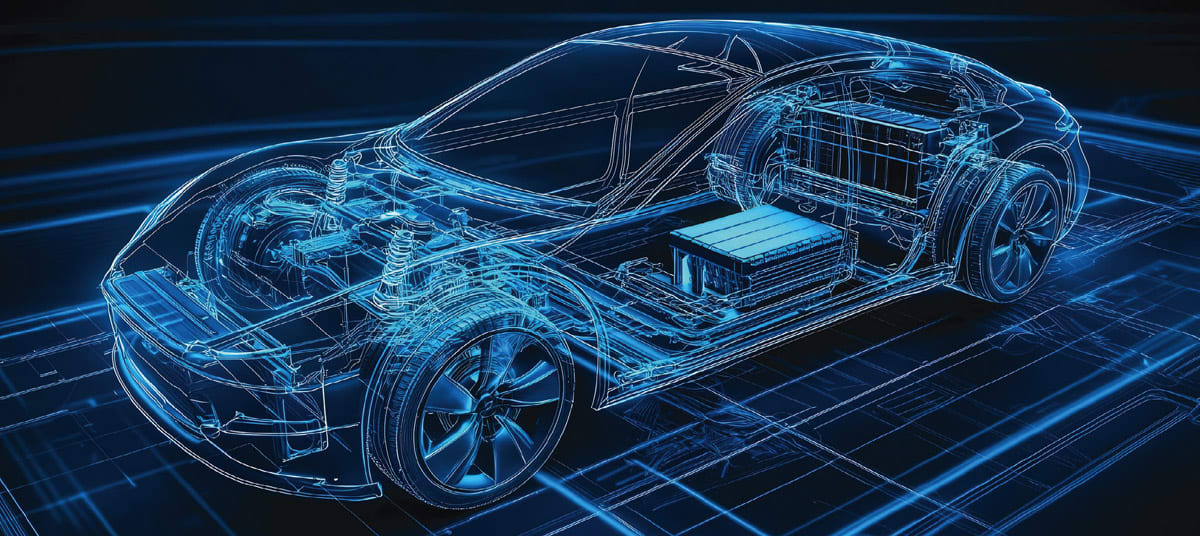
In the rapidly growing electric vehicle market, improved battery performance with shorter charging times, maximum temperature resistance and a longer battery life are key factors for success. To meet these demands, OEMs in Europe and the United States need materials that also comply with stricter national and international environmental standards.
Rising Demand for Batteries Fuels EV Expansion
The International Energy Agency’s (IEA) annual Global Electric Vehicle Outlook reveals global developments in electric mobility. According to Outlook 2024 the worldwide electric vehicle fleet must expand from less than 45 million vehicles in 2023 to 250 million by 2030 to stay on track for net-zero emissions. This will also drive a sharp increase in the demand for high-performance batteries.
This projected growth places unprecedented pressure on the entire electric vehicle supply chain, particularly on components critical to battery safety, reliability, and efficiency. As battery production scales up, so does the need for materials and technologies that can maintain performance under more demanding conditions — higher energy densities, faster charging rates, and longer service life. Advanced sealing solutions, such as next-generation elastomers, will be essential in supporting this expansion by ensuring battery integrity, preventing leakage, and mitigating the risks associated with thermal and mechanical stress throughout the battery’s lifecycle.
Current Challenges in Sealing Modern EVs
Throughout the automotive sector, the acceptance and use of electric as well as hybrid drivetrain technologies continues to grow. At the same time, these new technologies and applications come with new demands on many of the materials used for sealing. Systems and components in e-mobility applications, such as battery cells and packs, are newly designed to make efficient use of energy while producing significantly lower or zero emissions to meet enviornmental standards.
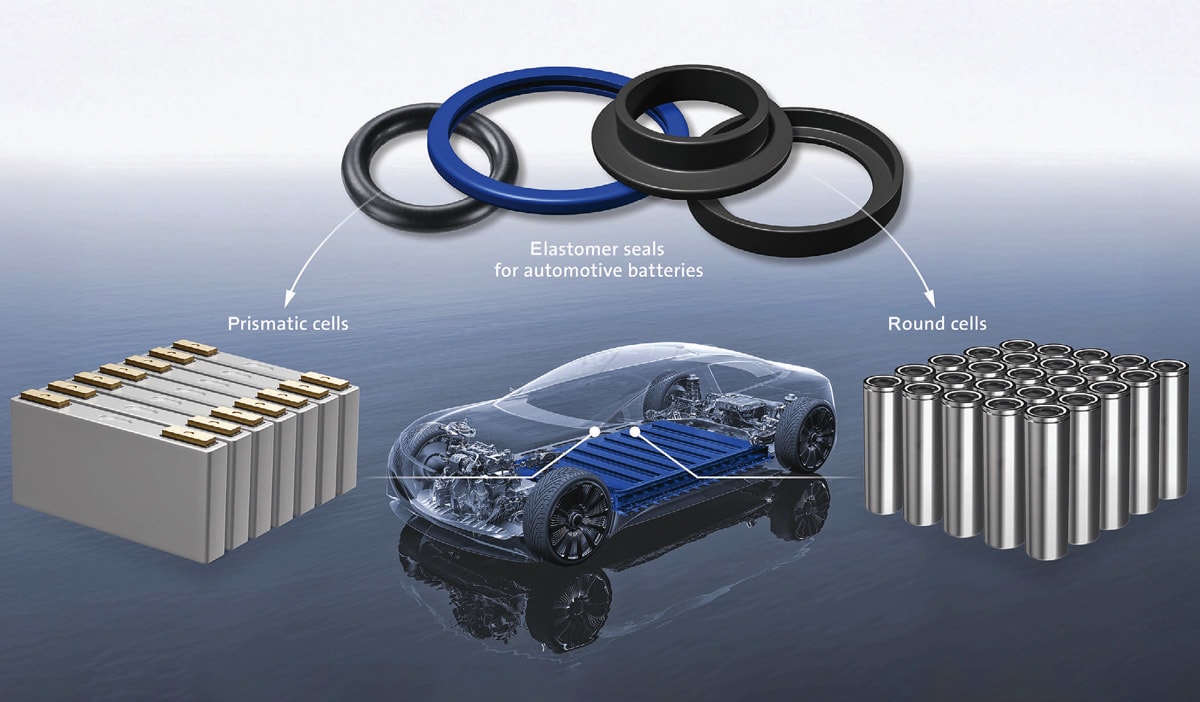
Current battery cell seals made from thermoplastics have limited dimensional stability under high-temperature conditions. They show plastic deformation, while elastomeric seals maintain their shape due to their elastic behavior. This results in an additional advantage in two key areas:
Accommodating dimensional changes caused by cyclic cell swelling during charging and discharging; and
Compensating for manufacturing tolerances in individual cell components and assembly processes.
Compared to thermoplastics, elastomeric materials can improve overall sealing performance by up to a factor of 10, as demonstrated in helium leakage rate testing.
Leading global sealing suppliers such as Freudenberg have developed the expertise to enhance sealing robustness in battery cells by using advanced elastomeric materials in place of conventional thermoplastics. These elastomers offer superior elasticity, thermal stability, and long-term performance under cyclic mechanical stress, making them ideal for managing the pressure fluctuations and dimensional changes characteristic of modern lithium-ion battery systems. Their high-performance elastomer material outperforms thermoplastics in overall sealing performance, during welding in assembly process and in the event of thermal runaway.
Material Marvels: Elastomers vs. Thermoplastics
Thermoplastics traditionally used for battery seals have macromolecules with long-chain molecular structures that are not chemically cross-linked but instead held together by weak intermolecular forces. While thermoplastics can be elastically deformed to some degree, the constant charging and discharging of the battery cell also causes them to undergo functionally relevant plastic deformation over time.
This is different in elastomers whose molecular chains are chemically cross-linked. In their basic state, the polymer chains form a tangled ball that stretches or compresses under tensile and compressive loads. Due to the entropy elasticity, these cross-linked materials react elastically and reversibly, maintaining their shape exceptionally well during the cyclical volume change of the battery cells under load.
Application and Integration Differences. Mobility suppliers like Freudenberg often offer two complementary approaches to integrate elastomeric seals into battery systems. This flexibility ensures that elastomeric seals can be introduced without requiring major redesigns, while also offering a clear upgrade path for manufacturers seeking advanced sealing performance. The two approaches include:
Build-to-print solutions: Drop-in replacements for thermoplastic seals that seamlessly fit into existing assembly processes and cell designs.
Collaborative sealing design development: Tailored sealing concepts that optimize performance, longevity, and compatibility for next-generation battery applications.
Manufacturing and Scalability Differences. Both thermoplastics and elastomers are manufactured using injection molding, but the process parameters — including temperature, pressure, and time — differ significantly. To address this, Freudenberg has developed an innovative cold runner technology that enables the production of high-quality elastomeric seals through a robust and scalable process. Combined with the company’s global manufacturing footprint, this technology supports local-to-local production, reducing logistics complexity and ensuring supply chain reliability for global customers.
Real-World Applications and Performance
Freudenberg’s new O-rings made from the new elastomer prevent electrolytes from leaking out of the battery cell or impurities from entering the cell. Further, when the temperature in the battery cell rises from ambient levels to approximately 60° C (in some cases temperatures up to 75 °C are possible), the cell shows thermal expansion. Elastomers show significant advantages over thermoplastics during this continuous stress.
Sustainable Mobility: Materials Supporting Long-term Battery Use
The development of new battery materials prioritizes sustainability as well as economic aspects. In general, the longer a battery can be used, the more sustainable the electric vehicles become. New sealing material development, such as Freudenberg’s elastomer material innovation, contributes to this goal.
When used in customer projects, the new material was able to improve the performance-relevant leakage rate of the battery cells by an order of magnitude — resulting in a tenfold improvement compared to conventional thermoplastic seals. In addition, process engineering has optimized manufacturing techniques to such a degree that it is possible to produce these high-performance battery cell seals in large series.
Another essential consideration is the extreme sensitivity of battery cell electrochemistry to potential contamination. Premature capacity loss, which has been observed in cells sealed with conventional elastomers, can result from minimal but still present impurities in the sealing material. The infiltration of moisture into the cell has a similar effect, as it can cause the decomposition of electrolyte components. These aspects were considered when the new material was developed.
Industry Outlook and Strategic Implications
As the EV market accelerates toward mass adoption, the need for durable, efficient, and scalable battery technologies is reshaping supply chain priorities across the automotive and energy sectors. Advanced sealing materials, such as high-performance elastomers, are emerging as strategic enablers in this transformation.
The expected 250-million-unit EV production by 2030 requires OEMs and battery system suppliers to focus on component reliability and manufacturing efficiency as their key differentiators. The reliability of sealing materials under thermal and mechanical stress will extend battery life while enhancing safety and reducing warranty expenses to maintain consumer trust and meet regulatory requirements.
Further, the evolution of sustainability standards forces companies to reassess traditional materials while promoting environmentally friendly alternatives. The combination of purity and low permeability in elastomers enables these goals by extending battery life cycles and minimizing internal failure risks. Manufacturers who invest in elastomer sealing technology can achieve better battery system robustness while gaining rapid regulatory adaptation and next-generation EV platform performance capabilities. The increasing competition and advanced battery technologies make sealing performance an essential factor that will determine product success.
This article was written by David Kuhne, Application Engineer and Dr. Stefan Schneider, Head of Material Development, Freudenberg Sealing Technologies (Weinheim, Baden Württemberg, Germany). For more information, visit here .










