

Smart Charging Network
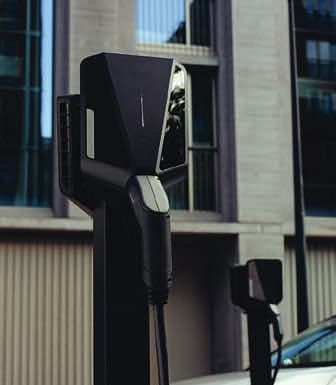
Easee (Stavanger, Norway) will support national and regional grid balancing efforts, leveraging its rapidly growing network of over 850,000 4G-connected EV chargers across Europe. As transportation electrifies and renewable energy generation accelerates, the grid faces unprecedented challenges. Without intervention, homes, businesses, EV charging, and even essential services could suffer from partial blackouts where the grid struggles to meet soaring demand. Easee’s connected charger network offers an immediate and scalable solution. Through advanced load balancing, demand response capabilities, and dynamic charging controls, its chargers can shift energy usage to times of lower demand and prioritize renewable energy integration. The aim is to empower energy providers and grid operators with new, responsive tools. Easee’s technology supports a smarter, more resilient energy system by enabling features such as smart charging, which adjusts EV charging speeds in real time to respond to grid conditions. It also lays the groundwork for Vehicle-to-Grid readiness, preparing for a future where electric vehicles not only draw energy but also return it to the grid when needed. Additionally, Easee’s Time-of-Use Optimization feature shifts charging to periods when electricity is cheaper, cleaner, and more abundant.
Visit Here
Electrostatic Discharge Diodes
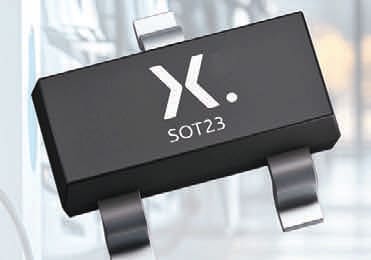
Nexperia (Nijmegen, Netherlands) introduced the ESD diodes designed to protect 48V automotive data communications networks against the destructive effects of electrostatic discharge (ESD) events. This new portfolio of six robust AEC-Q101 qualified devices covers the required higher reverse working maximum voltage (VRWM) for increasingly common 48V board nets. This ultimately saves PCB space and system cost while maintaining signal integrity even at higher data rates. While data communications protocols like controller area network (CAN) have been around for several decades, their proven reliability in lower speed applications means they continue to feature in even the most recent automobiles, including EV and HEV models. However, unlike conventional ICE-powered vehicles that have a 12V battery, or commercial vehicles that feature a 24V battery, the higher efficiency requirements of EVs and HEVs mean they are increasingly moving toward using a 48V battery to power various electrical systems, including these legacy communications networks. For design flexibility, this portfolio features ESD diodes with 54V (PESD2CANFD54VT-Q and PESD2CANFD54LT-Q), 60V (PESD2CANFD60VT-Q and PESD2CANFD60LT-Q), and 72V (PESD2CANFD72VT-Q and PESD2CANFD72LT-Q) VRWM. These ultra-low capacitance (down to 3.4 pF) devices are packaged in the widely used standard SOT23 package. The optimized capacitance ensures that signal integrity is not impacted even in higher-speed protocols like CAN-FD.
Visit Here
Battery Electrode Manufacturing
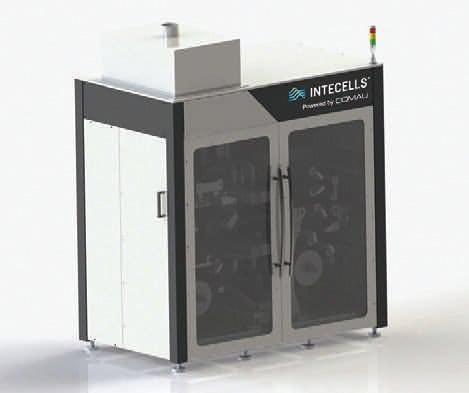
Comau (Turin, Italy) has entered an important collaboration with Intecells to optimize the use of cold plasma within industrial cell manufacturing processes. Comau will work with Intecells, who has patented an innovative cold plasma application, to develop a cost-effective technology path for customers looking to integrate the new technology within existing cell manufacturing lines. The plasma-based solution available today reduces cycle time and energy consumption in soaking and drying when added to existing cell manufacturing lines, while also improving cell capacity, cyclability, and production quality across a full range of battery types and sizes. As a further step, a plasma-based solution under development is reducing significantly process steps along the cell manufacturing process. The final target is to reduce investments by 50 percent and halve energy consumption and carbon emissions. As a provider of best-practice technologies within the electrification field, Comau is actively contributing to the advancement of electrification through a comprehensive approach that spans the entire battery lifecycle from cell formation to module and pack assembly, and from testing all the way to dismantling and recycling.
Visit Here
Vibration-Resistant Fluid Connectors
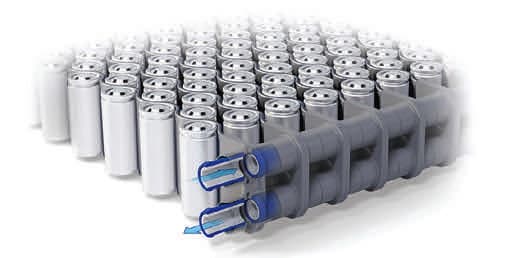
At the Battery Show Europe in Stuttgart, Freudenberg Sealing Technologies (Weinheim, Germany), presented its latest materials developed to provide rapid charging and higher battery capacity. It also demonstrated the high level of design flexibility these materials offer for their integration into customer-specific production processes. The global automotive industry is rapidly advancing technologies that enable fast and safe battery charging. Progress has been substantial, and Freudenberg Sealing Technologies is playing a key role: its product lines make it easy to install vibration-resistant connectors with high offset tolerances. At the same time, newly developed materials can both electrically insulate and dissipate heat. With these products, the company is solving several fundamental challenges in e-mobility: increased driving ranges, including higher battery capacities, longer battery life, ultra-fast charging, and precise thermal management. As conventional cooling systems no longer have the capacity to keep up with ultra-fast charging, thermal management of battery cells becomes increasingly important. Freudenberg Sealing Technologies offers a key component for high-performance electric drive systems in the form of its fluid connectors. They accommodate the thermodynamics of different cooling fluids under high load and ensure cooling between the battery cells. These materials, perfectly tailored to their operating environments, also extend the battery life.
Visit Here
Dynamic Load Balancing
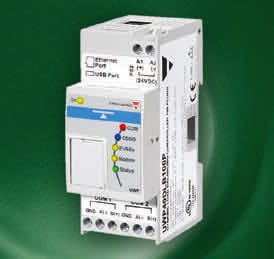
Carlo Gavazzi Automation (Buffalo Grove, IL) has launched the UWP-DLB Series, an advanced solution delivering intelligent dynamic load balancing for EV charging systems. It provides real-time power optimization across EV charging points to prevent overloads and reduce operational costs. As EV adoption accelerates globally, the challenge of managing limited power resources across charging sites has become increasingly critical, especially in environments where charging stations must operate alongside other high-demand infrastructure such as buildings, lighting, or HVAC systems. The UWP-DLB addresses this need with a smart, scalable, and cost-effective solution. According to the company, at the core of this innovation is a dynamic load balancing controller that intelligently allocates available power across multiple charging point. The system continuously monitors the site’s total power capacity and dynamically adjusts the output of each EVSE (Electric Vehicle Supply Equipment), ensuring the overall load stays safely within limits. Fully compatible with any OCPP 1.6-compliant charger or backend CSMS (Charging Station Management System), the UWP 4.0 DLB easily integrates into both new and existing EV infrastructures.
Visit Here
Battery Energy Storage System

Emerson (Pittsburgh, PA) has released specialized battery energy storage system (BESS) solutions featuring energy and asset management software for its Ovation™ Green portfolio of renewable energy solutions. Combining field-proven, purpose-built power plant controllers, energy management strategies and supervisory control and data acquisition software (SCADA), Emerson’s BESS solution connects devices and systems across manufacturers, aggregating and contextualizing battery storage data into actionable insights to help optimize battery usage and extended battery life, enabling higher profitability, efficiency and sustainability. The solutions include an advanced, specialized battery algorithm suite that streamlines battery control through out-of-the-box, customizable function blocks that distribute proportioned setpoints to individual components such as inverters and battery management systems. The resulting control strategy automatically optimizes charge and discharge cycles and grid interactions for fast, precise and reliable demand management. Emerson’s collaboration with Zitara Technologies expands BESS capabilities by integrating cutting-edge battery management with an automation platform. The enhanced solution provides operators with instant and accurate visibility into the state of charge and health conditions for batteries, improving the site’s energy power and availability forecasting and adding predictive safety features.
Visit Here
Vertical-Mate Battery Connectors
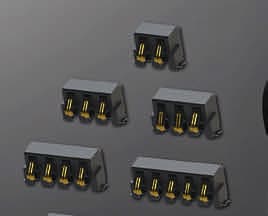
KYOCERA AVX (Fountain Inn, SC) has introduced its new 9155-900 Series 2.5mm-pitch vertical-mate battery connectors. The new 9155-900 Series 2.5mm-pitch vertical-mate battery connectors feature a unique contact geometry that deflects cleanly when a module, battery pack, mating connector, or PCB is vertically pushed into position, enabling full vertical engagement without the risk of contact damage. Traditional right-angle battery connectors require users to engage the contacts by inserting the mating module or battery pack at an angle before rotating it into position to reliably prevent contact damage that could negatively impact connector performance and lifetime. The 9155-900 Series does not. In fact, users can mate these connectors from any angle without inadvertently damaging the contacts, ensuring high-integrity connections regardless of user experience or skill level. The connectors feature an extremely forgiving sweeping beam contact design and an anti-snag feature that reliably protects the contacts from damage during deflection, as well as when static. The series also features ultra-robust and -reliable gold-plated beryllium copper (BeCu) contacts that deliver excellent electrical and mechanical performance for up to 5,000 mating cycles.
Visit Here
Switcher IC
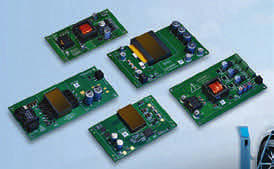
Power Integrations (Nuremberg, Germany) has announced five new reference designs targeting 800V automotive applications based on the company’s 1700 V InnoSwitch™3-AQ flyback switcher ICs. Spanning power levels from 16 W to 120 W, the designs leverage both wound and low-profile planar transformers and target automotive applications such as DC-DC bus conversion, inverter emergency power, battery management and power supplies for auxiliary systems. The designs feature Power Integrations’ new wide-creepage InSOP™-28G package, which supports 1000 VDC on the primary side while providing appropriate creepage and clearance between pins in pollution degree 2 environments. The new InSOP™-28G package, with its wide 5.1-mm drain-to-source pin creepage distance, addresses the critical need for enhanced safety and reliability in high-voltage applications. It provides sufficient isolation that conformal coating can be eliminated, saving a manufacturing process step and associated qualification effort. The switching power supply ICs deliver up to 120 watts of output power. The highly integrated ICs reduce power supply bill of materials (BOM) count by as much as 50 percent, saving space, enhancing system reliability and easing component sourcing challenges.
Visit Here











