A dilatometer based on a laser interferometer is being developed to measure mechanical creep and coefficients of thermal expansion (CTEs) of materials at temperatures ranging from ambient down to 15 K. This cryogenic dilatometer has been designed to minimize systematic errors that limit the best previously available dilatometers. At its prototype stage of development, this cryogenic dilatometer yields a strain measurement error of 35 ppb or 1.7 ppb/K CTE measurement error for a 20-K thermal load, for low-expansion materials in the temperature range from 310 down to 30 K. Planned further design refinements that include a provision for stabilization of the laser and addition of a high-precision sampleholding jig are expected to reduce the measurement error to 5-ppb strain error or 0.3-ppb/K CTE error for a 20-K thermal load.
The dilatometer (see figure) includes a common-path, differential, heterodyne interferometer; a dual-frequency, stabilized source bench that serves as the light source for the interferometer; a cryogenic chamber in which one places the material sample to be studied; a cryogenic system for cooling the interior of the chamber to the measurement temperature; an ultra-stable alignment stage for positioning the chamber so that the sample is properly positioned with respect to the interferometer; and a data-acquisition and control system. The cryogenic chamber and the interferometer portion of the dilatometer are housed in a vacuum chamber on top of a vibration-isolating optical table in a cleanroom. The sample consists of two pieces — a pillar on a base — both made of the same material. Using reflections of the interferometer beams from the base and the top of the pillar, what is measured is the change in length of the pillar as the temperature in the chamber is changed.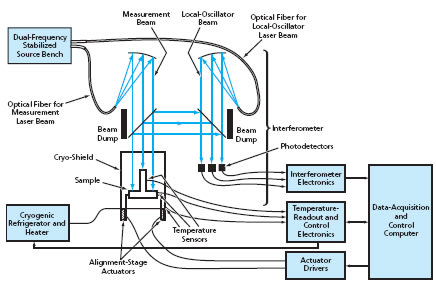 The Change in Height of the sample pillar in the cryogenic chamber is measured interferometrically. Design features that are much too numerous to depict here ensure a high degree of optical and mechanical stability over wide temperature range, as needed for high-precision measurements of thermal expansion and creep in the sample.
In their fundamental optical and electronic principles of operation, the laser light source and the interferometer are similar to those described in “Common- Path Heterodyne Interferometers” (NPO-20786), NASA Tech Briefs, Vol. 25, No. 7 (July 2001), page 12a, and “Interferometer for Measuring Displacement to Within 20 pm” (NPO-21221), NASA Tech Briefs, Vol. 27, No. 7 (July 2003), page 8a. However, the present designs incorporate a number of special geometric, optical, and mechanical features to minimize optical and thermal-expansion effects that contribute to measurement errors. These features include the use of low-thermal-expansion materials for structural components, kinematic mounting and symmetrical placement of optical components, and several measures taken to minimize spurious reflections of laser beams.
This work was done by Matthew Dudik, Peter Halverson, Marie Levine-West, Martin Marcin, Robert D. Peters, and Stuart Shaklan of Caltech for NASA’s Jet Propulsion Laboratory. For further information, access the Technical Support Package (TSP) free online at www.techbriefs.com/tsp under the Physical Sciences category. NPO-40389
This Brief includes a Technical Support Package (TSP).

Precision Cryogenic Dilatometer
(reference NPO-40389) is currently available for download from the TSP library.
Don't have an account?
Overview
The document is a Critical Design Review for a Cryogenic Dilatometer, authored by Matthew Dudik from NASA's Jet Propulsion Laboratory (JPL) on July 12, 2002. It outlines the design, requirements, and operational aspects of the dilatometer, which is a precision instrument used to measure changes in the dimensions of materials at cryogenic temperatures.
The review begins with an introduction to the dilatometer's purpose and significance in scientific research, particularly in understanding material properties at low temperatures. It emphasizes the importance of precise measurements in various applications, including aerospace and materials science.
The design section details the construction of the dilatometer, highlighting key components such as the cryogenic dewar, which is essential for maintaining low temperatures. The dewar is designed with features like AL6061 flexures for cooling, a fully kinematic monopod support structure, and radiation cylinders to minimize heat transfer. The use of materials like Zerodur for conductive isolation is also noted, ensuring that the instrument operates effectively in cryogenic conditions.
The document discusses the data acquisition (DAQ) system, which includes hardware and software components necessary for collecting and processing measurement data. It specifies the use of JPL post-amp boards, digital phase meters, and a LabVIEW software interface for data management. The DAQ system is designed to facilitate efficient data transfer and analysis, crucial for accurate results.
Additionally, the review addresses the error budget, outlining potential sources of measurement error and the strategies implemented to minimize them. This section is critical for ensuring the reliability and accuracy of the dilatometer's measurements.
The document concludes with acknowledgments and references to further resources available through NASA's Scientific and Technical Information (STI) Program Office. It emphasizes the collaborative nature of the project and the importance of adhering to export regulations due to the proprietary information contained within.
Overall, the Critical Design Review serves as a comprehensive overview of the Cryogenic Dilatometer's design, functionality, and operational framework, showcasing its potential impact on scientific research and technological advancements in cryogenic applications.