A method of dynamic self-locking has been demonstrated to be effective as a means of stabilizing the wavelength of light emitted by a vertical-cavity surface-emitting laser (VCSEL) that is an active element in the frequency-control loop of an optoelectronic oscillator (OEO) designed to implement an atomic clock based on an electro-magnetically-induced-transparency (EIT) resonance. This scheme can be considered an alternative to the one described in “Optical Injection Locking of a VCSEL in an OEO” (NPO-43454), NASA Tech Briefs, Vol. 33, No. 7 (July 2009), page 33. Both schemes are expected to enable the development of small, low-power, high- stability atomic clocks that would be suitable for use in applications involving precise navigation and/or communication.
To recapitulate from the cited prior article: In one essential aspect of operation of an OEO of the type described above, a microwave modulation signal is coupled into the VCSEL. Heretofore, it has been well known that the wavelength of light emitted by a VCSEL depends on its temperature and drive current, necessitating thorough stabilization of these operational parameters. Recently, it was discovered that the wavelength also depends on the microwave power coupled into the VCSEL. This concludes the background information.
From the perspective that led to the conception of the optical injection-locking scheme described in the cited prior article, the variation of the VCSEL wavelength with the microwave power circulating in the frequency-control loop is regarded as a disadvantage and optical injection locking is a solution of the problem of stabilizing the wavelength in the presence of uncontrolled fluctuations in the microwave power. The present scheme for dynamic self-locking emerges from a different perspective, in which the dependence of VCSEL wavelength on microwave power is regarded as an advantageous phenomenon that can be exploited as a means of controlling the wavelength.
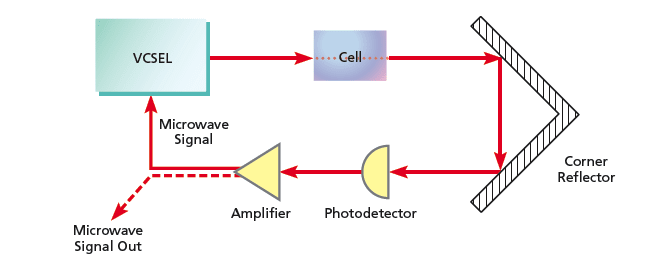
The figure schematically depicts an atomic-clock OEO of the type in question, wherein (1) the light from the VCSEL is used to excite an EIT resonance in selected atoms in a gas cell (e.g., 87Rb atoms in a low-pressure mixture of Ar and Ne) and (2) the power supplied to the VCSEL is modulated by a microwave signal that includes components at beat frequencies among the VCSEL wavelength and modulation sidebands. As the VCSEL wavelength changes, it moves closer to or farther from a nearby absorption spectral line, and the optical power transmitted through the cell (and thus the loop gain) changes accordingly. A change in the loop gain causes a change in the microwave power and, thus, in the VCSEL wavelength. It is possible to choose a set of design and operational parameters (most importantly, the electronic part of the loop gain) such that the OEO stabilizes itself in the sense that an increase in circulating microwave power causes the VCSEL wavelength to change in a direction that results in an increase in optical absorption and thus a decrease in circulating microwave power. Typically, such an appropriate choice of operational parameters involves setting the nominal VCSEL wavelength to a point on the shorter-wavelength wing of an absorption spectral line.
This work was done by Dmitry Strekalov, Andrey Matsko, Nan Yu, Anatoliy Savchenkov, and Lute Maleki of Caltech for NASA’s Jet Propulsion Laboratory.
In accordance with Public Law 96-517, the contractor has elected to retain title to this invention. Inquiries concerning rights for its commercial use should be addressed to:
Innovative Technology Assets Management
JPL
Mail Stop 202-233
4800 Oak Grove Drive
Pasadena, CA 91109-8099
(818) 354-2240
E-mail: This email address is being protected from spambots. You need JavaScript enabled to view it.
Refer to NPO-43751, volume and number of this NASA Tech Briefs issue, and the page number.
This Brief includes a Technical Support Package (TSP).
Dynamic Self-Locking of an OEO Containing a VCSEL
(reference NPO-43751) is currently available for download from the TSP library.
Don't have an account?
Overview
The document titled "Dynamic Self-Locking of an OEO Containing a VCSEL" (NPO-43751) from NASA's Jet Propulsion Laboratory discusses advancements in the stabilization of vertical cavity surface emitting lasers (VCSELs) within optoelectronic oscillators (OEOs) that reference atomic standards. The primary focus is on addressing the dynamic complexities associated with the wavelength stability of VCSELs, which are crucial for applications in atomic clocks and magnetometers.
A significant challenge highlighted in the document is the dependence of the VCSEL wavelength on temperature, current, and notably, the power of microwaves injected into the laser. This dependence poses a problem in active loop configurations, where the microwave power is a dynamic variable that cannot be easily stabilized, unlike in passive loops that utilize a fixed-power reference oscillator. The document emphasizes that fluctuations in microwave power can lead to changes in the VCSEL wavelength, which in turn affects the oscillation power and overall system stability.
To tackle this issue, the authors propose a novel technique for wavelength stabilization that leverages the dynamic feedback mechanism inherent in the OEO configuration. By carefully selecting parameters, particularly the electronic part of the loop gain, the system can stabilize itself on a negative slope of the microwave transfer function. This stabilization occurs in a manner similar to electronic lock systems, where any increase in circulating microwave power leads to a red tuning of the laser, thereby increasing absorption and reducing power, while negative fluctuations result in the opposite effect.
The document also outlines the potential applications of this technology, particularly in enhancing the performance of EIT-based atomic clocks and magnetometers, which are critical for precision measurement in various scientific and technological fields. The findings presented in this technical support package are part of NASA's broader efforts to develop aerospace-related technologies with wider scientific and commercial implications.
In summary, the document provides a comprehensive overview of the challenges and innovative solutions related to VCSEL wavelength stabilization in OEOs, highlighting the importance of this research for future advancements in precision measurement technologies.