Applications for AI are growing by leaps and bounds, which means we need many more data centers to handle the vast computing workload. Providing power to run all of them is a serious challenge. Part of the solution is to reduce their energy load by making them more efficient. The computing circuits could be designed to minimize losses, and the most efficient semiconductors can be chosen. But there is an upper limit to the efficiency of the electronics — there will always be losses in the form of heat.
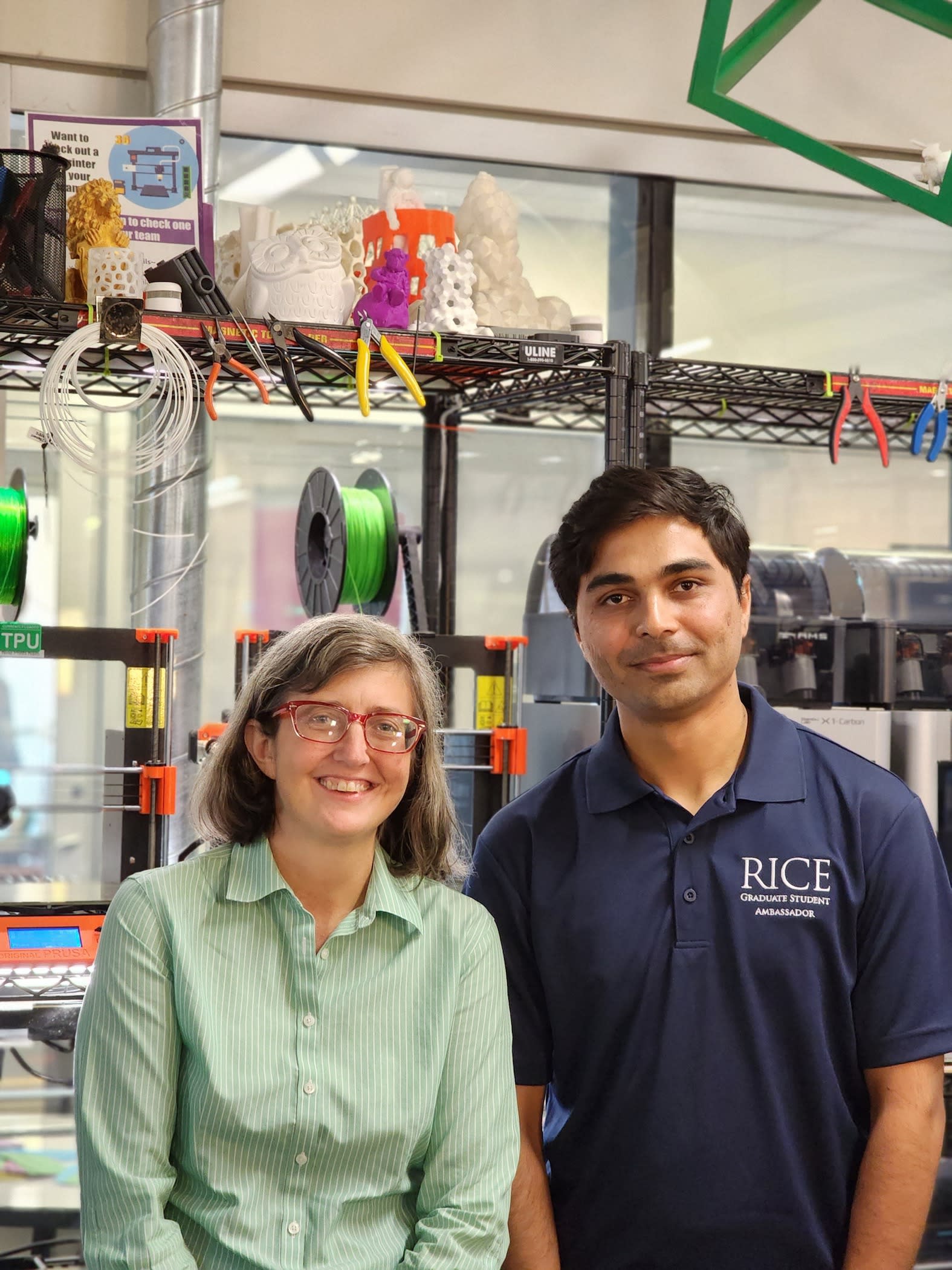
Laura Schaefer, the Burton J. and Ann M. McMurtry Chair of Mechanical Engineering along with her team at Rice University, has been working on renewable energy in general and concentrating solar energy in particular. Solar collectors use the energy of the sun to heat a liquid that can be used directly for space or water heating or indirectly to drive a turbine connected to an electric generator.
In considering different applications for concentrating solar energy, her team had the idea that it could be used as a source of free energy for improving the efficiency of data center cooling. In a paper in the journal Solar Energy authored by Schaefer and graduate student Kashif Liaqat, they point out that “studies have revealed that 30 – 50 percent of the total energy consumed in data centers is attributed to cooling systems.”
One of the difficulties of using waste heat from electronics is that its temperature has to be kept too low to do much useful work — if the CPUs get too hot, they become less efficient and in the worst case fail. “You have this stream that's at a higher than atmospheric temperature, but it’s not high enough to efficiently generate power,” said Schaefer. So, she and Liaqat decided they could raise the temperature to a useful operating range by giving the cooling fluid a boost from a standard flat-plate solar collector.
The system they designed is based on a standard organic Rankine cycle. There are two isolated loops in the system. In the first loop, the cooling fluid coming out of the data center at about 50°C (122°F) is piped through the solar collector, which raises its temperature to at least 85°C (185°F). The heated fluid then flows into a countercurrent heat exchanger where it heats a working fluid in the second loop.
In their experimental setup they used isopentane as the working fluid, since it has a low boiling point. That means the heat from the solar-boosted data center coolant is enough to evaporate the liquid isopentane and transform it into a high-temperature, high-pressure gas, a process similar to the way a teapot whistles. The gas turns the blades of a turbine connected to an electric generator. Having transferred most of its energy to the turbine in the form of work, the pressure and temperature have been reduced, although it is still a vapor. It is then further cooled down with a second heat exchanger, which lowers its temperature enough to return it to a liquid state. The cooled-down working fluid flows into the opposite end of the countercurrent heat exchanger, where it cools the data center fluid to about 25°C (77°F), which is the recommended temperature for the CPU.
This Rankine cycle system is a powerful tool for reducing data centers’ energy drain on the grid. The beauty of it is that the only energy required to run the system is the negligible amount used for the pump that circulates the working fluid. The external energy comes from the sun. So, once the system has been installed, there’s virtually no cost to run it and you receive a significant savings in the overall cost of electricity for the data center.
Schaefer and Liaqat calculated the potential savings by doing a techno-economic analysis of likely outcomes using publicly available databases. They applied their model to analyze projected performance in data centers in Los Angeles, CA, and Ashburn, VA. These two locations have very different weather patterns, and although the results for Los Angeles, where there are consistently higher temperatures, were more striking: “even in Ashburn, where winters are colder and cloudier, the hybrid system meaningfully increases output and cuts costs,” said Liaqat. For example, the levelized cost of electricity (LCOE) would have decreased by 16.5 percent in Los Angeles, but a not-insignificant 5.5 percent in Ashburn.
So far, they have just used off-the-shelf solar collectors. “This is just the base case for how this could operate,” said Schaefer. “If you use more sophisticated components, like a parabolic collector, you could get even better performance.” They would also like to add heat storage into the system so it can continue to function well even when the sun is down.
This article was written by Ed Brown, Associate Editor, SAE Media Group. For more information, contact Laura Schaefer at