

Mansour Masoudi and Nick Poliakov
Emissol LLC
Mill Creek, WA
There are 110 million diesel engines in use worldwide, with an additional 10 million added each year. Diesel engines pose significant risks to both human health and the environment. A study by NREL shows that in the U.S., medium- and heavy-duty vehicles make up just 5 percent of the vehicle fleet but are responsible for 21 percent of transportation-related emissions. According to the U.S. Energy Information Administration, by 2050, only about 37 percent of vehicles are projected to use electrification or alternative powertrains, while the majority will still rely on low-emission combustion engines.
Stringent global emission regulations, in the U.S., Europe, China, Japan, South Korea, and South America, and elsewhere increasingly target reducing two major pollutants from diesel engines: Particulate matter (soot) and Nitrogen Oxides (NOx). Most modern diesel engines are now equipped with Diesel Particulate Filters (DPFs) to reduce their soot emission, and with Selective Catalytic Reduction (SCR) systems to control their NOx emissions. While DPFs are highly effective in reducing soot emissions, lowering NOx emissions remains a significant challenge.

This challenge led Mansour Masoudi and his team at Emissol LLC to spend seven years developing NOxZero™ — a highly efficient, low-cost, and easy-to-install technology that reduces diesel NOx emissions to near-zero levels. “I have spent 25 years in reducing emissions from vehicles and engines. This concept originated, both due to my motivation to develop a greentech to help our environment and from having observed shortcomings in current industry solutions. All our evidence thus far shows we are on the right track,” said Masoudi.
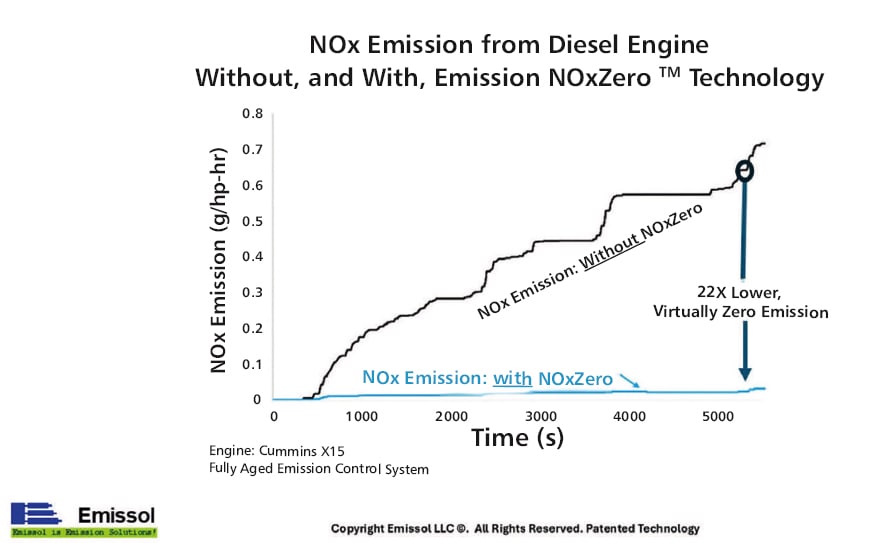
In the standard diesel system, urea — also known as Diesel Exhaust Fluid (DEF) or AdBlue — is injected into the diesel exhaust stream. As the injected urea contacts the NOxZero™ unit, which is installed in the exhaust line, NOxZero rapidly heats the droplets. This generates several times more ammonia than conventional systems, significantly enhancing NOx reduction in the downstream Selective Catalytic Reduction (SCR) catalyst. Engine testing demonstrates that NOxZero™ can reduce NOx emissions by up to 22 times more compared to standard methods — bringing emissions down to extremely low, often hard-to-detect levels.
According to Masoudi, the key challenges while developing this system included successful integration of industry feedback (voice of customers) into their technology, testing it on a variety of engines (light, medium and heavy duty, on- and off-road), and specially design it to last a million miles. “We are further demonstrating it for lowering fuel use (fuel cost savings) and reduced CO2 emissions. These will lower total cost of ownership while benefiting our environment,” he said.
NOxZero™ can be manufactured using press forming — a standard, low-cost production method. It is also easy to install in Diesel system, making it suitable for both OEM integration and retrofit applications. “We are very close to commercialization and series production. There are clear and tangible industry interests, inside the U.S. and globally. We are working with several industry OEMs on that front. We expect industry interests to expand further,” added Masoudi.
For more information, visit here .











