

A methodology for processing spectral images to retrieve information on underlying physical, chemical, and/or biological phenomena is based on evolutionary and related computational methods implemented in software. In a typical case, the solution (the information that one seeks to retrieve) consists of parameters of a mathematical model that represents one or more of the phenomena of interest.
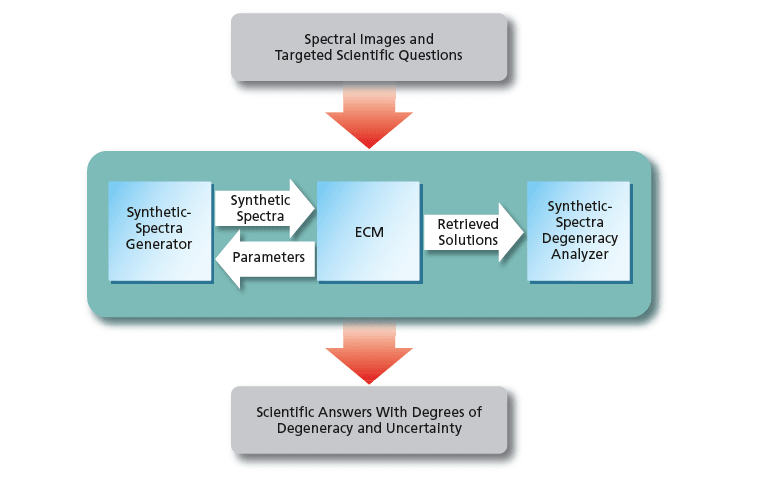
In this methodology, one utilizes an iterative process that minimizes a fitness function indicative of the degree of dissimilarity between observed and synthetic spectral and angular data. The evolutionary computing methods that lie at the heart of this process yield a population of solutions (sets of the desired parameters) within an accuracy represented by a fitness-function value specified by the user. The evolutionary computing methods (ECM) used in this methodology are Genetic Algorithms and Simulated Annealing, both of which are well-established optimization techniques and have also been described in previous NASA Tech Briefs articles. These are embedded in a conceptual framework, represented in the architecture of the implementing software, that enables automatic retrieval of spectral and angular data and analysis of the retrieved solutions for uniqueness. This framework is composed of three modules (see figure):
- The central core, which consists of the aforementioned ECM;
- The synthetic-spectra generator, which, coupled with the ECM, generates a population of automatically retrieved spectral solutions; and
- The synthetic-spectra degeneracy analyzer (“degeneracy” is used here in the mathematical sense of signifying the existence of multiple equally valid solutions for a given set of data and user-defined accuracy), which applies several well-established mathematical methods to characterize the uniqueness (or the degeneracy, which is essentially the lack of uniqueness) of the solutions within the population.
One advantage afforded by this ECM-based methodology over traditional spectral retrieval methods is the ability to perform an automatic, unbiased search for all solutions within the entire parameter space, using criteria that make searching computationally far more economical than in complete-enumeration (“brute force”), Monte Carlo, or random searches. (As used here, “unbiased” characterizes a search that does not depend on initial ad hoc guesses by experts.) Other advantages include the following:
- Optimal solutions are found;
- Better interpretations of planetary spectral and angular data are possible, and initial tests have shown these interpretations to be consistent with ground truth; and
- The methodology is not limited to specific problems, and can be extended to solve problems of greater complexity.
This work was done by Richard Terrile, Wolfgang Fink, Terrance Huntsberger, Seungwon Lee, Edwin Tisdale, Paul Von Allmen, and Giovanna Tinetti of Caltech for NASA’s Jet Propulsion Laboratory.
In accordance with Public Law 96-517, the contractor has elected to retain title to this invention. Inquiries concerning rights for its commercial use should be addressed to:
Innovative Technology Assets Management
JPL
Mail Stop 202-233
4800 Oak Grove Drive
Pasadena, CA 91109-8099
(818) 354-2240
E-mail:
Refer to NPO-42564, volume and number of this NASA Tech Briefs issue, and the page number.
This Brief includes a Technical Support Package (TSP).
Evolutionary Computing Methods for Spectral Retrieval
(reference NPO-42564) is currently available for download from the TSP library.
Don't have an account?
Overview
The document titled "Evolutionary Computing Methods for Spectral Retrieval" (NPO-42564) from NASA's Jet Propulsion Laboratory outlines innovative techniques for solving the inverse problem of spectral retrieval, which involves determining the combination of planetary and atmospheric conditions from observed spectra. Traditional methods often face limitations, such as generating only single solutions and being vulnerable to non-unique solutions, which can hinder the discovery of new phenomena.
The document emphasizes the advantages of using Evolutionary Computing Methods (ECM), which incorporate stochastic optimization techniques like Genetic Algorithms (GA) and Simulated Annealing (SA). These methods allow for an automatic and unbiased search across the entire parameter space, overcoming the constraints of traditional approaches that rely on initial expert guesses. ECM is designed to efficiently explore complex and high-dimensional search spaces, making it more economical than exhaustive searches, Monte Carlo methods, or random searches.
The ECM framework consists of three main components: the central core (ECM), a Synthetic Spectra Generator that produces a population of spectral solutions, and a Synthetic Spectra Degeneracy Analyzer that assesses the uniqueness of these solutions. This structure enables the retrieval of multiple statistically significant solutions, addressing the issue of solution degeneracy and enhancing the interpretation of Earth science and planetary data.
The document also highlights the theoretical foundations of the inversion process, which has been studied in various fields such as dynamical systems and information theory. However, these techniques have not been systematically applied within the atmospheric remote sensing community until now. The ECM approach not only improves the retrieval process but also provides a robust methodology that can scale to more complex problems.
In summary, the document presents ECM as a transformative approach to spectral retrieval, offering significant improvements over traditional methods by enabling unbiased searches for multiple solutions and enhancing the understanding of spectral data. For further inquiries, the document provides contact information for the Innovative Technology Assets Management at JPL.










