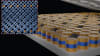

When natural disaster strikes, a building’s survival often depends on how it’s built. Engineers at Carnegie Mellon University have created a fast, highly accurate simulator for spray-based concrete 3D printing that could enable stronger, more complex, and less wasteful construction by predicting how concrete behaves and solidifies, even around rebar.
Concrete 3D printing reduces both time and cost by eliminating the traditional casting molds. Yet most of today’s 3D-printing concrete systems make it impossible to print around reinforcement bars (rebars) without risk of collision, limiting both design flexibility and structural integrity of builds.
The College of Engineering's Kenji Shimada and researchers in his Computational Engineering and Robotics Laboratory (CERLAB), are breaking through that limitation with a new simulation tool for 3D-printing spray-based concrete, or shotcrete.
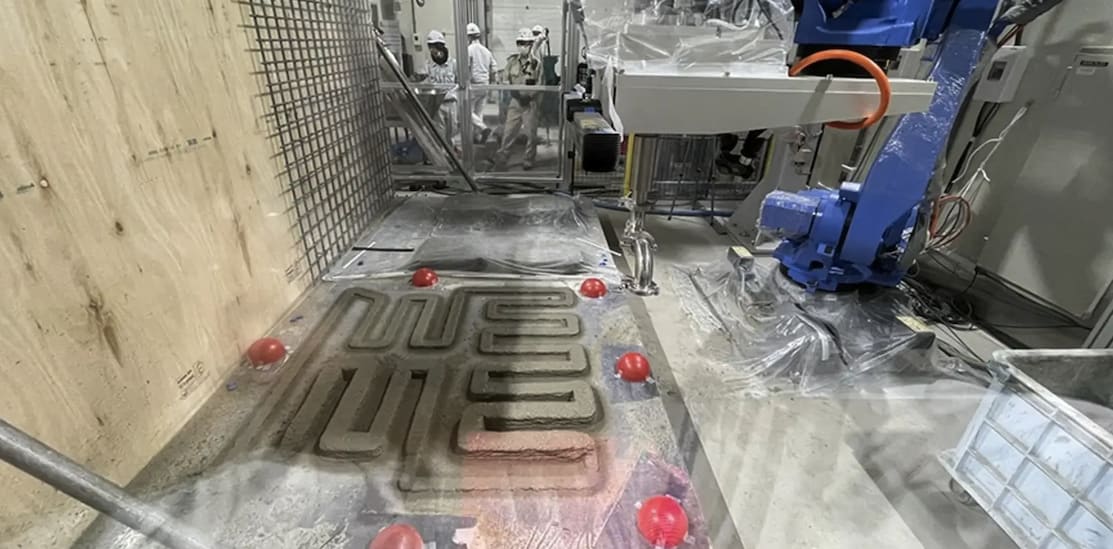
“Spray-based concrete 3D printing is a new process with complicated physical phenomena,” said Shimada, Professor of Mechanical Engineering. “In this method, a modified shotcrete mixture is sprayed from a nozzle to build up on a surface, even around rebar.”
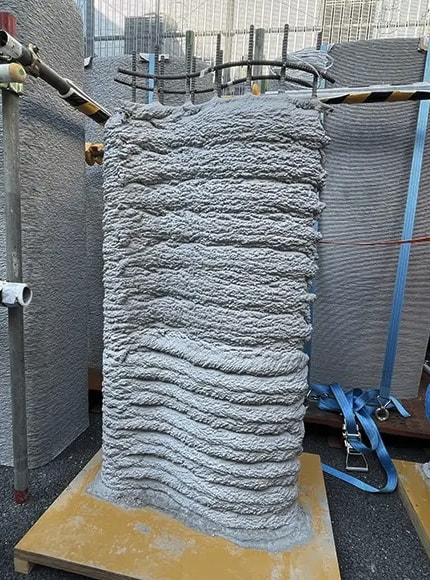
The ability to print freely around reinforcement is especially important in places like Japan and California, where earthquakes are an imminent threat and structural strength is critical.
“To make this technology viable, we must be able to predict exactly how the concrete will spray and dry into the final shape,” Shimada explained. “That’s why we developed a simulator for concrete spray 3D printing.”
The new simulator can model the behaviors of spray concrete mixtures, including drip, spread, and solidification time. This allows contractors to assess multiple printing paths and evaluate whether spray 3D printing is a feasible technique for their structure.
To assess their tool, the team traveled to Tokyo, Japan, where Shimizu Corporation already operates spray 3D-printing robots. With 90.75 percent accuracy, the simulator could predict the height of the sprayed concrete. The second test showed that the simulator could predict printing over rebar with 92.3 percent and 97.9 percent accuracy for width and thickness, respectively.
Future work will aim to increase accuracy by identifying environmental parameters like humidity, optimize performance, and add plastering simulation to create smoother finished products.
“There are still so many applications and technologies that we can develop with robotics,” said Co-Author Kyshalee Vazquez-Santiago, Mechanical Engineering Ph.D. Candidate, leading the Mobile Manipulators research group within CERLAB. “Even in concrete 3D printing, we are working with an entirely new type of application and approach that has so many advantages but leaves so much room for further development.”
Here is an exclusive Tech Briefs interview, edited for length and clarity, with Shimada.
Tech Briefs: What was the biggest technical challenge you faced while developing this 3D-printing simulator?
Shimada: The biggest technical challenge was to achieve accuracy and computational efficiency in multi-phase simulation: The process involves a highly viscous fluid (fresh concrete) that must be simulated as it gradually solidifies into a stable solid.
Tech Briefs: Can you please explain in simple terms how it works?
Shimada: Our novel simulator predicts the final shape of sprayed concrete. It tracks thousands of droplets landing in 3D boxes, or voxels, modeling how the wet material spreads, drips, and solidifies over time. It even simulates spraying around reinforcing bars using a "semi-transparency" feature.
Tech Briefs: What are your next steps in this research work?
Shimada: The next significant step, which we have started working on, is developing computational methods for robot trajectory generation and adaptation to print more complex curved 3D shapes.
Tech Briefs: Is there anything else you’d like to add that I didn’t touch upon?
Shimada: Concrete 3D printing is vital for future construction because it promotes sustainability by reducing material waste and enabling low-carbon mixes. It also cuts costs and accelerates building timelines through automation and minimal formwork. Additionally, it offers unprecedented design freedom, allowing complex, customized structures without significant expense or structural compromise.
Tech Briefs: Do you have any advice for researchers aiming to bring their ideas to fruition?
Shimada: I advise my students and researchers to start by clearly defining a problem statement based on real-world needs — that ensures relevance and impact. Then, develop quick, iterative prototypes to test feasibility, as we can only optimize our solution through iterative processes.